

Author: cfliao


By Francis Kuo, Taipei A Church foundation has published two books on the lives of elderly Taiwan Jesuit priests including their experiences with mainland China. The books, launched on Sept. 25 by the Cardinal Tien Cultural Foundation, narrate the experiences of Father Mark Fang Chih-jung, 84, and Father Peter Sun, 86. Father Fang, during the Taipei book launch, recalled that he was blacklisted by mainland Chinese authorities after his 1984 trip there because he had celebrated Sunday Mass. The mainland-born Jesuit was also interrogated by Taiwan security officers after the China government repatriated him to Hong Kong during his 1995 China trip. At that time, Taiwan did not allow its residents to travel to the mainland. As he was forbidden to enter mainland China, Father Fang, the first Chinese to obtain a biblical doctorate in Rome, decided to help in the formation of mainland clergy and nuns who were studying in Europe. Mainland-born Father Peter Sun recalled that his mother, his spiritual director, his bishop and even the apostolic nuncio had tried to dissuade him from becoming a Jesuit. After the Chinese communists took power in 1949, he fled to the Philippines and it was only three months before his ordination in 1957 that his wish was granted by the Holy See. The priest recalled an unhappy episode in which he was accused of using Taiwan Church money to fund his hometown diocese in Handan, northern China. He said that he had forgotten to tell his parishioners at that time that the money came from the Holy See and it was not him but laypeople who took charge of the parish finance. The two books are the latest in a series of books on Jesuits who have been in Taiwan for about half a century. The first two books were published last year. Project coordinator Chang Fan-ren says more than 10 Jesuits have agreed to be interviewed for the project, which aims to publish two books each year.

Fathers Mark Fang Chih-jung (left) and Peter Sun at the book launch


Father General Visit to Belgium. From September 24 to the 27 Father General will visit the two Provinces of Belgium, beginning with the Province of Southern Belgium and Luxembourg. On September 25 first there will be meetings with the Provincial consultors and the finance committee, then at the Collège Saint Michel there will be for the Province of Southern Belgium and Luxembourg an assembly, during which three topics will be examined and discussed. Theintellectual perspective, based on the theme: “In what way am I present to the Church and to the world in the way I consider my apostolic mission beginning with the intellectual perspective?” The social perspective, with the question: “In what way am I present to the Church and the world in the way I consider my apostolic mission beginning with the social perspective?” The spiritual perspective asks the question: “How am I present to the Church and to the world in the way I consider my engagements beginning with the spiritual perspective?” The method will be an initial presentation given by three Jesuits (in the case of the spiritual perspective by three lay people from CLC) and then discussion will follow. At the end of the day the theme of collaboration will be treated with the laity and then Father General will preside at a celebration of the Eucharist. September 26 will be dedicated to the Province of Northern Belgium, where in the morning is foreseen a meeting with the laity involved in the apostolic works of the Province. At the focus of the debate will be Decree no. 6 of the last General Congregation on the specific characteristics of a work of the Society of Jesus. In the afternoon the meeting with the Jesuits will be on: “The challenges in the Province of Northern Belgium in a Society that moves beyond the frontiers.” Discussion will follow and the day will conclude with a celebration of the Eucharist, again presided by Father General. In the last day of his visit, September 27, Fr. Nicolás will meet the Jesuits and their collaborators, who in Brussels labour in the European works entrusted to the Society, in the Chapel of the Resurrection. In the evening Fr. General will return to Rome. From the Curia – Tempo Forte. In the annual calendar of Father General, there are three special meetings known as Tempo Forte, or days of intense consultation, during the months of January, June and September. Thus, the past few days, 16 to 19 September, Father General met with his advisers to address issues of universal government. This time devoted significant time to ongoing training, accompanied by Father Hans Zollner, Province of Germany and Professor at the Gregorian, who presented some psychological aspects of the issue of sexual abuse and raised a number of considerations to take into account in our training. The monitoring of the Curia’s apostolic planning, government restructuring and the preparation of the next Congregation of Procurators completed the agenda items. On Saturday afternoon, a group of the Community of Sant’Egidio went to the Curia to discuss with the Council the presence and activity in China and Africa. The Community of the Curia, also participated in the training sessions listed, and the Council joined the Curia at Eucharistic on the first and last days of Tempo Forte. – The meeting of the Presidents of the Conferences of Provincials will take place at the Curia September 20 to 23. The purpose of this annual meeting is described in decree 21, n. 25 of GC 34: “To heighten the sense of the Presidents for the universal character of the Society; to give them a better understanding of the global priorities of the Society; to work with Father General in overseeing and encouraging the further development of regional and global cooperation.” The meeting will serve first of all as an examen of the work carried out by the Conferences in the past year and on the role of the President of the Conferences of Provincials. For Father General the meeting will be an opportunity for an updated overview of the circumstances and issues of the Society throughout the world, which will serve as a basis for further discussions and deeper understanding. A number of other topics will be also discussed: the issue of finances and mutual assistance among the Conferences, intercultural formation of young Jesuits, the topics to be taken up at the Congregation of Procurators in the coming year, etc. – From October 4 until the 14 at the General Curia Fr. Paul Oberholzer will conduct for 25 students from Tübigen a seminar on the historical documents of the Roman Archives of the Society of Jesus (ARSI) and on the history of Jesuits in Rome. Professor Franz Brendle and his assistant Fabian Fechner will accompany the students. The program will consist of lectures in the morning and visits in Rome to places associated with the history of the Society. Appointments Father General has appointed Fr Charles Lasrado of Karnataka Province (India) Assistant to the Treasurer General of the Society of Jesus. Fr. Lasrado has a Ph. D. in finance and presently is the treasurer of his Province. He was born in 1968, entered in the Society in 1986 and was ordained in 2000. From the Provinces AFRICA: A competition for youth To offer the young generation a chance to understand and express what the epidemic HIV/AIDS means for their own everyday lives and for their friends, families and communities. This is the objective of The Youth Movies for Life and for Love scriptwriting regional contest launched within all Jesuit educational institutions and other centres of learning affiliated to the Jesuits in sub-Saharan Africa. From 15 September to 15 December 2010 all youth aged between 10 and 25 years are invited to come up with an original idea or “scenario” for a short film of 5 to 8 minutes in length. The hope is to have good scripts that propose the best message on how the youth can respond to the challenge of HIV pandemic, adopting value-based lifestyle or making choices that are life-giving and that will help them avoid contracting sexually transmitted infections and HIV. The first 20 best ideas with correct information on AIDS will be adapted by professionals chosen by AJAN (the “African Jesuit AIDS Network”) to make educational DVDs in the context of HIV and AIDS prevention in sub-Saharan Africa. BOLIVIA: Ancient paintings recovered It all began in 1972 when the Swiss Jesuit Hans Roth started to take care of the rich and wide Jesuit patrimony in Bolivia. After 30 years of work done in different stages, thanks to a project financed by AECID (Spanish Agency for International Cooperation for Development), the Bolivian church and the local municipality, the more than 1.700 sq. m. of frescoes of the Jesuit Church San José de Chiquitos in the Santa Cruz region shine brightly again. The church, declared by UNESCO World Heritage in 1990, was built in 1748 when the Jesuits arrived in Bolivia to carry out their apostolic mission. The building, considered one of the best among the missionary buildings of the region, after the expulsion of the Jesuits was transformed into residence of the Spanish governors. Among the frescoes there are geometrical shapes, pictures of flora and fauna, religious and military paintings with historical value. The work done is part of a broader project aimed at improving the region as a destination for cultural, religious and natural tourism. INDIA: Radio Station seeks larger community Sarang Radio, a Jesuit radio station run by the Jesuits of St. Aloysius Collegeof Mangalore, in southern India, is looking to broaden its appeal by launching a host of new community-oriented programs. The introduction of the new services will also help mark its first anniversary on September 23, 2010 (see our Electronic News no. 17, 5 October 2009). “We plan to start more community-oriented programs in regional languages like Kannada, Tulu and Konkani along with Hindi and English,” said Father Richard Rego, who is in charge of the radio station and heads the Journalism Department at the College. There are also plans to launch several weekly phone-in programs, such as Kannoonu Kacheri, on legal issues, Arogya Sparsha, a live program on health concerns, and a special program for children. The station will also invite leaders, writers, social workers, farmers and local artists for interviews, narration and feature presentations in order to broaden its activity, which initially was to broadcast about four to six hours a day, but now it is on air for 14 hours. JESUIT COMMONS: A Virtual Meeting Place A new website has been created called Jesuit Commons. In describing its mission, it states: “A virtual meeting place where a million-strong, global network of individuals, schools and institutions collaborate to benefit poor communities… More than a thousand schools and universities count millions of students, graduates, or faculty; and countless others work and pray in Jesuit refugee agencies, justice institutes, parishes, development NGOs, and retreat houses. Imagine the power that would be unleashed if this million-strong network could jointly innovate projects, launch global advocacy or prayer campaigns, share teaching materials, or mount research efforts.” The website invited users to register and become part of community and support projects from Asia to South America. The message continues: “The Jesuit Commons enables such collaborations by putting online communications and networking tools at the service of all those committed to working for a more just world, in solidarity with the Jesuit mission.” For more information: http://www.jesuitcommons.org PERU: House named after Matteo Ricci Francisco Chamberlain, S.J., arrived in Peru in 1963 and since some time ago he works in Ayacucho. He explains his work this way: “There is a private company that took the people the land, their only mean of subsistence. We are studying some juridical ways to defend their rights and to obtain back the properties inherited from their ancestors. This is possible because we can speak, understand their problems and needs and then act consequently. People needs support and if left alone they cannot do much. In Cangallo we developed a pastoral presence that encouraged social and economic action by the parish, in order to allow people to develop self initiatives. We opened a house named after Matteo Ricci, to encourage dialogue and exchange ‘among others’ of the town and the region, on the present and future of Ayacucho; a dialogue meaning not only love and understanding, but also discussion carried on together. To meet “others” and to promote dialogue is a typical Jesuit work, and I think it can be of help to the town and to the region.” SPAIN: Fifth-centenary of St Francis Borgia During the summer many initiatives have taken place in Gandía, birthplace of St. Francis Borgia, on the occasion of the fifth-centenary of his birth. Many Jesuits arrived in town in order to visit the Ducal Palace and to celebrate the Eucharist in its chapel. There were numerous pilgrimages of religious groups and members of the Spanish dioceses and many eucharistic celebrations in honour of the saint. An exhibition presented to the public the restoration of the frescoes of the ancient chapter house of the Convent of the Clarisse, which in the past counted 32 religious women from the Borgia family. The “Cabalgata de los Clásicos”, a drama on the history of Gandía’s dukedom from 1399 to 1551 (the year when St. Francis Borgia renounced to the Dukedom and entered into the Society of Jesus) was performed twice in a new renovated version with great success. The “Visitatio Sepulchri”, a holy-lyric drama, attributed to St. Francis Borgia, on the death and resurrection of Christ, which is performed every year in the church of Gandía’s palace on Holy Friday and Easter day, was exceptionally performed during summer as a concert with participation of a large public. TURKEY: Signs of hopes for Christians The Turkish government’s decision to allow the Orthodox patriarch to celebrate a liturgy at the ancient Panagia Soumela Monastery near Trabzon was a sign of hope for Turkey’s Christian minority, said Fr. Thomas Michel, a Jesuit expert in interreligious matters. Ecumenical Patriarch Bartholomew of Constantinople celebrated the Orthodox liturgy on August 15th, for the feast of the Dormition of Mary at the Panagia Soumela Monastery, which was founded in 386. The building, which is maintained by the government as a museum, was closed in 1923 after Greek monks’ community abandoned it under the terms of the Treaty of Lausanne. The present government has promised it really will pay attention to the needs of the Christian minority so this is a positive step in the right direction. Turkey is a country with a majority of Muslim and a population respectful of people’s different beliefs. “Turks are open-minded and they always emphasize the fact that Turkey is a place where you can find a mosque, a synagogue, and a church side by side,” Fr. Michel said. He expressed the hope that Christians will be able to use again the Catholic Church of St. Paul in Tarsus. The 4th centenary of Matteo Ricci’s death Hong Kong: Ignatian Symposium. Xavier House-Ignatian Spirituality Centre, Hong Kong is organizing an Ignatian Symposium, in memory of the 400th anniversary of the death of Matteo Ricci. It will be held in from December 2-5. It will focus on three aspects of Ricci’s legacy in related to Ignatian Spirituality, namely, Affectivity, Cultures mediating God, and Apostolic Creativity and Leadership. Ten speakers from around the world will come to lead this meaningful event. It is conducted in English. This symposium is open to any participants, especially Ignatian people, around the world. For more information and application: Email: [email protected], tel: (852) 2981-0342,http://xavier.ignatian.net/html/is2010/program_highlights.html Macau wants his place too. Even Macau wanted to participate to the celebrations for Matteo Ricci. From August 7 to October 31 the exhibition “Matteo Ricci, encounter of civilizations in Ming’s China”, which was already held in Bejing, Shanghai and Nankin is hosted at the Macao Museum of Art.But in Macau there is a something new for the first time the “mysterious map of the two shapes” was introduced in the exhibition. This is the biggest universal map traced by Ricci. For the occasion a bronze statue was inaugurated, remembering the passing through of Ricci in Macau. “We welcome Father Ricci in his second homeland,” Fr. Louis Gendron, Chinese Provincial said in this occasion. And Fr. Howard Lui Ching-hay, Jesuit superior for Macau, added: “This is an historical moment for the Church and an opportunity for evangelization.”


Here’s one with benefits that last a lifetime . . .

When you think of family fun activities, you likely think of activities in the truest sense of the word: swimming, biking, sledding, and the like-in other words, doing something that involves activity. While all those things are, in fact, fun family activities, there’s likely one key element missing from them: real conversation-the kind that helps you get to know the most important people in your life and helps them get to know you!
Consider trying a NEW kind of family fun activity-learning about the ones you love. To do it, you only need a few questions to spark fun conversation. That’s right-having conversations with your family can be downright fun. How?
Well, grab a bowl of popcorn, gather your family, and try the questions listed here for starters (excerpted from The Meal Box):
What has been the most exciting moment or event in your life to this point?
If you could change one thing about the way your favorite holiday is celebrated, what would you change?
Kids: What aspect of being an adult are you looking forward to the most? Adults: What aspect of being a kid do you miss the most?
If you had to describe your personality in terms of a farm animal, which one would it be?
When you consider our amazing earth, in what particular aspect of it do you find it easiest to “see” God?


By John Choi Seoul
Fully-fledged cultural exchanges between East and West began with Father Matteo Ricci, according to a prominent speaker at a seminar commemorating the 400th anniversary of the Jesuit missionary’s death.

“Father Ricci held in-depth discussions with intellectuals in China for years and documented them,” said Song Young-bae, honorary philosophy professor of Seoul National University. “Ricci was the pioneer of exchanges between East and West, so to speak,” he said.
Song was speaking at a Sept. 16-17 international symposium on Father Matteo Ricci organized by the Jesuit-run Sogang University.
According to Song, the Jesuit missioner used three methods in his evangelization efforts in China.
Ricci first drew people’s attention by introducing European science like world maps and alarm clocks. He also respected Chinese traditions and Confucian ancestral rites as a form of inculturation. Finally, by mixing with the upper classes, he tried to make Christianity known to ordinary people.
“He brought Western science technology, philosophy and religion to Chinese,” Song said. “In turn he enlightened Europe about the socio-political system, philosophies and religions of China through his letters and books.”
These exchanges “had a strong influence on Eastern and Western civilizations,” Song said.
Father Matteo Ricci’s presentation of world maps and theories of deduction had a major effect on the Chinese who until then believed China was at the center of the earth, and had only theories on inductive reasoning, Song said.
Some 14 local and foreign scholars reviewed the achievements of the Jesuit missionary and reflected the symposium’s theme: Cultural Encounters of East and West, Challenge and Opportunity.
They also studied tensions, struggles and challenges in ongoing exchanges between East and West by reviewing Father Matteo Ricci’s works.
Italian Father Matteo Ricci (1552-1610) traveled from Italy to China in 1582. He wrote The True Meaning of the Lord of Heaven in Chinese and transmitted Catholic teachings through it.
His missionary work was based on a cultural approach involving discussions, inculturation, fellowship and human development.

Eboo Patel, the co-founder of the Interfaith Youth Core, talks about his campaign to foster interfaith dialogue among young people, and why Catholic campuses are uniquely suited to host these conversations. Patel also discusses how he was inspired by Dorothy Day and other Catholic figures. This is Part 1 of a two-part interview.


Two scholars respond to Luke Timothy Johnson.
by BERNARD BRANDON SCOTT AND ADELA YARBRO COLLINS
The relation of the Christ of faith to the Jesus of history is a topic fraught with controversy in theological circles. It also has implications for the way Christian believers understand and practice their faith. We invited Luke Timothy Johnson to reflect on the topic and state his own position, which he did in “The Jesus Controversy,” published in America on Aug. 2. We have asked two biblical scholars with different views, one a Catholic, the other a Protestant, to respond to Professor Johnson’s article. The three articles together give an indication of the scope of current thinking by mainstream scholars. All three articles appear online, where readers can add their own insights, experience and viewpoints. -The Editors

Following the Troubadours
How the historical Jesus tests-and strengthens-our faith
Bernard Brandon Scott
The biblical scholar Luke Timothy Johnson has sung the same tune for a long time, one that reassures those who are satisfied with the status quo. The quest for the historical Jesus, however, was founded on a rejection of the status quo.
Professor Johnson’s argument plays out in a series of either/ors, the implication being that one side is the false position and the other the true one. A primary opposition for him is the historical Jesus and the real Jesus. Who can argue for the impoverished Jesus of historical efforts when one can have the real Jesus? But if one challenges both the obviousness of the categories and the necessity of the opposition, then suddenly the tune becomes discordant.
Scholars have created “apocryphal gospels,” Johnson charges. These modern apocryphal gospels stand in contrast, of course, to the true, canonical Gospels. He offers no proof that these are either apocryphal or gospels, but rhetorically, the category once established is irresistible. Who could possibility prefer an apocryphal gospel to a real Gospel?That the Jesus of these apocryphal gospels “is often a mirror image of the scholars’ own ideals,” is an old, well-worn charge. For the sake of argument, let’s grant that Johnson is right, that these are all mirror images of the scholars’ own ideals. Is that not also the case of the Jesus of Mark’s Gospel and every other Gospel? So the real Jesus turns out also to be a reflection of the various Evangelists’ ideals about Jesus. The real Jesus is just as constructed as the historical Jesus of the modern apocryphal gospels. Even more, the real Jesus turns out to be multiple, a different Jesus conjured up by each Evangelist, just as scholars conjure up multiple images or reconstructions of Jesus. If one is honest, the tradition has conjured up even more images of Jesus, perhaps an almost infinite number.
Johnson has a solution to this problem: “Each Gospel witnesses to the truth that Jesus as a human being was defined first by his radical obedience to God and second by his utter self-giving to others.” Johnson argues that this Platonic essence is reconstructed from the Gospels’ convergent pictures of Jesus by historical method, historically verified. His argument reminds me of Adolf von Harnack’s argument in What Is Christianity?: “In the first place, they [the Gospels] offer us a plain picture of Jesus’ teaching, in regard both to its main features and to its individual application; in the second place, they tell us how his life issued in the service of his vocation; and in the third place, they describe to us the impression which he made upon his disciples, and which they transmitted.”
This Platonic essence is convenient but not self-evident. It is not a historical statement, as Johnson declares, but a theological judgment, and not the only possible theological judgment about the Gospels. He maintains that the Gospels “converge impressively precisely on the historical issue that is of the most vital importance concerning the human Jesus, namely his character.” This raises inevitable historical questions. Where does this convergence come from? Would any Gospel writer acknowledge Johnson’s Platonic essence? So general is his Platonic essence that I wonder if it is helpful or even distinctive. Is it not true of other historical characters? Again, if we grant this as a valid summary of the character of Jesus in all four Gospels, where did those authors get their information? How does one know they are right in their judgment? Maybe they are just following the lead of Paul or Mark.
These questions lead back either to history or to Johnson’s preferred modality, faith. You have to take it on faith. Faith is not innocent. Push below the surface and faith is a stand-in for authority. To take it on faith means to take it on authority. But then, whose authority? How does one test that authority? Once again one faces historical questions.
Not only do I find Johnson’s categories not established by rigorous method; I also find his either/or method of argumentation unconvincing. There is another option. Historical criticism can be a both/and. Historical analysis is deconstructive and often corrosive to authoritarian claims. History does not grant certainty, only probabilities, but then neither does faith grant certainty. If it were certain, we would not need faith. A historical understanding of early Christianity presents a range of options and demonstrates development and difference within the early movements that sprang up from those seeking to follow Jesus. That can be liberating but also challenging and threatening.
Johnson concludes with a passionate plea about the proper focus of Christian awareness: “learning the living Jesus…in the common life and common practices of the church.” But how do we know this is the real Jesus? For Johnson, the either/or is history versus faith. That for me is a false dichotomy. Faith must always be tested, and that raises historical questions (as well as other kinds of questions), which provide only probability. There is no way around it, unless faith is an authoritarian claim. Given the bankruptcy of authority in the church today, we should take any such claim of authority with a historical and deconstructive grain of salt. That is why people are listening to the troubadours.
In Defense of the Historical Jesus
Empirical studies of the Gospel are limited. They are also necessary.
Adela Yarbro Collins
Luke Timothy Johnson makes a good case for the importance of, in his words, “the living Jesus-the resurrected and exalted Lord present to believers through the power of the Holy Spirit-in the common life and the common practices of the church.” But in his essay Professor Johnson also claims, “History is a limited way of knowing reality.” I must point out that all ways of knowing reality are limited. Even experience of “the living Jesus” is limited by the questions and needs of individual believers, by the leadership of professional ministers and by the ethos of particular congregations and churches.
Johnson praises (faintly) the excellent work of Msgr. John P. Meier in A Marginal Jew and cites with approval Monsignor Meier’s recognition that “the empirically verifiable Jesus is by no means the ‘real’ Jesus.” Both scholars are right in saying that historical methods can give us only a partial picture of Jesus. In my view, however, the “real” Jesus is absolutely unknowable. Anyone who makes a claim about “the real Jesus” is speaking rhetorically and not making a verifiable claim about reality. Historians are concerned with the human Jesus who was born, lived and died, leaving traces that can be studied using historical methods. The resurrected and exalted Lord is just as much a construction of those who worship and experience him as is the historical Jesus constructed by scholars.
In his book The Real Jesus, Professor Johnson was very critical of the Jesus Seminar. The basic idea and procedures of the seminar are, in principle, admirable. I attended a number of their meetings in the 1980s, which were early years in its history. Each meeting focused on a particular topic-for example, the parables. One or more scholars volunteered to research the parables of Jesus in preparation for the meeting to see what previous studies had concluded about them and to evaluate the evidence for their origin. Then these scholars gave presentations at the meeting itself, arguing that Jesus had spoken some of the parables and that followers of Jesus created others after his death. After the presenters had laid out the evidence and the arguments, the assembled scholars debated these findings. After extensive debate, a vote was taken on each parable. Every member of the seminar would place a bead in a basket: red for the view that Jesus most probably spoke the parable, pink for the view that he probably told it, gray for the view that he probably did not tell it and black for the view that he most probably did not.
In an ideal world, well-educated and well-informed scholars would assess the evidence and arguments with an open mind and vote in accordance with the stronger evidence and arguments. I am sorry to say that such was increasingly not the case in later meetings of the Jesus Seminar, notably in the 1990s. Scholars had preconceived ideas, such as the conviction that Jesus was a teacher or philosopher, not a prophet, and these ideas determined how they voted, regardless of the evidence.
This situation, however, is not a fault unique to the Jesus Seminar. It is characteristic of the human condition. There will always be more and less competent scholars and better and worse arguments and thus more and less reliable historical conclusions. Similarly, there are more and less competent professional ministers, better and worse types of common life and more and less helpful common practices in the church.
Johnson aims “to show how encountering Jesus as a literary character in each of the canonical Gospels enables a more profound, satisfying and ultimately more ‘historical’ knowledge of the human Jesus than that offered by scholarly reconstructions.” Such an attempt does indeed have value. But many Americans, inside and outside the church, care about history in a stronger sense and about historical methods and results. In other words, they want to know in what ways the Gospels represent the actual Jesus accurately and in what ways they are fictions or later theological interpretations of Jesus that contradict or go beyond what historians can determine about the past. Historians recognize that the Gospels are interpretations of Jesus from the perspective of faith in him as the Messiah, Son of God or Son of Man and that this faith is founded upon the experience and proclamation of his resurrection, an event that by definition is beyond history.
In Johnson’s view, “Each Gospel witnesses to the truth that Jesus as a human being was defined first by his radical obedience to God and second by his utter self-giving to others” (emphasis added). Imitation of the character of Jesus has long been a high value in the church. It would truly be the manifestation of the kingdom of God on earth if all members of the church would imitate these two aspects of Johnson’s reconstruction of the character of Jesus. The trouble is that in the history and present life of the church, radical obedience and utter self-giving are moral values that only some members of the church are seriously expected to practice. Already in the second century, Ignatius of Antioch taught that the members of Christian communities should obey the bishop as they would obey God. Such advice creates too great a gulf between the clergy and the laity. The value of obedience can serve to increase the power of the hierarchy in the church and to limit the participation of lay people in general and women in particular.
The study of the historical Jesus, however limited the reliable results may be, is an important means of testing theological interpretations of Jesus that claim to be based on the intentions and life of Jesus. Those with a good grasp of the current state of research on Jesus can discern whether such interpretations are indeed congruent with the probable mission and aims of Jesus.
Bernard Brandon Scott is the Darbeth Distinguished Professor of New Testament at Phillips Theological Seminary, in Tulsa, Okla. Adela Yarbro Collins is the Buckingham Professor of New Testament Criticism and Interpretation at the Yale Divinity School in New Haven, Conn.


When St. Paul describes the gifts God has given the church, he includes teaching among the most important (1 Cor 12:28). No surprise there. “Go teach!” was the final mandate of Jesus. History has long taught that without teachers to announce the Gospel and educate the young, the church struggles to survive. Evangelization through good teaching is essential to Catholic life. Pastoral leaders in developing nations say that Catholic education is what attracts people to Jesus and his church. When it comes to education, nobody has a better track record than the church.

In the 20th century, for example, there was no greater witness to the effectiveness of Catholic schools than the Nazi and Communist efforts to destroy them. Pope Benedict XVI’s own beloved homeland-where to be Bavarian was to be Catholic-was perhaps hardest hit in all of Germany. By January 1939 nearly 10,000 German Catholic schools had been closed or taken over by the Nazi Party. Tyrants know and fear the true strength of a Catholic education: what parents begin in the home, Catholic schools extend to society at large.
But what of today’s Catholic schools that exist in a world largely free of those sorts of 20th-century threats? Are we not facing our own crisis of closure for the Catholic school in America?
The answer is yes. Statistics from the National Catholic Educational Association tell a sobering tale about Catholic schools in the United States. From a student enrollment in the mid-1960s of more than 5.2 million in nearly 13,000 elementary and secondary Catholic schools across America, there are now only half as many, with just 7,000 schools and 2.1 million students enrolled.
The reasons for the decline are familiar: the steady drop in vocations to the religious teaching orders who were the greatest single work force in the church’s modern period; the drastic shift in demographics of the late-20th century that saw a dramatic drop-off in Catholic immigration from Europe; the rising cost of living since the late 1970s that forced nearly every American parent to become a wage-earner and put Catholic education beyond their budget; and the crumbling of an intact neighborhood-based Catholic culture that depended upon the parochial school as its foundation.
The most crippling reason, however, may rest in an enormous shift in the thinking of many American Catholics, namely, that the responsibility for Catholic schools belongs only to the parents of the students who attend them, not to the entire church. Nowadays, Catholics often see a Catholic education as a consumer product, reserved to those who can afford it. The result is predictable: Catholics as a whole in the United States have for some time disowned their school system, excusing themselves as individuals, parishes or dioceses from any further involvement with a Catholic school simply because their own children are not enrolled there, or their parish does not have its own school.
Widespread Benefits
The truth is that the entire parish, the whole diocese and the universal church benefit from Catholic schools in ways that keep communities strong. So all Catholics have a duty to support them. Reawakening a sense of common ownership of Catholic schools may be the biggest challenge the church faces in any revitalization effort ahead. Thus, we Catholics need to ask ourselves a risky question: Who needs Catholic schools, anyway?
The answer: We all do. Much of the research on Catholic education conducted over the last five decades-from the Rev. Andrew Greeley to the University of Notre Dame; from the National Opinion Research Center to the work of independent, often non-Catholic scholars-has answered with a unanimous voice that without a doubt Catholic schools are an unquestioned success in every way: spiritually, academically and communally. More to the point, the graduates they produce emerge as lifelong practitioners of their faith. These Catholic graduates have been, are and will be our leaders in church and society.
Consider:
• The academic strength of Catholic schools is unassailable. Researchers like Helen Marks, in her essay “Perspectives on Catholic Schools” in Mark Berends’s Handbook of Research on School Choice (2009), have found that when learning in a Catholic school is done in an environment replete with moral values and the practice of faith, its test scores and achievements outstrip public school counterparts.
• Updating the work of John Coleman in the early 1980s, Professor Berends also estimates that two factors-the influence of Catholic values and the fostering of Catholic faith and morals-are the single biggest supports for the success of many young people, Catholic or not, educated in inner-city Catholic schools.
• Sociologists like Father Greeley, in his book Catholic Schools in a Declining Church (1976), and Mary Gautier, in her more recent article “Does Catholic Education Make a Difference?” (National Catholic Reporter, 9/30/05), have found that graduates of Catholic schools are notably different from Catholic children not in parochial schools in four important areas: 1) fidelity to Sunday Mass and a keener sense of prayer; 2) maintaining pro-life attitudes, especially on the pivotal topic of abortion; 3) the personal consideration of a religious vocation and 4) continued support for the local church and community, both financially and through service projects, for the balance of their adult lives.
• Catholic school graduates make good citizens, deeply committed to social justice, the care of the poor and the planet, proud volunteers in the church and in community. The widespread institution of service program requirements in Catholic schools over the last two decades has helped to create an entire generation of generous, socially minded alumni ready to help, no matter the need.
More could be written, of course, about how Catholic schools continue to excel in so many ways, helping to form citizens who are unabashedly believers in the way they live out what is most noble in our American identity. The few points listed above are potent reminders of the many long-term effects that Catholic schools have on the formation of their students. As both history has shown and researchers have documented, there are plenty of reasons for all American Catholics to take proud ownership of Catholic schools.
Reviving Catholic Schools
Not only should the reasons behind changes in attitude toward Catholic schools give us pause, but also the consequences of letting this school system decline. If Catholic education promotes lifelong commitment to faith and virtue, a high sense of social justice, greater numbers of religious vocations and an embrace of a way of life based on responsible stewardship, then will not its continued decline risk further erosion in all of these areas? Catholic history can answer this clearly.
In New York, for example, a nagging concern from the 19th century is re-emerging at the start of the 21st. My predecessor, Archbishop John Hughes-famously known as Dagger John for his fearsome wit and readiness to fight for Catholic rights-struggled to rid the New York public schools in the 1840s of their anti-Catholic bias. He was convinced, after watching immigrant families fight discrimination, that “the days had come, and the place, in which the school is more necessary than the church” (from James Burns’s A History of Catholic Education in the United States, emphasis added). Quite a statement-one echoed by several of his brother bishops, including a saint, John Neuman, bishop of Philadelphia, and the scholar and reformer John Lancaster Spalding of Peoria, who said that “without parish schools, there is no hope that the Church will be able to maintain itself in America” (see David Sweeney’s The Life of John Lancaster Spalding). These men understood that until Catholic schools were up and running, Catholic life would be stagnant. They made the establishment of Catholic schools their priority, and, thank God, most other American bishops followed their example. In 1956, for instance, my own parish in Ballwin, Mo., built its school even before its church, and I am sure glad they did, because that year I entered first grade to begin the most formative eight years of my life.
Given the aggressive secularization of American culture, could it be that Catholics are looking at the same consequences that met those 19th-century prelates? Today’s anti-Catholicism hardly derives from that narrow 19th-century Protestantism, intent on preserving its own cultural and political hold. Those battles are long settled. Instead, the Catholic Church is now confronted by a new secularization asserting that a person of faith can hardly be expected to be a tolerant and enlightened American. Religion, in this view, is only a personal hobby, with no implications for public life. Under this new scheme, to take one’s faith seriously and bring it to the public square somehow implies being un-American. To combat this notion, an equally energetic evangelization-with Catholic schools at its center-is all the more necessary.
The 21st-century version of the Hughes predicament, which tried to establish Catholic rights in the face of a then anti-Catholic America, would seem to suggest that without Catholic schools the church in the United States is growing less Catholic, less engaged with culture and less capable of transforming American life with the Gospel message. As long as we Catholics refuse to acknowledge that the overall health of the church in the United States is vitally linked not only to the survival but the revival of the Catholic school, we are likely to miss the enormous opportunity this present moment extends.
It is time to recover our nerve and promote our schools for the 21st century. The current hospice mentality-watching our schools slowly die-must give way to a renewed confidence. American Catholic schools need to be unabashedly proud of their proven gritty ability to transmit faith and values to all their students, particularly welcoming the immigrant and the disadvantaged, whose hope for success lies in an education that makes them responsible citizens. This is especially true for the Catholic Hispanics in the country, whose children account for a mere 4 percent of the Catholic school population. Failure to include the expanding Hispanic population in Catholic education would be a huge generational mistake.
To re-grow the Catholic school system, today’s efforts need to be rooted in the long-term financial security that comes from institutional commitment through endowments, foundations and stable funding sources and also from every parish supporting a Catholic school, even if it is not “their own.” Catholic education is a communal, ecclesial duty, not just for parents of schoolchildren or for parishes blessed to have their own school. Surely American Catholics have sufficient wealth and imagination to accomplish this.
It is both heartening and challenging to remember that Catholic churches and schools were originally built on the small donations of immigrants who sacrificed nickels, dimes and dollars to make their children Catholics who are both well educated and fully American. Have we Catholics lost our nerve, the dare and dream that drove our ancestors in the faith, who built a Catholic school system that is the envy of the world?
We cannot succumb to the petty turf wars that pit Catholic schools against religious education programs and other parish ministries. Pope Benedict XVI reminds us that the church is all about both/and, not either/or. Strong Catholic schools strengthen all other programs of evangelization, service, catechesis and sanctification. The entire church suffers when Catholic schools disappear.
As the Most Rev. Roger J. Foys, Bishop of Covington, has said: “While there may be alternatives to Catholic education, there are no substitutes.”
Most Rev. Timothy M. Dolan, archbishop of New York, has just released “Pathways to Excellence,” a new course of long-term planning for Catholic schools in the Archdiocese of New York.


Communal prayer is when two or more people gather together to raise their minds and hearts to God. A prayer service is a form of communal prayer that follows a set order with designated parts (Leader, Reader, All).
In general, prayer services follow a basic pattern.

Gathering/introduction-song, greeting, opening prayer
The Word of God-Scripture reading, response, silence
Shared prayer-petitions, traditional prayers, litanies, composed prayers, and so on
Conclusion-closing prayer, blessing, song
In addition, a prayer service may include nonverbal expressions such as gesture and ritual.
As a catechist, you will be called upon to lead prayer services from time to time. Here are some things to consider when leading such services.
The Role of the Holy Spirit
The Holy Spirit guides all prayer. Prayer leaders do not perform, but offer themselves as a vehicle of the Spirit for those at prayer. Pray to the Holy Spirit to guide and inspire you.
Scripture
Prayer services should always involve the Word of God so that participants can listen to God speaking to them.
Music
Singing and instrumental music are not just frosting on the cake. They are essential ingredients in prayer services.
Environment
Introduce elements into the environment to create a greater awareness of the sacred. Consider candles (when appropriate), dimmed lights, enthroned Bible, cross, and objects from nature such as flowers, rocks, and shells.
Assembly Participation
Don’t think of what just you are doing during prayer. Ask yourself what the assembly is doing. Be sure to involve the assembly as a whole in the prayer, not just those taking the Leader or Reader roles.
Nonverbal Elements
Consider the elements of movement and gesture (procession, bowing, venerating the Bible, outstretching hands, laying on hands, blessing) and of symbols (water, oil) as well as of silence.
Verbal Elements
Follow and borrow from the prayer of the Church (Sacramentary, Liturgy of the Hours): introductory rites, psalm responses, antiphons, penitential rites, collects, intercessions, and blessings. These prayers are rich and evocative and therefore, powerful.
Liturgical Feasts and Seasons
Pay special attention to the time of the liturgical year (Advent, Lent, feasts, solemnities) when selecting themes and prayers.
As a catechist, you will be called upon to lead prayer services from time to time. Here are some additional things to consider when leading such services.
Know your assembly.
Be aware of the age level of your assembly and their faith development as well as their level of maturity.
Prepare.
As when planning a session, be sure of your focus, theme, and goal. Envision the prayer, feel the flow, get a sense of space, time, sound, silence, and so on. Select Readers and assign roles ahead of time. If possible, rehearse with those chosen to read.
Include silence.
Our lives are noisy already. Much of our prayer is too wordy. Allow for periods of silence. Be sure to include silence during the prayer service, perhaps after a prayer or a reading.
Give instructions beforehand.
There’s nothing worse than interrupting a prayer to give directions such as “the left side takes this part, and the right side takes that part!”
Be creative.
Consider using appropriate visuals (video, DVD, slides, PowerPoint, and so on).
Encourage spontaneous prayer.
Not everyone is comfortable with spontaneous prayer, but it is a form of prayer that needs to be taught and fostered.
Proclaim.
Throughout the prayer service speak clearly and slowly. Proclamation is more than merely reading the text and less than a dramatic performance. As you speak, try not to bury your head in the text; look at the assembly as much as possible. Speaking in this way will help to involve the participants.
Move with reverence.
Moving with reverence means moving not too quickly or slowly, and not stiffly, but with ease and regard for what you are doing.
By following these simple suggestions, you can involve yourself effectively and wholeheartedly in a prayer service so that others will follow.


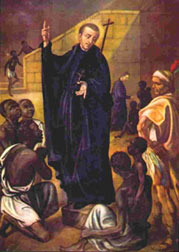 St. Peter Claver, SJ, was a member of the Society of Jesus and is the patron of African missions and of interracial justice, due to his work with slaves in Columbia.
Peter Claver was born to a prosperous family in Verdu, Spain, and earned his first degree in Barcelona. He entered the Jesuits in 1601. When he was in Majorca studying philosophy, Claver was encouraged by Alphonsus Rodriguez, the saintly doorkeeper of the college, to go to the missions in America. Claver listened, and in 1610 he landed in Cartagena, Columbia. After completing his studies in Bogotá, Peter was ordained in Cartagena in 1616.
Cartagena was one of two ports where slaves from Africa arrived to be sold in South America. Between the years 1616 and 1650, Peter Claver worked daily to minister to the needs of the 10,000 slaves who arrived each year.
When a ship arrived, Peter first begged for fruits, biscuits, or sweets to bring to the slaves. He then went on board with translators to bring his gifts as well as his skills as a doctor and teacher. Claver entered the holds of the ships and would not leave until every person received a measure of care. Peter gave short instruction in the Catholic faith and baptized as many as he could. In this way he could prevail on the slave owners to give humane treatment to fellow Christians. Peter Claver baptized more than 300,000 slaves by 1651, when he was sickened by the plague.
In the last years of his life Peter was too ill to leave his room. The ex-slave who was hired to care for him treated him cruelly, not feeding him many days, and never bathing him. Claver never complained. He was convinced that he deserved this treatment.
In 1654 Peter was anointed with the oil of the Sacrament of the Sick. When Cartagenians heard the news, they crowded into his room to see him for the last time. They treated Peter Claver’s room as a shrine, and stripped it of everything but his bedclothes for mementos. Claver died September 7, 1654.
St. Peter Claver was canonized in 1888. His memorial is celebrated on September 9.
Quote: “We must speak to them with our hands before we speak to them with our lips.”
Saint Peter Claver
Video introduction to the life of St. Peter Claver, produced by the Apostleship of Prayer.
St. Alphonsus Rodriguez, SJ (1533-1617)
Biography of the saint who influenced Peter Claver to consider service in foreign missions.