

Author: cfliao


Saint Retreats for Children Grades 3-6
Each year we celebrate All Saints Day on November 1 and All Souls Day on November 2. In honor of the saints, Loyola Press offers the reflections of four saints for children. This November, we recognize St. Nicholas, Blessed Kateri Tekakwitha, Saint Francis Xavier Cabrini, and Saint Andrew. In these brief saint retreats:

Saint Nicholas

Blessed Kateri Tekakwitha

Saint Frances Xavier Cabrini

Saint Andrew
You can navigate through the retreats by using the continue button or by clicking on the side navigation boxes. If you are unable to see the retreat, download Adobe Flash for free.

Feast Day December 6

Children all over the world know him and love him.
In Germany, he’s Kriss Kringle. In France, he’s Pere Noel. British children call him Father Christmas. Of course, you know him as Santa Claus.
He’s got another name, you know. It’s an ancient one that goes back hundreds of years. It’s one of the very first names people called him: St. Nicholas.
Children tell lots of fun stories about Santa Claus, Pere Noel, or Kriss Kringle. All of these stories remind us of how much we’re loved and of how happy we are when we give. The earliest stories we know were told about St. Nicholas, the bishop of Myra.
Hundreds of years ago, Nicholas lived in a seaside town named Myra, which is in the country we now call Turkey. Ever since he was a small child, Nicholas loved God more than anything. He studied hard, prayed often, and followed Jesus by helping the poor.
The people of Myra loved Nicholas so much that when their old bishop died, they immediately elected Nicholas to replace him. He served them well for a long time.
Nicholas was loved for one reason. He loved. He loved God and God’s people so much that he would do anything for them.
Here is a story about Nicholas that has been passed down through many generations.
There was a man living in Myra who was very poor. This man had no wife, but he had three grown daughters who lived with him.
In those days, when a young woman got married, she had to bring money or property with her into the marriage. This is called a dowry. If a woman didn’t have a dowry, she would never marry.
This man was so poor that he had no money for his daughters’ dowries. And he didn’t have enough money to support them either. He had, he believed, only one choice: to sell his daughters into slavery. Nicholas heard about this terrible situation. Late one night, Nicholas crept to the man’s home and threw something through the window. It was a bag of gold-enough to pay the dowry for his oldest daughter.
The man was overjoyed, and his daughter was too. She married, but her father was still left with a problem. Two, to be exact. What about the two younger daughters? Sadly, he prepared to send them away.
Nicholas returned one night and again threw a bag of gold through the window. The father rejoiced. But he wondered who was helping him and why.
Of course, Nicholas didn’t want the man to know. He knew that it’s best to help others without letting them know we’re helping them. If we help others in this way, we help because we truly want to and not because people will praise us for it.
But the father was determined. He had one daughter left and no money for a dowry. He certainly hoped he would be helped again, especially because he wanted to find out who was doing it. So he locked the windows and watched out the door.
Nicholas still wanted to help, but he didn’t want to be seen. So, in the back of the house, far from the father’s sight, he dropped the bag of gold for the third daughter right down the chimney!
Other stories are told about Nicholas. It’s said that God worked through Nicholas’s prayers to raise children from the dead-some who had been killed in a fire and another child who had drowned. All of these stories tell us the same thing about St. Nicholas. He lived for God, which means that he lived for love. If people were in need and he was able to help, St. Nicholas gave them hope and strength. St. Nicholas never paused for a minute to wonder what he should receive in return for his help. He only thought about what he could give to those who needed him.
Stories about St. Nicholas spread from his home in Turkey up to Russia, where he is still a very popular saint. Through the centuries, people passed on stories of him across the most northern parts of Europe, then to Germany, France, and England, and finally to the United States. The children in every country gave St. Nicholas a name in their own language, and ours is Santa Claus.
Christmas is a fun, exciting time, isn’t it? It’s fun because of all the time we get to spend with our families. It’s fun because we do a lot of celebrating. It’s fun because we get to think, sing, and pray about Jesus, who was born into the world to save us.
Christmas is also fun because we get to give. We can show our family and friends how much we love them by giving them special gifts that we make or buy.
We give because we’re thankful. We’re thankful for friendship and love and for all the people who take care of us. We’re thankful to God for giving us life.
St. Nicholas was thankful too, and that’s why at Christmastime we try to be just like him. He was so grateful for the life God had given him that he just couldn’t stop giving joy and hope to others-no matter how far he had to travel or how many roofs he had to climb!
St. Nicholas showed his gratitude for God’s gifts by giving to others. What gifts can your family share with those in need?
|
|
from Loyola Kids Books of Saints by Amy Welborn © 2001 |

The best Catholic apps

by Jack McLain, S.J.

During a recent discussion with a brother Jesuit about the inherent goodness or badness (I believe the terms ‘Luddite’ and ‘Borg’ were trotted out during the conversation) of smart phones, I asserted that there were plenty of Catholic-centric uses for such devices. In the great Jesuit fashion, my confrere asked me to prove it. So I began combing through Apple’s App Store in order to find the best Catholic apps I could.
From the beginning, I left a few things off of my list, most notably digital rosaries. I am not opposed to rosary apps; I have one actually, but trying to separate the sheep from the goats in this particular instance proved to be a little too bandwidth intensive. Most rosary apps had free versions so you could try them before you invest your 99 cents. My other criterion was one I alluded to above, namely, I wanted to find apps that were applicable to the non-techno person who was looking to use their device to add to their faith life. I focused exclusively on iPhone apps because of its userbase and because I don’t have access to an Android-based phone.
Here are some of the better apps:
iBreviaryPro (Free): This app, which I’ve been using for over a year, can be a life saver. Last year my campus minister, seated next to me at a student Mass, whipped her head around and turned white as a sheet. “I forgot to put the Gospel in the binder!” She whispered during the Psalm. I calmly fished under my alb, pulled out my iPhone, fired up the app and had the Gospel ready by the time I made it to the lectern. It includes the Office readings for the day and, as a bonus, all the parts of the Mass for a presider. Plus, all the readings update automatically when you turn the app on-in five different languages, no less! The only downside is that it requires a data connection. If our chapel had been a signal dead spot, I would have been sunk.
Universalis ($24.99): This is from the super-useful Universalis software house, whose goal is to “harness computer technology to help enrich the spiritual lives of Christians.” The app contains all the readings within the app itself, so it doesn’t matter if you are on top of Mount Everest (although I read recently they have 3G coverage there now), you can get your daily readings and pray the Office with out a wireless connection. Exceptionally well organized and easy to navigate, this is best of the daily reading and Office apps I reviewed. Two caveats about the app: First, the price. In a world of 99 cent apps, $25 will give some people pause, but this is clearly a case of getting what you pay for. The app replaces both a lectionary and a breviary (not to mention being much easier to carry) so the price tag shouldn’t be a sticking point, in my opinion. My second quibble is a priest-centric one: I wish the app also provided the parts of the Mass.
Divine Office ($14.99): This app has all the functions of the apps above, automatically figuring out the date and bringing up the readings for the time of day. The feature that sets it apart is that it will also download audio files of the prayers of the hours so that you can listen to a group of people praying, and pray with them. Ideal for quiet time on a train or bus or even over your car audio system during your commute. Another neat feature: by tapping on a globe icon you see a map showing where other people are using the app around the world. This gives you a real sense of praying with universal church.
iCatholicRadio & Radio Vaticana (Free & $3.99 cents respectively): These apps stream audio from Catholic radio stations. iCatholicRadio streams from Holy Family Communications, which features shows ranging from Catholic call-ins to the recordings of Bishop Fulton Sheen. The user interface needs work-it doesn’t have the buttery smoothness usually associated with Apple-but it works fine. It can also stream the audio in the background so you can listen while you navigate to another app. Radio Vaticana does the same thing, only it offers a direct line to the broadcasts of the Vatican Radio in several different languages. Good for a change of pace.
3-Three Minute Retreat (99 cents): The Irish Jesuits started a Web site several years ago that leads you through a quick reflection for your day. Loyola Press has taken this idea and applied it to the portable world. Each day it supplies you with a brief reflection set to placid music in either English or Spanish. It follows the Ignatian arc of settling down to pray, reading Scripture, reflecting and deciding act. It is a simple, straightforward app that does exactly what it says.
Mass Times (Free): For sheer useful simplicity, this app was probably the best one I reviewed. It uses your location to find the nearest parish and gives you the Mass times at those locations. You can also search for a particular church and bookmark your favorites. A sponsored banner pops up every once in a while, but that’s how they make the app free. This is a must-have for Catholics on the move who like to find a Mass wherever they go.
CatholicTV (Free): This app allows you to watch the Mass of the day along with much of the other programming of CatholicTV from Boston on your iPhone. The catch is that you need to have a WiFi signal. An excellent app for someone in an isolated place who wants to enjoy tons of quality Catholic content.



The Lord will fulfill his purpose for me;
your steadfast love, O Lord, endures forever.
Do not forsake the work of your hands.
Psalm 138:8
From an early age, we get the message that in order to succeed we must be good managers. Whatever the task, it should be done to perfection. Whatever the event, it should go without a glitch. Whether we are making sure our children are well-fed and arriving at school every day in clean clothes, or we are leading a company through a much-needed organization, it is crucial that we juggle all the responsibilities and tend to every detail, while monitoring how everyone is doing.
Of course, life rarely works that way. And it doesn’t take long to become overwhelmed with the impossible task of managing life as it is rather than how we expected it to be. Before long, real life is overflowing and unmanageable.
We often cope by finding containers for the overflow, developing habits that might temporarily relieve our sense of being overwhelmed. Maybe we work longer hours or develop addictions. Or we redirect our attention to distractions and entertainment, or we begin unloading emotionally on the people around us.
Maybe it’s time to ask yourself just how you’re managing. You’re probably doing well much of the time. But you will live out holy purpose only with the help of holy love.
This is a reflection by Vinita Hampton Wright, author of Days of Deepening Friendship. This reflection and Vinita’s retreat can be found at the Days of Deepening Friendship blog.


The second presentation in The Ignatian Way series gives an overview of Ignatian spirituality. The series is based on materials written by Brian Grogan, SJ, of the Irish Jesuits.
When you are ready, start the presentation. If you wish to view it in full-screen mode, click the icon at bottom right. Options for sharing the presentation are also available through the bottom row of icons.
When you are ready, click here to start the presentation.
PBS’s Kim Lawton discusses sainthood with Jesuit Father James Martin, Dominican Father Gabriel O’Donnell and Sister Thomasina Lanski.
Watch the full episode. See more Religion & Ethics NewsWeekly.
• Visit to England
 From 12th to 16th April Father General visited England together with the Assistant for Western Europe, Fr. Antoine Kerhuel. On the afternoon of their arrival, after a visit to the Apostolic Nuncio, they moved on to Swanwick, the place of the Province Assembly. The meeting which was attended by about 250 people, Jesuits and laity, was the main purpose of the trip, and Father General participated in the sessions on the 13th and 14th of April. The focus was: “Our mission for the life of the world, a reflection on our life and mission, ad intraand ad extra, especially on people at the frontier.” The issue was examined in study groups and general meetings. At the end Father General made his speech and answered questions. On 14th April, he met Mons. Vincent Nichols and Cardinal Keith O’Brien. On 15th April he returned to London. After a visit with the Archbishop of Canterbury, in the afternoon he moved to Wimbledon for the Mass – presided over by Mons. Peter Smith – with Jesuits, members of the Ignatian family, Christian Life Communities, friends, collaborators and, of course, parishioners. On 16th April, the last day of his visit, he attended the Province Consultation and an informal meeting for the inauguration of Hurtado Jesuit Centre (Wapping) before leaving for Rome.
• Visit to Africa and Madagascar
 From 26th April to 11th May Father General will be in Africa and Madagascar, accompanied by Father Jean Roger Ndombi, Assistant for Africa, and Father Antoine Kerhuel, Assistant for Western Europe.
The first part will be the visit to the Province of Central Africa, which is celebrating this year 50 years of its erection (see our Bulletin n. 25, December 9, 2010). Given the brevity of the trip, Father General will visit only Kinshasa and its surroundings, where the Province operates a number of works in different apostolates.
The second part o the visit is the participation in the General Assembly of JESAM. At the beginning of May the Major Superiors of Africa and Madagascar will meet in Antananarivo in Madagascar for their annual gathering, with Fr. General and Fr. Jean Roger Ndombi, the Regional Assistant for Africa.
The third part of the trip will be devoted to the visit to the Province of Madagascar. This will take place from 7th to 11th May and again, as for the Province of Central Africa, Father General will limit his visit to the capital city of Antananarivo and surroundings.


2nd Week of Easter
3rd Week of Easter
4th Week of Easter
5th Week of Easter
6th Week of Easter


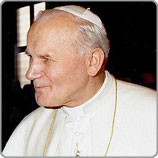
The ceremony for the beatification of John Paul II, on May 1, 2011, presents a good discussion opportunity with children. Take, for example, the pontif’s view of God in our everyday life. People tend to segment their lives into two parts — the non-secular, spiritual part; and the secular part. More often than not, it’s the secular part that gets the most attention in the news, in the media and throughout our culture. John Paul II said that there cannot be two parallel lives. Every area of our lives enters into the plan of God, who desires that these areas be the places where the love of Christ is revealed and realized for both the glory of the Father and service of others.
Consider discussing these questions:
How was the love of Christ revealed to Pope John Paul II when he was a young child?
How would you find God if you had lived at the same time as John Paul II?
What aspects of John Paul II’s life would you like to emulate?


by David Scott

For forty days Jesus stayed among the people, until he was taken up to heaven in a cloud.
During this time, he laid the foundations for his church to continue his presence and work on earth.He gave final instructions to his twelve handpicked apostles, the patriarchs of this new extended family of God.
He had instructed them privately throughout his ministry and given them powers to heal and cast out demons in his name. In those last forty days, he taught them how to interpret the Scriptures and preach. He breathed his Spirit into them, confirmed their authority to forgive sins in his name. He gave them a mission-to preach the good news of his salvation to the ends of the earth, to celebrate the breaking of the bread in his memory, to teach what he had taught them, to baptize all nations and make them one family in God. He promised he would remain on earth through his church-present in the sacraments, living signs that truly bring people into contact with his saving presence.
Jesus ascended to heaven in his glorified, risen body. He took his place in heaven in all the fullness of his humanity, bearing for all time the marks where the nails had been, the signs of his passion carved forever into his precious skin. From that day forward, we could never think of God without thinking of humankind. The very being of God-the Trinity of Father, Son, and Spirit-now contains One who is one of us.
Jesus is now “seated in glory at the right hand of the Father.” He is “King of kings and Lord of lords.” He will come again one day to render a final judgment on the living and the dead and to usher in the never-ending kingdom that Israel’s prophets proclaimed, the new Jerusalem that will come down from heaven. Until that day, Jesus will remain our high priest in the precincts of heaven, hearing our prayers and sending us his Spirit. He is the one mediator between our Father and us, the only one who can save us from the sin of the world.
Until Christ comes again, Catholics live as the first apostles did-as witnesses to his resurrection, trying by his grace to testify with our entire being to the salvation he won for us. We live by faith in all that he revealed about God. We experience our lives as people born of the water and blood that flows from his sacred heart. We call God our Father and love all men and women as our brothers and sisters. We live by hope in the promise that the kingdom is coming, growing and spreading under the Father’s watchful eye in the church of his Son, empowered by his Spirit. And we live by love, in imitation of Jesus, with the love of God in our hearts giving meaning to everything we do. By his grace, we live as he did, as living “Eucharists,” as offerings of praise and thanksgiving.
And we see miracles every day, not only at the altar where bread and wine become his body and blood. We see lives changed by the encounter with the risen Jesus, and we believe that no person stands beyond the pale of his love. We have seen with our own eyes the truth of what he said, that with God all things are possible.

from The Catholic Passion: Rediscovering the Power and Beauty of the Faith by David Scott
© 2005 Loyola Press
