

Author: cfliao


From the Curia – From May 20-22 to be held in Rome at the General Curia, the ordinary annual meeting of ICAJE (the International Commission on the Apostolate of Jesuit Education). ICAJE is composed by 6 members elected by the Secretary for Secondary Education for each Jesuit Conferences, along with the Secretary for Secondary Education. Current members are: Edward Fassett SJ for North America Region; Norbert Menezes SJ for South Asia Region; Marie-Thérèse Michel for Europe Region; Alejandro Pizarro Bermúdez SJ for Latin America Region; Etsuo Sekine SJ for Asia-Pacific Region; Emmanuel Ugwejeh SJ for Africa Region; José Alberto Mesa SJ as Secretary for Secondary Education. “We will be presenting a report from each region – says Fr. José Albert Mesa – analyzing the challenges for Jesuit Secondary Education today, and preparing the Boston International Colloquium for Secondary Education in 2012 organized by Boston College High School.“ – From May 23rd to 28th the Secretariat for Social Justice and Ecology will host the Coordinators of the Conferences for the Social Apostolate which will meet at the General Curia on the occasion of their annual meeting. During these work days they will outline, from the point of view of the Social Apostolate, an overview of the major challenges the Society of Jesus has to face today. The theme of the justice dimension inside the Society will be deepened and the different aspects regarding the future of the Social Apostolate will be taken into exam. Representatives from each Conference will be Fathers César Torres and Alfredo Ferro for Latin America, Andreas Gosele, Brendan McPartlin and Higinio Pi for Europe, Denis Kim for East Asia and Pacific, Ghislaine Tschikendwa and Rigoberto Minani for Africa and Madagascar, Tom Greene for United States and Xavier Jeyarai for South Asia. – Office of Development Resources. Father Jorge Eduardo Serrano Ordoñez SJ, writes: “On 2007 the Father General P.H. Kolvenbach named Mr. Chuck Duffy (USA) as the first director of the development office created in the General Curia after the Major Superiors’ meeting in Loyola (2005). These first three years were to lay the foundations of this new and urgent service to the universal Society due to the great changes in the world’s economy, as well as to the new structures within the apostolic body of the Society and its government. This work done by Mr. Duffy with the support of the Assistants, Provincials and Treasurers was the basis for the proposal presented to the Father General, Fr. Adolfo Nicolás, and to the presidents of the Conferences in September 2010, called the Flagship Project.This proposal seeks to support one Province a year in each Conference until 2013, whether the Province is beginning a fundraising office, or in the midst of strengthening a fundraising program. What is important is that the Province desires to fundraise for the apostolic priorities not only of the Province but also of the shared priorities of the Conference and the world-wide Society. The Conferences have already chosen the pilot Province: East Africa (AOR/Africa), Philippines (PHI /Asia Pacific), Madhya Pradesh (MAP/South Asia), and Malta (MAL/Europe). Latin America has postponed the selection of a pilot Province until the year 2012. The name of this General Curia service has been changed from “Development Office” to “Office of Development Resources”, since it is not this office’s task to do fundraising, but to facilitate the growth of Development Offices in each of the Provinces and Conferences of the Society.” Appointments Father General has appointed: – Father Bhausaheb Sansare Provincial of Pune (India). Father Bhausaheb, who is currently superior of the community and director of St. Joseph Technical Institute and Hostel in Pune, was born in 1970, entered the Society of Jesus in 1994 and was ordained a priest in 2004. – Father Sebasti L. Raj Provincial of Madurai Province (India). Fr. Sebasti L. Raj, up to now director of the Xavier Institute od Development Action and Studies of Jabalpur (Madhya Pradesh), was born in 1945, entered the Society of Jesus in 1965 and was ordained a priest in 1976. From the Provinces CHAD: Recognition to Fr. Gherardi On May 19 in Geneva, at the UN Headquarters, the WHO (World Health Organization) awarded the Chadian Community Association for Progress, founded by Father Angelo Gherardi, an Italian Jesuit missionary living in Chad for decades, the 2011 prize of the Foundation of the Union of Arab Emirates for Health, and the 2011 prize of Kuwait State for research and promotion of health. The reason for both prizes highlighted the excellent work done by the Association for the research and development of health. In addition to the prestigious award, the prizes involve also a substantial sum of money. EUROPE: Strategic Plan A special meeting of the council of the Conference of European Provincials (CEP) was held recently in order to realize a strategic plan of action for the next three or four years. Father John Dardis, the president, outlined the main points: “First we took into consideration evangelization and its importance across Europe, in a moment of big secularization. The Jesuit charism is open to culture, to meet God in all things and to help people to meet him too. This is our particular contribution to the Church. A second basic idea in our discussions was to pay particular attention to young people (…). Everywhere young people have a deep hunger and a great potential. Will we be able to bring out this potential and to develop it? Regardinginterreligious dialogue, it was stressed that they are really more than one dialogue.Islam is not the only group with whom we have to interact, even though it is the most complex and difficult. We must not forget also the ecumenical call in Europe among all Christian Churches (…). Then, we stressed the importance of helping the renewal of the Church all over Europe.” INDIA: New Jesuit Center to provide media training A newly opened Jesuit Center, the Lievens’ Institute of Film and Electronic Media(LIFE), aims to offer young tribal people media skills training with a certain ethical viewpoint and highlight issues related to their communities in Eastern India. Father Francis Kurien, head of the Hazaribagh Jesuit Province, opened theLievens’ Institute of Film and Electronic Media (LIFE) in Ranchi, the Jharkhand state capital, recently. Addressing the gathering, Father Kurien expressed hope that the center’s students would take up tribal issues in various media channels and will make tribal voices heard nationally and internationally: “Today the media is not reporting many events happening in Jharkhand,” he regretted. Ranchi Provincial Father Xavier Soreng, who blessed the building, hailed the Center as “a new chapter in the life of Jharkhand and a gift of the Central Zone Provincials to the tribal people of the region.” The Center will offer a course in film and television production from July 15, with the Mumbai-based Xavier Institute of Communicationsawarding diplomas to graduates from the Ranchi Center. In the near future it will also offer certificate courses in electronic media. ITALY: The residence of Florence closes A statement of the Italian Province announces the closing of the residence of Florence with these words: “After the decision to close the communities of San Remo and Gorizia, the Italian Province of the Society of Jesus has come to the point of having to carry on the painful closure of the community in Florence. In fact, the two younger fathers had to leave for other destinations and the remaining community, formed by the Superior and two elderly fathers, is no longer able to stand. This choice does not mean in any way that the Society leaves Florence. Fr. Ennio Brovedani, director of the Stensen Institute, will remain in town and the Institute will continue with its programs of high cultural level which are widely recognized. The educational, spiritual and charitable activities will continue thanks to the generous hospitality offered from the neighboring parish as well as from the Stensen. They will continue under the responsibility of lay people helped by some Jesuits from other towns. The destination of the building has not yet been defined. We will try to find solutions according to the educational purposes that characterized its use up to now.” ITALY: Global Campaign for Education The Magis Foundation, together with other 15 GNOs, is one of the organizers of the Global Action Week (GAW), a week of global action promoted by the Global Campaign for Education. The event was held from 2-8 May in more than 100 countries around the world and involved millions of students and teachers. The first edition, held in 2003, was attended by 2 million people. Over the years the number of participants in the initiatives increased steadily, reaching in 2008 the world record for the biggest ever lesson in the world which counted 8,8 million people and, in 2010, almost 20 million people. In 2011 the main initiative of the GAW was the Big Story. The theme that was handled and deepened during the week of action was the gender discrimination and the access to education for girls and women around the world. Today there are still 69 million young people who have no access to primary education and 54% of these are girls, while of the 759 million illiterate adults, two thirds are women. Unfortunately in the last ten years this figure is increasing. Convinced that the development of a country cannot be separated from education of its people (and thus also of its women) the aim of this week was to raise awareness and to take concrete action to help girls all over the world to have access to an inclusive education at all levels and to foresee an ongoing formation over the course of their lives. For more information:www.cge-italia.org PORTUGAL: Drama on Father Vieira Throughout the month of May, the Museum of San Roque (Lisbon) offers to secondary students a drama around the figure of Father Antonio Vieira (Portuguese Jesuit and famous preacher and writer in Portugal and Brazil), to be held in the exhibition areas of the Museum and the Church of San Roque, the very place where the “Emperor of the Portuguese language” uttered some of his most famous sermons. Are interpreters: Francisco Vaz, Sylvia Figueiredo and Paula Só. In June, the sessions of the show are directed to the general public, and will take place at night. Fr. Vieira was born in Lisbon on February 6, 1608. When he was 6 years old he traveled to Brazil to join his father who was already there. After joining the Society of Jesus in 1623 he distinguished himself as one of the most brilliant preachers of the XVII century. He played important diplomatic roles and was a great defender of the Brazilian indigenous people. SLOVAK: Jesuits celebrate 450 Jubilee The Slovak Jesuits are commemorating 450 years of the Society of Jesus in the area of Slovakia. The main celebration will take place in Trnava, 22 May 2011. Fr. Lubomir Pilarcik, jubilee coordinator, invites Jesuits from abroad to join the community for the occasion or to visit Trnava during the jubilee year. Different events for pilgrims are organized in the recently renovated Holy Trinity Church in Trnava where the relics of the Martyrs of Kosice are preserved. Plenary indulgences were granted by the Holy See for pilgrims prayerfully visiting any Jesuit church in Slovakia from the Easter till the Solemnity of Christ the King. The national postal company will issue a special postmark with a Jesuit theme to be applied over postal documents in the city of Trnava. The historical Jesuit Collegium in Trnava started from the 23 April 1561. In later centuries Jesuits were famous by the Trnava University (1635-1777). The main highlights of the program on May 22 in Trnava will be the sightseeing of the historic Jesuit places, Holy Mass presided by the Archbishop of Trnava Mons. Robert Bezak, followed by the blessing of the renovated exterior of the Jesuit Church and exhibition of artworks by Slovak Jesuits. SPAIN: “The last Jesuit” The latest historical novel of Father Pedro Miguel Lamet was presented on May 9 in the conference hall of ICADE in Madrid. The book, titled The Last Jesuit, recounts the tragic persecution of the Society of Jesus during the reign of Charles III. The work, Father Lamet’s 37th, has been a major challenge for the author, who considered it “the most dramatic, exciting and rigorous historical novel” he never wrote. According to Lamet the expulsion and suppression of the Society is comparable to “the expulsion of the Moors and Jews.” The reasons are many and various: the Order was at that moment in the zenith of its height and influence in Rome and in the world, theological issues such as Jansenism, the doctrine of Father Mariana on the tyrannicide, the publication of the famous novel “Fra Gerundio” by Father Isla, and especially the lies about the Reducciones in Latin America. But, according to Father Lamet, the main reason for this and other expulsions the Society of Jesus suffered during the centuries was “to work at the frontiers of faith and culture, and an independence of approach which has its basis in the inner freedom of spirit acquired through the Exercises of Saint Ignatius.” SPAIN: Ignatian immersion in Manresa The spiritual center at the Cave of St. Ignatius in Manresa has welcome 36 participants for the first international immersion course. The course has turned out to be such a success that it has been necessary to open a waiting list with 60 applications for the future. This is the first international course in English to take place at the Cave of St. Ignatius. There are participants from all over the world, from 20 different countries and from every continent including an important presence from Africa and Asia and representing 19 different languages. A third of the participants are lay and the majority of the rest are Jesuits. Over five weeks, the participants will be “immersed” in Ignatian spirituality. The course, said Father Francisco José Ruiz Pérez, Provincial of Spain, “demonstrates that Ignatian spirituality is alive and that there is everywhere a strong desire to know about it and bring it up to date and adapt it to the needs of the Church and mankind.” Spain’s Provincial reminded us that the spirituality of St. Ignatius does not only belong to the XVI Century but it is open to the challenges of every day and everywhere. A proof of the fact that this course is international is that the Spiritual Exercises can be followed in English and also in Chinese thanks to the presence of Colleen Wang, who is a member of the Center run by the Society of Jesus in Hong Kong. The course began on 27th April and will end on the 4th June. U.S.A.: Jesuit chaplain of US House of Representatives Jesuit Father Patrick J. Conroy, a chaplain and theology teacher at Jesuit High School in Portland, has been nominated to be the next chaplain to the U.S. House of Representatives. House Speaker John Boehner of Ohio announced the decision May 6 and said it was made in consultation with Nancy Pelosi of California, House Democratic leader. The priest will be the 60th House chaplain, the first Jesuit priest and the second Catholic priest in this role, succeeding Father Daniel P. Coughlin who retired in April after more than 11 years of service. “One does not aspire to become the chaplain to a chamber of Congress,” said Father Conroy and added: “This opportunity to serve is an extraordinary gift, and I hope to be worthy of the trust the Speaker of the House and the Minority Leader are extending to me. I am also humbled by the confidence my Jesuit superiors are demonstrating in making me available to answer this call to serve the people’s House.” He is expected to be sworn in late May. “We are honored that Father Conroy has agreed to serve as House chaplain,” Boehner said, “his dedication to God’s work, commitment to serving others and experience working with people of faith from all traditions will make him an asset to the House community. We look forward to having his counsel and guidance in the people’s House.”



Oh, they can be quiet, poor, and diffident. They can rise up to God’s heaven like silver doves from a happy heart, or they can be the inaudible flowing of bitter tears. They can be great and sublime like thunder that crashes in the high mountains, or diffident like the shy confession of a first love.
If they only come from the heart. If they only might come from the heart. And if only the Spirit of God prays them together also.
Then God hears them. Then he will forget none of these words. Then he will keep the words in his heart because one cannot forget the words of love.
And then he will listen to us patiently, even blissfully, an entire life long until we are through talking, until we have spoken out our entire life.
And then he will say one single word of love, but he is this word itself. And then our heart will stop beating at this word. For eternity.
Don’t we want to pray?
Karl Rahner, SJ
The Need and the Blessing of Prayer


by William O’Malley, SJ


6th Week of Easter
7th Week of Easter
11th Week in Ordinary Time
12th Week in Ordinary Time
13th Week in Ordinary Time


In general, prayer services follow a basic pattern.
Gathering/introduction-song, greeting, opening prayer
The Word of God-Scripture reading, response, silence
Shared prayer-petitions, traditional prayers, litanies, composed prayers, and so on
Conclusion-closing prayer, blessing, song
In addition, a prayer service may include nonverbal expressions such as gesture and ritual.
As a catechist, you will be called upon to lead prayer services from time to time. Here are some things to consider when leading such services.
The Role of the Holy Spirit
The Holy Spirit guides all prayer. Prayer leaders do not perform, but offer themselves as a vehicle of the Spirit for those at prayer. Pray to the Holy Spirit to guide and inspire you.
Scripture
Prayer services should always involve the Word of God so that participants can listen to God speaking to them.
Music
Singing and instrumental music are not just frosting on the cake. They are essential ingredients in prayer services.
Environment
Introduce elements into the environment to create a greater awareness of the sacred. Consider candles (when appropriate), dimmed lights, enthroned Bible, cross, and objects from nature such as flowers, rocks, and shells.
Assembly Participation
Don’t think of what just you are doing during prayer. Ask yourself what the assembly is doing. Be sure to involve the assembly as a whole in the prayer, not just those taking the Leader or Reader roles.
Nonverbal Elements
Consider the elements of movement and gesture (procession, bowing, venerating the Bible, outstretching hands, laying on hands, blessing) and of symbols (water, oil) as well as of silence.
Verbal Elements
Follow and borrow from the prayer of the Church (Sacramentary, Liturgy of the Hours): introductory rites, psalm responses, antiphons, penitential rites, collects, intercessions, and blessings. These prayers are rich and evocative and therefore, powerful.
Liturgical Feasts and Seasons
Pay special attention to the time of the liturgical year (Advent, Lent, feasts, solemnities) when selecting themes and prayers.
As a catechist, you will be called upon to lead prayer services from time to time. Here are some additional things to consider when leading such services.
Know your assembly.
Be aware of the age level of your assembly and their faith development as well as their level of maturity.
Prepare.
As when planning a session, be sure of your focus, theme, and goal. Envision the prayer, feel the flow, get a sense of space, time, sound, silence, and so on. Select Readers and assign roles ahead of time. If possible, rehearse with those chosen to read.
Include silence.
Our lives are noisy already. Much of our prayer is too wordy. Allow for periods of silence. Be sure to include silence during the prayer service, perhaps after a prayer or a reading.
Give instructions beforehand.
There’s nothing worse than interrupting a prayer to give directions such as “the left side takes this part, and the right side takes that part!”
Be creative.
Consider using appropriate visuals (video, DVD, slides, PowerPoint, and so on).
Encourage spontaneous prayer.
Not everyone is comfortable with spontaneous prayer, but it is a form of prayer that needs to be taught and fostered.
Proclaim.
Throughout the prayer service speak clearly and slowly. Proclamation is more than merely reading the text and less than a dramatic performance. As you speak, try not to bury your head in the text; look at the assembly as much as possible. Speaking in this way will help to involve the participants.
Move with reverence.
Moving with reverence means moving not too quickly or slowly, and not stiffly, but with ease and regard for what you are doing.
By following these simple suggestions, you can involve yourself effectively and wholeheartedly in a prayer service so that others will follow.


by Peter Daniel, S.J.
This is the story of the village of ‘Agnipuri‘ (A village of Fire). When I was appointed parish priest in Darsi, in the state of Andhra Pradesh, I soon heard of a neighbouring village called Erraobanapalli, which is more than 100 years old. In this village, there was a group of 65 high caste farmers, divided into two political groups, who used to win the elections for local government (Panchayat) every time. On the other side of the village lived 250 Dalit families who served them, and who were also split into two groups, and never allowed to come together. Most of the Dalits were either Christians or Catholics, but some Dalit Muslim and Hindu families had joined them over time. All the Dalits were landless labourers. The Government Primary School was situated in the high caste part of the village and hence the Dalit children had no access to education. The Dalit part of the village was 100% illiterate.
When I started visiting the village and found out about this situation, I met with the Dalits, first with the two groups separately and then eventually with everybody together. It took four years, but when the next elections for local government were called, the Dalits were ready to vote for their ‘independence’. They chose a single candidate and regardless of their great fear of taking a stand against the high caste farmers, they won the elections. As soon as the high caste farmers found out about the election results, they burned down the Dalits’ houses.
The homeless Dalits, men, women and children, fled with only the clothes they were wearing into a nearby forest. When I found out about this, I immediately organised food for them. The next morning, we marched together to Darsi, to the office of the governor of our county. We sat in front of his office for seven days until the sub-collector came to meet us. He agreed to build a new village, where the government would take care of building the road, a drinking water facility, electricity and a new school. Since the government was only going to rebuild the same number of houses that had been destroyed by the fire, and which had been shared by three families each, I found a private sponsor from Austria who agreed to finance the remaining new houses, so each family would have their own space. With the help of the Jesuit province, the community built temporary huts on the ground that had been identified five kilometres from the original village. Together, we then built the 250 houses.
We named the village ‘Agnipuri’ (A village of Fire) and blessed the new colony in July 1996. That day was also the day of reconciliation with the high caste farmers who came for the inauguration of the new village and made peace with the Dalits. I felt about this whole experience like Moses leading the people of Israel from Egypt to the Promised Land. Each of us had a role to play in this modern exodus and we all experienced God walking along with us.


by Kim Miller
Jesuit Refugee Service/USA
Quang D. Tran, S.J. poses with
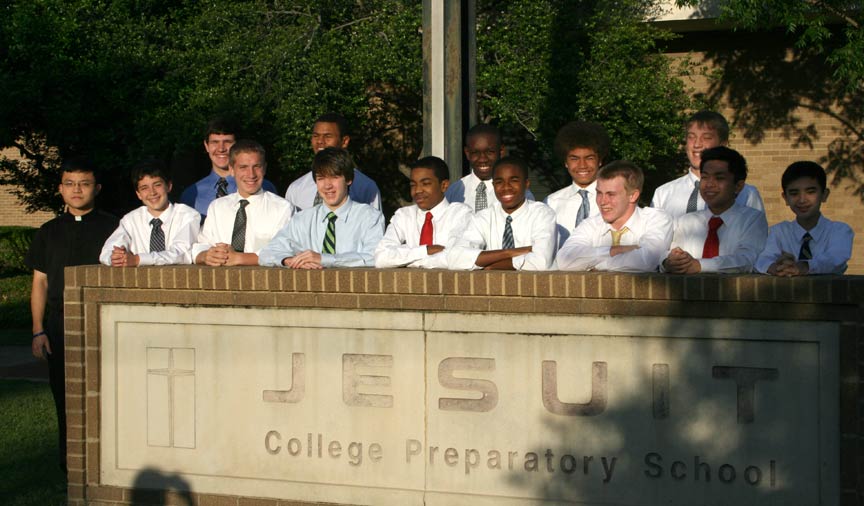
AAOS founding members Andrew Zaugg,
Jason Nguyen, Daniel Eboagu, Orion Salters, Connor Robison,
Justin Montgomery, Grant Uy, Jimmy Bucklar,
Tyler Kromkowski, Christian Koeijmans,
Kyle Shannon and Kellen McAlone. (JHS Dallas photo)
“Having watched the many natural disasters that have occurred across the country recently, and learning more about the lives of displaced persons and refugees overall, I am excited about the opportunity to help and support refugees through our JRS action team,” said JRS Action Team co-founder Brocke Stepteau.
Co-founder Justin Rotich added that he’d like their Action Team to “be a voice for the forgotten and vulnerable [refugees], especially the children, and raise awareness of their cry for help.”
The AAOS members know “that issues involving Christ’s poor, no matter where they are, are local issues that call for prayer, discernment, and action,” said Mr. Quang D. Tran, S.J., a teacher at the school and AAOS Faculty Moderator.
The two students have spent weeks planning out their club’s mission and projects as well as gathering support from the school’s faculty and students. While the Action Team hopes to support refugees worldwide, they will focus their efforts on refugees in the Kakuma Camp in Kenya. JRS runs multiple projects in the bustling camp of nearly 85,000 refugees including pastoral care, trauma counseling, and special education.
AAOS hopes to support these programs by raising funds for solar paneled lighting to improve safety and accessibility as well as gathering special education games to meet students’ developmental needs. AAOS also hopes to “educate more on the needs of refugees, particularly those located at the Kakuma Refugee camp,” said Rotich. Their Action Team already has planning underway for a Refugee Awareness Day to be held next year.
Students and faculty at Dallas Jesuit have been very receptive to the formation of AAOS, and the group already boasts 12 members. As a campus dedicated to social justice in the Jesuit tradition, it seems the Action Group is a natural fit:
Richard Perry, Director of Community Service at Dallas Jesuit and another AAOS Moderator shared, “In the tradition of Catholic Social Teaching, justice is about the formation of relationships across borders and boundaries. This program will lead us past boundaries and toward friendship, awareness, and action.”
“JRS-AAOS gives me a chance to serve on a global level those whose needs are vast. As a member of this JRS Action Team, I have been given an opportunity to carry out the mission of ‘Men for Others,’ a mission entrusted to me as a student of a Jesuit ” said Daniel Eboagu, AAOS’ Secretary.
JRS Action Teams are groups of anywhere from three to 100 members that rally around their common concern for refugee and forcibly displaced persons, and their drive to effect positive social change in their local and global neighborhoods. These teams support JRS/USA’s advocacy efforts by forming a grassroots movement to inform, educate, and empower local communities to take action and demand responsible actions from the U.S. government and beyond.
While teams vary in size, structure, and activities, they share the common goal to support JRS/USA’s advocacy efforts and refugee and forcibly displaced issues at large. Further, JRS Action Teams commit to meeting regularly and coordinating activities and events that promote a brighter future for our refugee brothers and sisters.
To form your own JRS Action Team, please contact Kim Miller at kmiller (at) jesuit.org
Jesuit Refugee Service/USA is an international Catholic non-governmental organization whose mission is to accompany, serve and defend the rights of refugees and other forcibly displaced persons.
JRS/USA witnesses to God’s presence in vulnerable and often forgotten people driven from their homes by conflict, natural disaster, economic injustice, or violation of their human rights.
As one of the ten geographic regions of the Jesuit Refugee Service, JRS/USA serves as the major refugee outreach arm of U.S. Jesuits and their institutional ministries, mobilizing their response to refugee situations in the U.S. and abroad. Through our advocacy and fund raising efforts, JRS/USA also provides support for the work of JRS throughout the world.
JRS/USA gives help, hope, ear and voice to vulnerable people on the move by being present to and bearing witness to their plight; by relieving their human suffering and restoring hope; by addressing the root causes of their displacement and improving international responses to refugee situations.
In addition, JRS/USA inspires the Ignatian family and others to respond together to the needs of refugees and displaced persons worldwide and forges strong partnerships with like-minded institutions and agencies devoted to the cause of refugees and displaced persons.
JRS works in more than 57 countries worldwide to meet the educational, health, social and other needs of refugees and other forcibly displaced persons. JRS services are made available to refugees and displaced persons regardless of their race, ethnic origin, or religious beliefs.
JRS provides primary and secondary education to approximately 170,000 children, and undertakes advocacy to ensure that all displaced children are provided with a quality education.
Jesuit Refugee Service/USA is a registered 501(c)(3) non-profit organization. Donations are tax-deductible to the fullest extent allowed by law.



You might also consider Creighton’s 34-week online retreat that follows the four weeks of the Spiritual Exercises. It’s also available in the book Retreat in the Real World, published by Loyola Press.
This was the topic of a conference given last week by the priest at the Pontifical Gregorian University, as part of a series of talks on “Conversion. A Change of God? Experiences and Reflections on the Interreligious Dialogue.”
Father Schatz, who is presently based at the Philosophisch-Theologische Hochschule Sankt Georgen of Frankfurt, Germany, was one of the presenters at this series organized by the Institute of Interdisciplinary Studies of Religion and Culture (ISIRC) of the Gregorian University.
The priest referred to the example of Father Matteo Ricci, a founder of the mission in China that lasted through the 17th and 18th centuries, H2O News reported.
He reflected on the missionary’s strategy, beginning with winning over the elite ruling class in an effort to gain the trust of the emperor and his court, the official interpreters of religion in that country.
In this way the Jesuits aimed to counteract the popular belief systems that included idolatry, superstition and magic.
In order to reach out to the political and cultural leaders, the missionaries used Western sciences and technology such as astronomy.
The novelty that they presented, Father Schatz noted, was that in Christianity every person could have a direct and immediate relationship with God.
This was a rare concept in China at that time, when the emperor was believed to be the only one who could offer sacrifices to heaven.
Father Schatz said that the Jesuit methods were criticized by other Catholic groups who distanced themselves from politics and science, and yet Father Ricci’s work brought results.
He noted that in Korea, for example, the local Church began not through preaching or direct contact with missionaries, but through literature, when a group read “The True Meaning of the Lord of Heaven” by Father Ricci.
Father Ricci, who died in 1610, is currently recognized as a Servant of God.
by Jim Manney, SJ
Video cameras are following Radmar Jao as he prepares to be ordained a priest next month. Jao is the subject of a video series produced by the US Jesuit conference. It’s aimed at vocations promotion, but it’s easy for anyone with an interest in Jesuits and Ignatian spirituality to get drawn into the story of this articulate, likable young man, who joined the Jesuits in 2001.
Jao used to be an actor. Among other things, he played a small part in this episode of “Seinfeld,” my favorite TV comedy. (He delivers Chinese food to Elaine about a minute into the clip.) Jao is now finishing theological studies at the Jesuit school at Berkeley. There will be three videos in the series, interspersed by short video diaries. The homepage for the series is here. Below is the first video. (If you can’t see it, click here.)