

Author: cfliao



That night the oil in all the other lamps went out. But the beggar woman’s lamp was still burning at dawn, when Buddha’s disciple Maudgalyayana came to collect all the lamps. When he saw that one was still alight, full of oil and with a new wick, he thought,”There’s no reason why this lamp should still be burning in the day time,” and he tried to blow it out. But it kept on burning. He tried to snuff it out with his fingers, but it stayed alight. He tried to smother it with his robe, but still it burned on. The Buddha had been watching all along, and said,”Maudgalyayana, do you want to put out that lamp? You cannot. You cannot even move it, let alone put it out. If you were to pour the water from all ocean over this lamp, it still wouldn’t go out. The water in all the rivers and the lakes of the world could not extinguish it. Why not? Because this lamp was offered with devotion and with purity of heart and mind. And that motivation has made it of tremendous benefit.”
When Buddha had said this, the beggar woman approached him, and he made a prophesy that in the future she would become a perfect buddha, call “Light of the Lamp.”
So it is our motivation, good or bad, that determines the fruit of our actions.



The farmer said, “Monks, I’m so unhappy. I have twelve cows and I don’t know why they all ran away. I have also a few acres of a sesame seed plantation and the insects have eaten up everything. I suffer so much I think I am going to kill myself.
The Buddha said, “My friend, we have not seen any cows passing by here. You might like to look for them in the other direction.”
So the farmer thanked him and ran away, and the Buddha turned to his monks and said, “My dear friends, you are the happiest people in the world. You don’t have any cows to lose. If you have too many cows to take care of, you will be very busy.
“That is why, in order to be happy, you have to learn the art of cow releasing (laughter). You release the cows one by one. In the beginning you thought that those cows were essential to your happiness, and you tried to get more and more cows. But now you realize that cows are not really conditions for your happiness; they constitute an obstacle for your happiness. That is why you are determined to release your cows.”


“Help! Help!” the Master shouted, “I can’t swim.”
“Please wait a while Master. Please don’t get drowned,” they pleaded. “We are still seaching in our holy book. There must be an instruction on what to do if you fell off from a wooden bridge into a river.”
While they were thus turning over the pages of the holy book in order to find out the appropriate instruction, the teacher disappeared in the water and drowned.


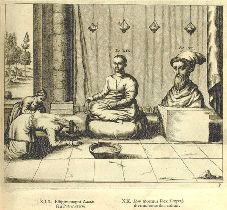
This image of a Dalai Lama was drawn by the 17th century scholar, Athanasius Kircher, S.J.
A monk keeps promising his student that he will take him on a picnic but is always too busy to do so. One day they see a procession carrying a corpse.
“Where is he going?” the monk asks his student.
“On a picnic.”


He approached the first worker and asked, “What are you doing?” The man, very disgruntled and obviously unhappy in his hard toil, replied, “I’m cutting these huge boulders with the simplest of tools and putting them together in the way I’ve been told to do. I’m sweating in this heat and my back is hurting. What’s more, I’m totally bored and I wish I didn’t have to do this hard and meaningless job.”
The traveller moved on quickly to interview a second worker. He asked the same question: “What are you doing?” The worker replied, “Well, I have a wife and children at home, so I come here every morning and I work these boulders into regular shapes, as I’m told to do. It gets repetitive sometimes, but it helps to feed my family and that’s all I want.”
Somewhat encouraged, the traveller went on to a third worker and asked, “And what are you doing?”
The third worker responded with shining eyes, as he pointed up to the heavens, “I’m building a cathedral!”


A campfire needs kindling and wood and air to survive. So, too, do we need something to ignite our faith and something to keep it going.


eRenlai Newsletter June 2011
Dear friends,
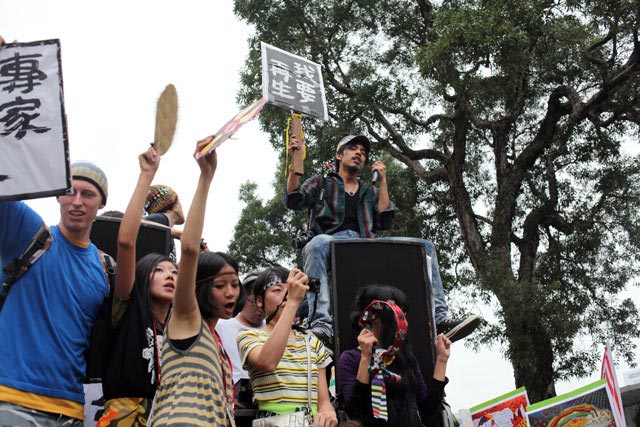
In this month’s Focus, eRenlai reveals the innovation and creativity of Taiwan’s most dynamic social movements, with activist Zijie Yang as our trusted guide. A scholar on local social movements, Professor Ho Ming-sho, first introduces the history of social movements in Taiwan. With this historical foundation in place, we then move on to look at more recent events with an exploration of the two contrasting opinions on the failure of the Wild Strawberry Student Movement, which was sparked off in November 2008 by alleged police brutality during a visit by Chen Yunlin, the chairman of the Association for Relations Across the Taiwan Straits of the People’s Republic, to Taiwan. The focus also includes a translation by Robert Voight of the first in-depth analysis of the student movement, an extract from Professor Ho Tung-Hungâ€TMs notes on the protests.
In the light of the perceived failure of the Wild Strawberry Movement, the focus goes on to explore the new energy and innovation that define or will go on to define social movements in Taiwan. One of these movements is what Sean Hsieh called “the opening of new spaces”. We introduce two of these spaces – Café Philo and Go Straight Café which cultivate, train and empower youth to take part in social and political activism, and which illustrate the key role that gathering places like coffee shops play in fortifying civil society. Go Straight Café has reflected on the lessons learned during the Wild Strawberries Protests to pursue more innovative and creative forms of protest. It is now home to a group of cultural activists called “NoNuke”, who employ music, art exhibitions and social events to foment dialogue within the wider public, and have fought for a nuclear-free Taiwan over the last two years. In the wake of the Fukushima Nuclear disaster in March, NoNuke also collaborated with Gon-li She, a group of young people attempting to promote punk music in Taiwan, to channel the anger and frustration of young punks and rave-goers into social activism. This cooperative effort bore fruit with the 4/30 manifestation against nuclear energy in Taiwan and in the subsequent art exhibition, ‘Don’t brush off what you see’, which brought together ten artistic works concerned with nuclear power and energy resources.
In a tribute to the American activist duo “The Yes Men”, the Academy of Interference, printed 10,000 hoax mock-ups of the front pages of Taiwan’s major newspapers, declaring falsely that the proposal for the controversial KuoKuang Petrochemicals factory had been rejected by the government. The stunt achieved its desired effect, garnering media attention. Eventually the government removed its support for the project which could have endangered the survival of the last remaining Chinese White Dolphins. Another group, concerned above all with nature and the land rights of indigenous peoples, is the Langyan Action Group, who every year since 2007 have lit pyres, setting off smoke signals that call for justice as well as a nuclear-free homeland.
Conor interviews a different type of activist – Vincent Huang took time to explain his experience in the Gay Movement and what bearing his disability has on his role within it and on his outlook on life in general.
Benoit Vermander imparts advice on the life-long process of moral development and warns us not give way to the overdetermined truths that logic might seem to provide. Benoit also summarizes the conclusions of the conference on “Interreligious Encounters, Peace-building and Theological Inventiveness in todayâ€TMs Asia†sponsored by the Xu-Ricci Dialogue Institute at Fudan University in Shanghai; Around 60 scholars debated the contribution that Christian studies bring to reconciliation and dialogue in an Asian context, from the perspective of cross-spiritual encounters, cooperation in the field of social and environmental justice, systematic theology and public philosophy.
In response to the Focus ‘Beyond the Pale: Architecture in Taiwan’ Pierre Maranda would like to introduce readers to what world-famous anthropologist Claude Lévi-Strauss wrote on the subject of religious and cosmic interpretation of traditional Chinese architecture.
Finally remember to look out for our world music CD which will come with Renlai Monthly magazine next month. The CD a sample represents the blend of various musical cultures that can be found in modern Taiwan. Congratulations to all the winning submissions and remember to check out the interviews with the bands that took part that will be online over the course of this month.
Happy Dragon Boat Festival and we wish you peace over the Feast of the Ascension!
Nick and all the eRenlai Team
www.eRenlai.com
Taipei Ricci Institute|eRenlai Magazine|Renlai Monthly
Hsin-hai Road, Section 1, No.22, 3fl.Taipei 100, TAIWAN
Tel: (886 2) 2368 9968 Fax: (886 2) 2365 4508
email: [email protected]
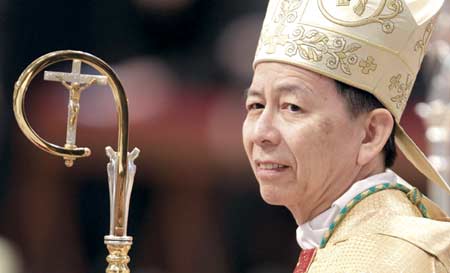
Vatican City (AsiaNews) – Each “division [. . .] causes great pain to the entire body” and the “whole body is scarred and bleeding,” said Mgr Savio Hon, secretary of Propaganda Fide, in response to reports that another Episcopal ordination is being prepared without a papal mandate. According to Mgr Hon, those who have resisted the will of the party, like Mgr Li Lianghui (Cangzhou, Hebei), are now in isolation, forced to undergo political education classes (brain washing). He insists that Chinese priests and bishops must show “some backbone” and resist the pressures out of love for Church unity, and the memory of the many heroic witnesses to the faith of the past decades. The secretary of Propaganda Fide notes that unlawful bishops do not have the right to perform the pastoral ministry, adding that the Vatican Commission for the Church in China is coming up with guidelines to save the Chinese Church from division and the scandal caused to the faithful. He also notes that there are American and European theologians who are in favour of an “independent” Church and that their ideas are spreading the seed of division in China. Mgr Hon, who for years visited and taught in Chinese seminaries, is in favour of the beatification of Card Ignatius Gong Pinmei, appointed cardinal in pectore by John Paul II, who passed away in 2000, and this despite some “technical problems”. Finally, the bishop is embittered about the fact that the Vatican is continuously asking for the release of imprisoned bishops (Mgr James Su Zhimin of Baoding and Mgr Cosma Shi Enxiang of Yixian) but is not getting any answer from the government in Beijing. Here is the full interview with Mgr Savio Hon: Rumours have it that on 9 June there could be a new unlawful Episcopal ordination in Hankow (Wuhan, Hubei), one without papal mandate . . . I am concerned about the report. The pope is concerned as well, as is the Church of China as a whole. From what I know, the faithful in Hankow have reacted by pleading with the government and the Chinese Patriotic Catholic Association (CPCA), citing the Code of Canon Law, not to carry out this ordination. It would appear that the candidate, Fr Shen Guoan, is against it, too. Sadly, at present we do not know what the candidate actually thinks. However, from brother to brother, I want to tell Fr Shen, “I trust you to act the right way. The only right thing to do is to refuse.” How serious is an unlawful ordination? The Church is one Body with Christ as the head and the rest of us as the parts, perfectly united in the Holy Spirit. It is mystical and sacramental fact. Every act of division, like this unlawful Episcopal ordination, is an act of division of the Church and causes great pain to the entire body, like tearing a piece from a living body. Eventually, the whole body is scarred and bleeding. There are also consequences. As more unlawful ordinations are made, the Church in China, or parts thereof, appear to be working for the constitution of a different Church, a community that wants nothing to do with the Holy Father. How is it that they are still prepared to carry out unlawful ordinations fully knowing this? According to some reports, the CPCA appears to be planning at least ten Episcopal ordinations . . . I cannot really say, but from what one can be see, it is clear that priests and bishops are under pressure. It is my impression that this pressure is not as strong as it was for our brothers in past decades. Today for instance, there is no risk of forced labour, prison or death. Nowadays, the government does not do that anymore. Of course, if bishops and priests do not submit, they will be punished in some way. For example, they can lose public funds for their diocese, obstacles will be put up against their daily pastoral activities; or their careers might suffer (for example, they may not be appointed to the government’s consultative assembly). Alternatively, they may not be allowed to travel abroad or inside China, or may be forced to undergo re-education courses. There are several examples of this. After Bishop Li Lianghui refused to take part in last December’s[1] assembly of Catholic representatives, he was sent to re-education. Yet, this also is evidence that it is possible to say no to submission. Forced isolation from other bishops, priests or faithful can be a heavy burden though. When faced with such punishment, some bishops resist better than others do. The government knows which candidates to pick, choosing the weaker, those more amenable to compromise. As one might expect, there are also opportunists who will accept a compromise, alleging a number of reasons, such as the greater good of the Church, the need for public monies, the imperative of evangelisation, etc. Such claims are however false. When the Church is cut off from its rock, from Peter, it automatically becomes weak. In any case, the punishment that might be meted out is no reason not to resist. Submission is a public act that causes scandal, sending the wrong message to the faithful. It undermines the heroic memory of so many bishops who have resisted. At present, various Episcopal candidates resist and do not want to be ordained without the appropriate canonical assurance and the right papal mandate. When he mentioned the Day of Prayer for the Church in China, the pope called for prayers on behalf of those who are tempted by opportunism . . . All candidates to the priesthood are our brothers, and we should help them and show understanding. However, this does not mean that we should encourage them to follow the wrong path. Compassion must make one strong in difficult times. Besides, if one shows some backbone, the government will not touch you. If you show some weakness or a propensity towards compromise, the government will take advantage of you. There are candidates who stood their ground and refused to be ordained by excommunicated bishops, at least until a papal mandate was issued. Faced with such firmness, the government could do nothing. What does the Holy See do for these candidates? For our part, we must work harder in training the clergy, so that strong leaders can come out of the seminaries. Unfortunately, we can do little from outside. At the same time, we can see that the government is keeping a close watch over its candidates, training them before forcing them into the mould they desire. However, no government likes opportunists because they can change their mind. They will always be used for as long as they are useful. In China’s situation, we must counsel bishops and priests that if they do not feel up to the task or if they cannot resist pressure, they should simply ask to be released from their pastoral duties and have the courage to suspend their ministry. Is setting up an independent Church useful for the government? All the government wants is for the Church to perform the sacraments for Chinese Catholics and foreigners visiting the in the country. This creates an impression of religious freedom even it raises many questions from a canonical and theological point of view. China follows one principle, the government comes first; religion comes second. However, it is unclear how subordinate religion has to be. A system of self-selection and self-ordination (without papal mandate) will eventually destroy the Church, as the faithful will move to the bishops who are not in communion with the Holy See. On the other hand, sacraments performed by an unlawful bishop are valid . . . What the papal letter to Chinese Catholics said was that, for the good of the faithful, it was possible, under exceptional circumstances, to receive a valid but unlawful sacrament from an unlawful bishop. It this became the norm, I think the guideline should be revised and Chinese and foreign Catholics should be told not to receive any sacrament from unlawful bishops. If no clear-cut distinction is made, the faithful will not understand the difference between bishops who are loyal to the pope and those who are not. The faith of the simple people could be jeopardised. Sacraments performed by unlawful bishops are acceptable in emergencies, but they do not enhance the communion of the Church. It is a modus non morientis, but not a modus Vivendi. It is a guideline to keep the Church alive, but it does not help the Church live and grow. What I say corresponds to many requests that come from the Church in China, which call on the Vatican to clarify some issues and give clearer guidelines on how the faithful and priests should behave vis-à-vis unlawful bishops. After the unlawful ordination of Chengde[2], the Holy See issued a very clear statement, condemning the act . . . Yes, but it did not say which one. It did not differentiate between Episcopal power and the pastoral ministry. One becomes bishop through sacramental ordination, but pastor of a segment of the people of God through papal mandate. This means that an unlawful bishop who unlawfully secured his ordination has no right to lead the faithful because he does not have a papal mandate. In the case of Chengde, the ordination is valid (even though it was unlawful), but the bishop has not no power to lead his flock. This means that in Chengde, the faithful have no obligation to obey the bishop, who has no power to ordain priests. Given all the difficulties and the threat of unlawful ordinations are there signs of hope for the Church in China? Many priests and faithful adhere to Catholic doctrine and do not obey unlawful bishops. However, I do not know how long that will last. For this reason, seminary training is important. One thing deserves closer attention, and that is how Chinese Catholics are inspired by new Blessed, John Paul II, who said, ‘Have no fear’. The pope said these words at the start of his pontificate after he left Poland, a country where the Church was persecuted and had few hopes of success. Yet, “Have no fear” was effective. Card Casaroli himself could not foresee the collapse of the Communist regime within a short period of time. I think the way to eliminate this ambiguity is to ask the bishops who engaged in actions contrary to the papal mandate (for example, carrying out ordinations or taking part in assemblies) to make public amend. What can the universal Church do? We must help the Chinese Church to live the faith and not bend to demands that undermine the deep heart of the Catholic faith and the relationship with the pope. Sadly, a certain theology from the United States and Europe is penetrating the Chinese Church. This theology calls for autonomy in the realm of Episcopal appointments and independence from the Holy See. There are people in America and Europe who are pushing Chinese bishops towards this kind of action. “If you succeed,” they argue, “we will follow.” As you can see, until recently the issues of “independence” and “autonomy” referred to the relationship with the government; now, it also touches the theological level. Sometimes it appears that the Holy See is dominated by diplomatic fears rather than pastoral concerns, that it is too eager to establish diplomatic relations at any costs. For example, how many times did the Holy See ask for the release of bishops in prison? Every time we meet representatives of the Chinese government, we demand the release of our brothers. However, the government will not listen. These bishops are old and sick. Their release would be a humanitarian gesture. Sadly, we never get an answer. Perhaps, we should make public appeals rather than speak to the authorities in person. Some underground Catholics want the cause of beatification of Card Ignatius Gong Pinmei[3] to start. What do you think? There are technical difficulties. It is up to Chinese dioceses, the local Church, to gather the documentation and present it to the Congregation of Saints. If this happens, the Vatican will certainly consider it. In the case of Card Gong, since he was the bishop of Shanghai, there is the matter of reconciling underground and official communities in Shanghai. But it is not impossible. The same is true for the martyrs of the Communist period, who died from hardships and privations in the camps or in prison, over the past few decades. Each diocese collects documentation on these martyrs, and determines whether to send it to Rome or not for the start of a formal process of beatification. If the diocese can start the process, we are happy. [1] See W. Zhicheng – Z. Yuan, “Chinese bishops deported to attend Patriotic Assembly,” in AsiaNews, 7 December 2010 and Zhen Yuan, “Assembly elects new leadership, causing major harm to the Church,” inAsiaNews, 9 December 2010 [2] See Zhen Yuan, “Chengde, eight bishops in communion with Pope participate in illicit ordination,” in AsiaNews, 20 November 2010 and “Holy See condemns illicit Episcopal ordination in Chengde,” in AsiaNews, 24 November 2010. [3] See Annie Lam, “Waiting for the beatification of Card Kung Pin-mei ten years after his death,” in AsiaNews, 25 February 2010.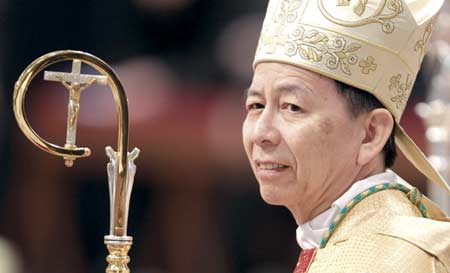 The bishop, a member of the Salesian order from Hong Kong, has been hard at work at his new job for several months now. He continues to stand in solidarity with the bishops and priests who are victims of pressures and threats. At the same time though, he urges them to reject the demands made on them by the Communist regime, whose goal is to set up a Church that is “independent” from the Holy See and totally subordinated to the state.


by Ron Hansen

HarperCollins Publishers
“Ever a mystic, at times the saint was in the midst of an official transaction when his thoughts would lift up to God and hang there, and his witnesses would shyly shuffle their shoes until he got back to his papers again. But there were also stories of him surprising a melancholic with a jig in order to cheer him up, and his happiness was such that he said he could no longer apply his own rules for discernment of spirits because he was finding consolation in all things-he once said he saw the Holy Trinity in the leaf of an orange tree. Although children threw apples at him when he first preached in the streets of Rome-probably because of his horrid Italian-he soon was as genuinely beloved as the pope. In fact, he was so highly thought of by prelates that in the 1550 conclave at which Julius III was elected pontiff, Ignatius de Loyola received five votes.”
Ron Hansen
Stay Against Confusion: Essays on Faith and Fiction


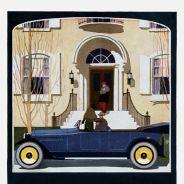
“You mean your brother gave it to you and it didn’t cost you nothing? Boy, I wish…” He hesitated. Of course Shuaib knew what he was going to wish for. He was going to wish he had a brother like that. But what the lad said jarred Shuaib all the way down to his heels. “I wish,” the boy went on, “that I could be a brother like that.” Shuaib looked at the boy in astonishment, then impulsively he added, “Would you like to take a ride in my automobile?” “Oh yes, I’d love that.”
After a short ride, the boy turned and with his eyes aglow, said, “Uncle, would you mind driving in front of my house?” Shuaib smiled a little. He thought he knew what the lad wanted. He wanted to show his neighbors that he could ride home in a big automobile. But Shuaib was wrong again. “Will you stop where those two steps are?” the boy asked. He ran up the steps. Then in a little while Shuaib heard him coming back, but he was not coming fast. He was carrying his little crippled brother. He sat him down on the bottom step, then sort of squeezed up against him and pointed to the car.
“There it is, little brother, just like I told you upstairs. His brother gave it to him for Eid and it didn’t cost him a penny. And some day I’m gonna give you one just like it…then you can see for yourself all the pretty things in the Shop windows that I’ve been trying to tell you about.”
Shuaib got out and lifted the boy to the front seat of his car. The shining-eyed older brother climbed in beside him and the three of them began a memorable ride. That Eid, Shuaib learned what the RasulAllah (salAllahu alayhi wasalam) meant when he had said: “love for your brother what you love for yourself”.