

Author: cfliao

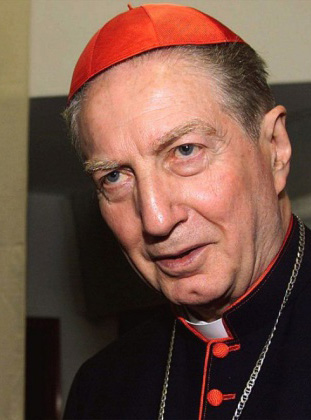 Italian Cardinal Carlo Maria Martini, a renowned biblical scholar and former archbishop of Milan, died Aug. 31 at the age of 85 after a long battle with Parkinson’s disease. After six years in the Holy Land, where he had retired to continue his studies biblical scholar, in 2008 he returned to Italy and was treated at Gallarate for Parkinson’s disease that affected him for 16 years. However he continued his work and released several books and until recently held a column in the newspaper “Il Corriere della Sera” of Milan. In last June, Pope Benedict XVI met him in private during his visit in the Archdiocese.
Born in Orbassano, near Turin, Italy, Feb. 15, 1927, Carlo Maria Martini entered the Society of Jesus in 1944, was ordained a priest July 13, 1952, and took his final vows as a Jesuit in 1962. The cardinal, a biblical scholar, never held a parish post. With doctorates in theology and biblical studies, he was a seminary professor in Chieri, Italy, 1958-1961; professor and later rector of the Pontifical Biblical Institute in Rome, 1969-1978; and rector of the Pontifical Gregorian University from July 1978 until his December 1979 appointment to Milan.

This summer has been the first summer after the public presentation of the Ignatian Way in March, and the Jesuit Province of Loyola is enthusiastically taking part in this project. Early in the summer, the Jesuit schools of San Sebastian and Bilbao organized pilgrimage experiences over several days for dozens of students along different parts of the Ignatian Way. The Jesuit Novices of the Novitiate located in San Sebastian also walked the first steps of the Ignatian Way; and so did a group of the “Centro Loyola Joven” of San Sebastian, the youngsters group of the Urban Spirituality Center (you can see them in the photo, in the Sanctuary of Aránzazu) On August, a group of Jesuits and Lay collaborators of the Curia and other Jesuit institutions walked the first part of the pilgrimage.
The Ignatian Way re-creates a pilgrim route commemorating the famous 1522 journey made by Ignatius of Loyola from his home in Loyola to Montserrat and Manresa. Pilgrims along the Camino Ignaciano walk virtually the same route that Ignatius did, pass through many towns that he did, pray at churches where he worshipped, and marvel at the same natural wonders that he saw. More information
Francis Garate was born in Recarte, a village not far from Loyola, in the Basque region of northern Spain in 1857. At the age of 14, after a few years of elementary education, he began work as a domestic servant at the Jesuit college in Orduna before entering the Society of Jesus as a Brother. From 1877-1888 he served as infirmarian and sacristan at the Jesuit college in La Guardia. For the next 40 years he was doorkeeper at the University of Deusto in Bilbao. As doorkeeper. As the first person most people would see on entering the university building he became also effectively receptionist, public relations officer, student counsellor and benefactor of the poor. He was noted by all for his innate goodness, humility, and prayerfulness. He has been called a “modern Alphonsus” because his Jesuit life reflected that of another doorkeeper, St Alphonsus Rodriguez SJ.

He died on 9 September 1929 (the feast of fellow Jesuit, Peter Claver) and was beatified by Pope John Paul II in 1985.
Blessed Francis is remembered for his outstanding charity, courtesy, and dedication to work.
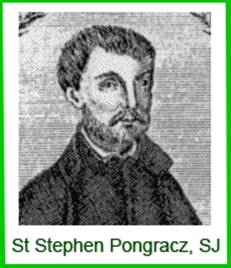
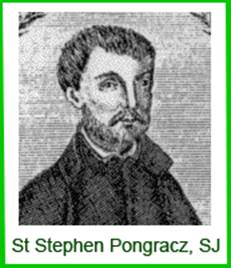
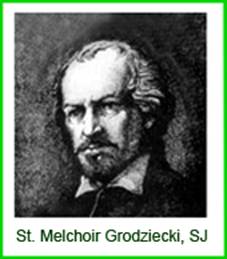
Today we remember three priests who died heroically for their faith, two of whom – Stephen Pongracz and Melchior Grodziecki – were Jesuits and one – Mark Krizevcanin – a diocesan priest.
Stephen was born in Transylvania, in central Romania, about the year 1582 and entered the Jesuits in 1602.
Melchior was born into the Polish aristocracy in Grodiec, near Cieszyn in Silesia, Poland, about 1584 and entered the Jesuits in 1603. He met his companion, Stephen Pongrácz, in the Jesuit novitiate at Brno in 1603.
Stephen could have lived an honourable pleasant life in his native Transylvania, but chose to
preach the Gospel in Prague, eastern Slovakia.
Mark was born in Krizevci in Croatia and did his studies in Graz and in Rome at the Germanicum and Hungaricum. After his ordination he returned to his homeland and served in the Zagreb diocese until he was put in charge of the seminary Trnava, Slovakia. Later, his former professor, Cardinal Pazmany, invited him to the Esztergom Archdiocese in Hungary and entrusted him with the very responsible task of the administration of the seminary and the training of future priests.
In 1619 both Jesuits were sent to the Kosice region (then in Hungary) to care for the religious needs of Catholics living in that Calvinist-dominated region. The king of Hungary had requested the services of Jesuits to care for Roman Catholics neglected during the 30 Years War of the early 17th century. At that time Kosice was a stronghold of Hungarian Calvinists, and the few Catholics who lived in the city and its outlying districts had been without a priest for some time.
Pongracz worked with Hungarians, while Grodziecki evangelised Slavic- and German-speaking peoples. Their ministries were so successful that they became targets of Calvinist antagonism.
Wanting to take advantage of Hungary’s involvement in the Thirty Years War, Gabriel Bethlen, a Calvinist prince in Transylvania tried to expand his own territory.
When the Calvinist Minister heard the Jesuits had arrived in Kosice, he sent his soldiers to arrest them. On news that the Protestant army was marching on the city, the two Jesuits who had been working in small towns returned to Kosice, where they were joined by the diocesan priest Mark Krizevcanin, who was then administrator of the nearby Szeplak Abbey and a canon in Kosice Cathedral.
In July 1619 the Catholics were accused of intentionally causing a fire. The commander of the Calvinist Armed Guard, Juraj Rakoczy, entered the city with the army on 5 September 1619 and on 7 September had all three Catholic priests thrown into a dungeon. They were urged to repudiate their faith in the Successor of St. Peter, stop being “papists” and become Calvinists.
When the priests refused to do so, the soldiers began beating Mark, stabbing him, crushing his fingers and rubbing flaming torches into his side. Finally they beheaded him.
Stephen Pongrácz was tortured next, with the soldiers twisting a rope around his head and almost crushing it. They hung him from the ceiling and cut him deeply before finally turning to Melchior Grodziecki who was beaten and beheaded. The soldiers threw the three bodies into a sewer ditch outside the house but Stephen Pongrácz did not die for another 20 hours.
The news of their martyrdom spread with the speed of lightning but Prince Bethlen did not want to allow the martyrs to be buried with dignity. Only after six months was the Countess Katarina Palffy allowed to bury them with his permission. Today, their graves are in the Ursuline church in Trnava.
21st Week in Ordinary Time
22nd Week in Ordinary Time
23rd Week in Ordinary Time
SS Laurent Imbert, Jacques Chastan, (Penang College General Fathers), & SS Andrew Kim Tae-gon, Priest, & Comps, Martyrs
24th Week in Ordinary Time
25th Week in Ordinary Time
26th Week in Ordinary Time


by Paul Brian Campbell, SJ
The devotee knelt to be initiated into discipleship. The guru whispered the sacred mantra into his ear, warning him not to reveal it to anyone.
“What will happen if I do?” asked the devotee.
Said the guru, “Anyone you reveal the mantra to will be liberated from the bondage of ignorance and suffering, but you yourself will be excluded from discipleship and suffer damnation.”
No sooner had he heard those words, than the devotee rushed to the marketplace, collected a large crowd around him, and repeated the sacred mantra for all to hear.
The disciples later reported this to the guru and demanded that the man be expelled from the monastery for his disobedience.
The guru smiled and said, “He has no need of anything I can teach. His action has shown him to be a guru in his own right.”
by Jim Manney
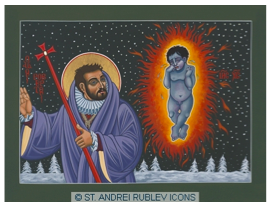
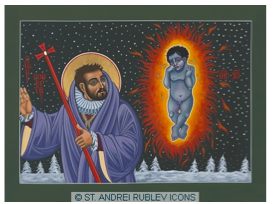
The latest edition of our occasional Best Ignatian Songs feature is a complete novelty. It’s the poem “The Burning Babe,” by St. Robert Southwell, SJ set to music and performed by the British rocker Sting. The poem describes a vision of Christ on Christmas Day. It’s best to read the poem while listening to the music, so here it is:
As I in hoary winter’s night stood shivering in the snow,
Surprised I was with sudden heat which made my heart to glow ;
And lifting up a fearful eye to view what fire was near,
A pretty babe all burning bright did in the air appear ;
Who, scorchëd with excessive heat, such floods of tears did shed
As though his floods should quench his flames which with his tears were fed.
Alas, quoth he, but newly born in fiery heats I fry,
Yet none approach to warm their hearts or feel my fire but I !
My faultless breast the furnace is, the fuel wounding thorns,
Love is the fire, and sighs the smoke, the ashes shame and scorns ;
The fuel justice layeth on, and mercy blows the coals,
The metal in this furnace wrought are men’s defilëd souls,
For which, as now on fire I am to work them to their good,
So will I melt into a bath to wash them in my blood.
With this he vanished out of sight and swiftly shrunk away,
And straight I callëd unto mind that it was Christmas day.
by AsiaNews
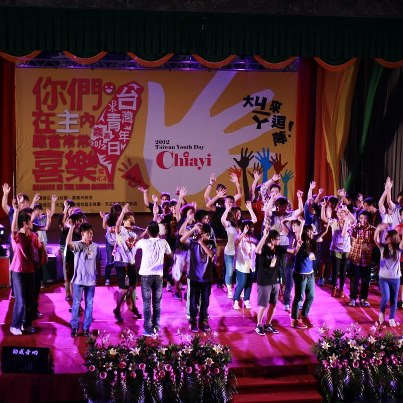
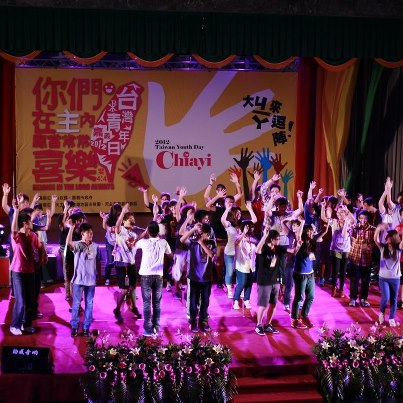
Today in Taiwan the school year began for all students. Young Catholics will greet classmates and share with them the experience that they have just had during the seventh national Youth Day, held in Chayi August 23 to 27.
This year’s theme was “Rejoice in the Lord always!” (你們在主內應當常常喜樂), a phrase taken from the letter to the Philippians, chapter four. In the five-day meeting, more than 300 young people from parishes, schools and Catholic movements throughout Taiwan were able to enrich their faith through sharing. The bishops of the island were present along with many priests and religious. The vigil of reconciliation during the late evening and the rich and emotional final Eucharistic celebration were the high points of the meeting, giving all present a strong sense of hope and the desire to continue to build a community of joyful faith around the message of Jesus
The Church of Taiwan is also preparing to celebrate this weekend, on 1 September in Kaohsiung, the funeral of Cardinal Shan Kuo-hsi, and the young faithful of the island have decided to pick up the baton from where he left off.
The first national Youth Day in Taiwan was organized in 2004 by a group of young Catholics who had participated in the previous World Youth Days and asked the bishops for something similar for Taiwan. Since then, the national Youth Day is organized in turn by one of the seven dioceses of the island.
Since 2004 seven days have been held, with different themes: “Walk toward God, walking towards love” (向主走, 向愛走 – 2004, Nantou), “Love one another as I have loved you” (就如我愛了你們, 你們應當彼此相愛 – 2007, Tainan), “Receive the power of the Spirit to be my witnesses” (領受聖神的德能, 為主作證 – 2008, Taipei), “Youth, stand up! Be the hope of Taiwan: My thoughts, my words, my walk with Christ “(年輕人 ‧ 站出來 ‧ 讓臺灣 ‧ 有希望 – 我思, 我言, 我行跟耶穌 – 2009, Taichung ), “Good Teacher, what must I do to inherit eternal life?” (善師, 為承受 永生, 我該做什麼? – 2010, Hsinchu), “Love and communion renew all things in Christ” (愛 ‧ 融合 – 在耶穌基督內 重建一切 – 2011, Kaohsiung).
Since Hsinchu 2010, the organization has also provided hospitality to participants in among local families, allowing a more personal and engaging experience in the annual event.
During the opening Mass of 2010, the Vatican Nuncio to Taiwain, Msgr. Paul Russell, proclaimed: “Some say that the church in Taiwan is old, but I tell you, seeing so many of you, that the church of Taiwan is really young. ” His words were met with a standing ovation. And since then, the Facebook page entitled “臺灣青年日 Taiwan Youth Day” has overflowed with comments and shares, with references to other blogs of young Catholics in Taiwan in a network that helps them to keep in touch and be informed of new initiatives and enrich their mutual friendship.

The Trinity has never been easy to explain in plain speech. From the first gestures toward Trinitarian theology in the early Church, this Christian doctrine has been mysterious and figural. Already in the first century, the Trinity was expressed ritually in baptism – indeed, I think that’s probably where the doctrine emerged – but performing a ritual and explaining a concept are entirely different tasks.
Nevertheless, the great theologians of the first four centuries each tried out different analogies, metaphors, and images to aid understanding. Some of these attempts did not catch on and have been forgotten. Others have stood the test of time, such that they ceased to be regarded as figural. In addition to Father-Son-Spirit, the other famous Trinitarian expressions drew from examples either natural or scriptural – or preferably both. At their best, they can express the mysteries of distinction-in-unity and dynamic unchangeability. The imagery of firelight (radiance, refulgence, sun-light-warmth) and water (fountain-stream) were popular, as were the concepts of procession or emanation (which captures the essence of both light and water imagery).
On today’s feast of St. Ignatius Loyola, let us recall the Trinitarian figure that enraptured him, recorded in the Reminiscences (section 28). Ignatius was pondering his own practice of praying to the three persons of the Trinity separately and wondering whether this was proper, until one day…
… while praying the office of Our Lady on the steps of [a] monastery, his understanding began to be raised up, in that he was seeing the Most Holy Trinity in the form of three musical keys (en figura de tres teclas), and this with so many tears and so many sobs that he could not control himself. And on walking that morning in a procession which was leaving from there, at no point could he restrain his tears until the mealtime, nor after the meal could he stop talking, only about the Most Holy Trinity … (trans. Munitiz and Endean, modified)
For Ignatius, the Trinity was captured best in the figure of a musical triad, the most common type of chord in Western music. But what was so arresting about this image? Why did it work better than others he had learned? Some reflection on 16th-century sacred music can help us to approach answers to those questions.
In 1522, when Ignatius had this insight, sacred music was primarily sung a cappella or played on an organ with just intonation. The use of equal temperament in keyboard tuning was not popularized until Bach’s “well-tempered Klavier” much later, and so Ignatius would have heard musical intervals at their naturally occurring wavelengths. When we combine the practice of just intonation with the fact that most sacred choral singing was done by men, we get a much clearer sense of Ignatius’s musical experience. In short, Ignatius was used to hearing overtones.
The resonances of human vocal cords produce waves besides the fundamental pitch being sung. A well-trained singer can produce higher-frequency upper partials or harmonics, which sound like quiet, ethereal whistles or flutes that alight above the fundamental pitches. These overtones are difficult or impossible for us to hear when the fundamentals are produced by women’s voices, since they are beyond the upper range of our auditory spectrum. But men’s voices, especially when singing justly intoned fifths or triads, can and should produce overtones as often they sing. (In American usage, overtones are thus often associated with men’s “glee clubs” or “barbershop” groups.)
I recall many times in my life as a choral singer when a few of us would practice intonation by trying to produce overtones. Resonant spaces, such as stairwells and stone cathedrals, afford ample opportunities for experimenting with the overtone sequence. I would say that I had not experienced the full beauty of choral music – and the mysteriousness of audible waves – until the first time I stood rapt by the faint sounds that floated above a perfectly tuned triad of men’s voices. High flute-like tones were undeniably audible, although none of us were (intentionally) singing them. I knew that the overtones were resonating back to me off the high walls, but it seemed also as if they were immediately present or even inside of my head. Overtones sound as if they happen in the midst of the group; they are often felt more than they are heard.
The musical triad, then, is a fitting figure for the Trinity. It embodies distinction-in-unity and dynamic unchangeability. What is more, a triad is a trinity that emanates more being. In the second and third centuries, the “light from light” figure – enshrined in the fourth-century creeds – captured the concept of undiminished giving, how a flame could give rise to another flame without itself being diminished. But the musical triad might capture that concept even more aptly: it is the triad’s very self-relationality which generates the overtone sequence. In other words, a musical trinity is a creator, or a begetter.
St. Ignatius of Loyola was a mystic and could justifiably be said to have been “hearing things” that others did not. In the case of the tres teclas, though, he was hearing things that were really there for every well-attuned ear. He heard the Trinity as a justly intoned musical triad, a relationship which through its harmony emanated other notes in a procession of audible light.
by AsiaNews

Taipei (AsiaNews) – Since yesterday evening all news programs have spoken of little else, other than the Cardinal of Taiwan, Paul Shan Kuo-Hsi (單國壐樞機主教) who died yesterday afternoon, Wednesday, August 22, 2012. Today, his photo appeared on the front page of all the major newspapers of the island, with many feature articles on the inside pages. President Ma Ying-jiou (馬英九總統) and many people of politics, culture and education have provided abundant and touching interviews about him.
In addition to the “people of importance,” even the “simple people” have a great memory of him. JI had only left the house when an elderly lady, seeing his photo on the newspaper that I was carrying under my arm said, “the cardinal did so much for Taiwan.” A Monk from a local Buddhist temple adds more details: “He always cared for and was involved in the cause of interreligious dialogue, becoming a constant reference point in Taiwan, and the Chinese world in general. Here in Taiwan his work with Buddhist Masters Xingyun (佛教星雲法師) and Sheng-yen (佛教聖嚴法師) was appreciated by all, it helped us a lot and he in turn received a lot of help, for example in the construction of the Mount of Beatitudes (真福山) in Kaohsiung. “
In fact through his work with lay Christians and with many friends belonging to different religions, he vigorously fought in defense of the weakest in society, starting with the aboriginal tribes of Taiwan and the poorest workers. “I remember when he was bishop of Hualian and Kaohsiung then, he offered many scholarships to young Aboriginal priests to encourage them to deepen their formation in Europe,” says, father Rao, pastor of Holy Family in Taipei, still deeply moved.
He was very active in the media and at the end of the seventies he was president of Kuangchi Program Service (光啟社) Taipei’s television production service, which boosted educational programs for children and young people, characterized by a strong commitment to make visible the poverty and social injustices of the time. Mr. Chen, now retired, was the artistic director of two major programs when then Fr. Shan began as a television director. “Poor him, he came straight from school, he was director of St. Ignatius High School here in Taipei, and knew nothing about television!” moved Mr. Chen said. “The same day he arrived I went into his office with a brick, a simple brick like the ones we use to build walls, and I put it on his desk asking, ‘What is this?’ and he said, ‘a brick’. ‘Only a brick?’ I asked him, and he said: ‘I understand, you need a new TV studio!’, ‘No!’ I almost yelled at him, poor man, ‘this brick can inspire thousand stories here in TV what you need most is creativity!.’ And what struck me then was his humility, in fact, the following year, he agreed to go to England for a specialization course on television production. Plus we built the new television studio, travelling all over Europe to gather the necessary funds. He also learned to use simple language, accessible to the people, abandoning the exclusively cultural terminologies that he had acquired working in schools. “
Father Jerry (丁松筠神父) well known in Taiwan and China through his television programs, confirms as much: “I think those years here with us had a huge influence on him, since then he has always been very friendly with the media in general and urged other bishops to do the same! I remember for example that on the occasion of the death of Mother Teresa we were the only two from the Catholic world, to offer testimonials and comments to the Chinese-language media about the life and mission of this great woman. He was a bit ‘disappointed by the lack of participation of his colleagues:’ I encourage them to be more constructive ‘ he repeated that to me often at the time”.
Fr. Jerry points out “the extraordinary visibility among the common people that the Cardinal reached after hearing about being sick.” Five years ago he was diagnosed with lung cancer. Rather than allowing this to get him down or morally defeat him it was the beginning of another fruitful part of his life. Recently, in a conversation between friends, he recognized that the disease had allowed him in the past five years, to meet people of different religious beliefs and from many different backgrounds, even more than in the previous 50 years.
The book entitled “huo chu ai (活出愛)” was published in 2009 and is an encouragement to readers “to give life and love.” In it he talks about his experience as a cancer patient, which made him even more known and loved. Since then he has given many workshops and conferences to bring his witness. In another book called “gao bie sheng ming zhi lu” (告別生命之旅) in which he speaks about his “path of farewell to life” after learning the diagnosis from doctors, and his returning to the conditionof a child. First on a physical level, then in his having to depend on others for everything.
In his reflections he overturns the question: “Why is this happening to me?” to “Why should not it happen to me?” in seeing his disease as an opportunity and a gift from God, which allowed him to open up to others feeling himself as “a friend to all” as a result of his own physical weakness. This is undoubtedly the most precious spiritual heritage that Cardinal Shan Kuo-Hsi leaves the young people of Taiwan.