

Author: cfliao

by John Looby SJ
Would receiving a letter from an old friend change your day? I remember someone once telling me how receiving such a letter brought a special blessing on his day. However sceptical I may have been then that receiving a letter might have such an effect, I remembered it recently when a letter came out of the past and my day was blessed indeed. He had been a pupil of mine for only one year close on forty years ago. He was quite clear about what I had taught him, and I could remember it well.
Now he finds his own sons studying almost exactly the same material, and realising how much that introduction to literature has meant to him over the years, he writes to me to thank me. You wonder how it happened that it meant so much to him, and not to many others. But then maybe it did. But why does he write to me now to tell me? Why does he bring a blessing on my day?
You will remember the parable of the sower who went out sowing seed. He seemed to waste a lot of seed scattering it on places where nothing could grow, but some fell on good soil and produced a great crop. Now Christ was telling his disciples that when they went out preaching a lot of what they would speak would be wasted, but some of it would be heard and believed. The point of the parable was that it wasn’t the efforts of the disciples that made the difference, but what God’s Spirit did through them. That is what brought the blessing on them that day.
Most people never realise the Spirit can speak through them: writing that letter, making a phone call, telling someone what they often thought of telling them but somehow never got around to telling them. Telling them what a difference they made to them at some time in their lives, maybe even years ago.
There is one particular moment when the Spirit will speak through you, and it is when you are with someone close to you who is dying. I remember I had just anointed a woman who had been in a coma for a few days and was almost at the point of death, when she suddenly became fully conscious and recognised those who were around her bed. Most of the family were overcome with emotion, but a daughter took her hand and told her how much they loved her. The old lady smiled beatifically and with that blessing went to meet her God.
Appointments
Pope Benedict XVI has appointed:
– Mgr Pedro Ricardo Barreto Jimeno S.J., archbishop of Huancayo (Perù), member of the Pontifical Council for Justice and Peace. Mgr Barreto was born in 1944, entered the Society of Jesus in 1961, was ordained a priest in 1971 and consecrated bishop in 2002.
– Fr. Felix Körner S.J. (GER), professor of the theology of religions at the Pontifical Gregorian University in Rome, as consultor of the Commission for Religious Relations with Muslims within the Pontifical Council for Inter-religious Dialogue. Father Körner was born 1963, entered the Society of Jesus in 1985 and was ordained a priest in 1995.
From the Provinces

AUSTRALIA: The Missionary History
The internet is providing opportunities for organizations such as the Jesuits to make publicly available material that previously might only have resided in archival collections. The Irish Jesuits’ online archive, containing records of their history from 1575 to 1980, now also features a collection of materials on the Australian Mission. The collection, which contains photographs of the first Jesuit churches and schools, a will, several letters regarding the mission and its work, maps and advertisements, gives an account of the mission’s history from 1865 to 1931. Frs William Lentaigne and William Kelly were the first Irish Jesuits to arrive in Australia in 1865, following the arrival of the Austrians in 1848. The Irish began their work immediately to establish a vibrant Catholic community and system of education, when they opened schools in Melbourne and Sydney. The Austrian and Irish missions merged in 1901, and the work continued. Australia became a vice-Province in 1931, and a Province in 1950, with Fr Austin Kelly as its first Provincial. Fr Kelly helped establish university colleges around Australia, as well as the Australian mission in India. The archival collection is available onhttp://www.flickr.com/photos/jesuitsireland/sets/72157626090480847/.
CANADA: A New Website
Canadian Jesuits International (CJI) has launched its new website atwww.canadianjesuitsinternational.ca The colourful new site showcases CJI, its educational advocacy in Canada, and the work of its partners overseas. There are feature articles, news, testimonies, updated country profiles, videos and other resources. The site holds invitations too: visitors can pray, volunteer, learn and read about social justice issues, and they may make donations as well. The site is uncluttered and easy to navigate. Seamless integration with social media featured on the site will help CJI widen its audiences and significantly improve its online presence. The inaugural home page features a tribute to the late Fr Jim Webb SJ, former Provincial of the Jesuits in English Canada. There are also a report and videos of the talks given in Toronto by Fr Agbonkhianmeghe E. Orobator SJ, the Provincial of Eastern Africa, who is a noted theologian.
CHINA: A Museum for Matteo Ricci
A museum dedicated to Jesuit missionary Matteo Ricci has recently been set up in China. It is located in Zhao Qing, a city of Guangdong province, where Matteo Ricci with his companion Fr Michele Ruggeri arrived in 1583, when they set foot on mainland China for the first time. The official and complete name of the museum is: “Museum of the Exchange between China and the West by Matteo Ricci”. It is located near Xian Hua Si (the temple of the flowers of the saints), the first church, dedicated to the Virgin Mary, built by Matteo Ricci in China. Besides manuscripts, clothing and astronomical instruments, the museum displays objects and photographs associated with other missionaries.
COLOMBIA: Meeting of Latin American Socii
The Socii of the Provincials of Latin America and the Caribbean met from the 24th to the 29th September in Bogotá, Colombia. The Socii of Ecuador and Puerto Rico were not able to attend. The representatives of the General Curia were Fr Ignacio Echarte, the Secretary General of the Society, and Fr Benjamin Crespo, Secretary of both Latin American Assistancies. Colombian, Fr Fernando Mendoza, who will be the new assistant to the Attorney General, was also present. The secretaries who came from Rome spoke about the General Curia (its work, practical themes, various issues), using the web page of the Curia itself. The issues they raised centered on the database of the Society, correspondence, statistics, Practica Quaedam, and the universal catalogue. The secretary for CPAL (the Conference of Latin American Provincials), Fr Miguel Zaldua, from the Venezuela Province, spoke about CPAL and its mission. Fr José Adolfo González, the former Provincial of Colombia, and Fr Luiz Fernando Klein, Socius to the Provincial of Brazil, focused on the work of the Socius as the first collaborator, consultant and admonitor of the Provincial, as well as on his relationship with the Provincial himself and with the Province. This second meeting of the Socii of CPAL (the first one was held in 2007 in Rio de Janeiro) provided a clearer understanding of both the General Curia in Rome and CPAL. It strengthened the sense of inter-provincial collaboration, and of commitment to the realization of the Common Apostolic Project of the Society of Jesus in Latin America and the Caribbean.
ITALY: Conference on Cristophorus Clavius
Jesuit Fr Cristophorus Clavius, one of the teachers of Matteo Ricci at the Roman College, is often called the “second Euclid”. This year we mark the 400thanniversary of his death. To celebrate the occasion, the Pontifical Gregorian University has organized, on 19th October, a day of study on the astronomer. The title of the conference is: “Christophorus Clavius (1538-1612) at the Threshold of Science: his Teaching and his Networks.” Clavius is widely known and respected as the outstanding mathematician of the pontifical commission which reformed the calendar, known today as the Gregorian Calendar. Clavius epitomizes perhaps the best example of the dialogue between science and faith. During the conference, a number of digital items, drawn from the Historical Archives of the Gregorian, will be presented in collaboration with Fondazione Rinascimento Digitale and the National Council for Research (CNR).
MICRONESIA: Jesuits in Video Series
Jesuits in Micronesia is a video series on the Jesuits of the New York Province who minister throughout the many islands in the Pacific. It made its debut this September. The series consists of an introductory episode, followed by five others. Jesuits in Micronesia: An Introduction, is about the history of the New York Province Jesuits in Micronesia, and it presents an overview of their work today. The first episode, on Faith & Spirituality in Action, concerns some of the Jesuits who serve in the parishes and schools on the islands of Yap and Chuuk. The second episode is on Jesuits in Formation: two Jesuit novices, who work at Yap Catholic High School and Xavier High School on Chuuk, discuss their faith and experiences. In episode three, on Preparing Tomorrow’s Leaders, you will learn about Jesuits and their lay collaborators as they prepare a new site for Yap Catholic High School. Also featured are those who are preparing young men and women to serve others at Xavier High School, as well as Jesuits who work in some of the parishes of the region as they provide spiritual guidance and the sacraments. For more information on the history and culture of Micronesia, and the Jesuits’ presence on the various islands, visit the Micronesian Seminar website at http://www.micsem.org/
SPAIN: One Province in 2014
At the suggestion of the Jesuit Provincials of the five Provinces of the Society of Jesus in Spain, Father General, Adolfo Nicolás, has approved setting the definitive integration of them all to 2014 instead of 2016. That is when the new “Province of Spain” will be born. The current five Provincials of Aragon, Andalusia, Castilla, Loyola and Tarragona, and the Provincial of Spain, Francisco José Ruiz Pérez SJ, recently proposed to Father General the desirability of this development. For them, “it need not be necessary that the diverse transformations be fully fulfilled to unite our five Provinces. Some of these changes will have to be extended and completed in the early phases of the Province of Spain.” The decisions of recent years “suggest that we should not unduly delay the passage of the moment of integration.” “Setting a deadline for this final phase will activate the energies in the direction of greater decision-making. The Provincials would then have a clearer calendar of governance and clearer foresight to plan more steps which are still unavoidable. ” Father General, in his letter dated 21 September 2012, has accepted this proposal and offers to the Provincials his “full support to the proposal to consider the year 2014 as the time of the creation of the unified Province and the appointment of a Provincial.” The two years that lie ahead will involve, on the one hand, the consolidation of the choices made so far and, on the other hand, will provide space for the development of other very important options that have been part of the preparation. In both cases, affirm the Provincials, “2014 is sufficiently close enough to indicate to us as Jesuits and as Provinces that our common future will soon become our present in our shared lives and in our vocation.”
USA: Review for Religious Online
Review for Religious, a journal published by the Missouri Province Jesuits from 1942 through January 2012, has made its complete archives available online. The collection documents the dramatic changes that have taken place in religious life over a span of 70 years. The journal published articles of interest for women and men religious across the spectrum of religious life, from active apostolic communities to contemplative monastic communities. Articles covered a range of topics pertinent to religious life, including prayer and spirituality, current best practices and canonical guidelines. The digital archives provide a unique window into religious life during the 30 years leading up to Vatican II, and document the impact the Council has had on religious communities during the 40 years that followed. Browse the archives here:http://cdm.slu.edu/cdm/landingpage/collection/rfr
VATICAN CITY: Ratzinger Prize to a Jesuit and a Layman
An American Jesuit theologian, Fr Brian E Daley, and a French layman and scholar, Rémi Brague, are the winners of Ratzinger Prize 2012, awarded by “Joseph Ratzinger-Benedict XVI Foundation”: in its own way, this prize can be seen as the “Nobel” for theology. Rémi Brague, born in 1947, is married and the father of 4 children. He is emeritus professor of medieval and Arabic Philosophy at the Université Panthéon-Sorbonne (Paris 1), and the professor of philosophy of European religions at the Ludwig Maximilian University in Munich, Bavaria. He studied philosophy and classical languages at the École Normale Supérieure in Paris, and went on to study Hebrew and Arabic later. He taught philosophy for two years at the University of Bourgogne (Dijon), followed by twenty years at the Sorbonne. Fr Brian E Daley has the chair of theology, funded by “Catherine F. Huisking”, at the University of Notre Dame (Indiana, USA). In 1961 he graduated from Fordham University (New York), and later, from 1961 to 1964, he studied ancient history and philosophy at Merton College in Oxford. In 1964, he entered the Society of Jesus.
ZAMBIA: Farmers to Benefit from Training
In a new three-year project by the Kasisi Agricultural Training Centre (KATC), one hundred young farmers in Zambia will successfully complete a course which is focused on sustainable and organic agriculture. Women comprise half the participants in the course. Zambia is one of the world’s poorest countries, where poverty and food insecurity are widespread in both rural and urban areas. The KATC is a farmer-training institution run by the Jesuits in the Chongwe District. It was set up in 1974 by Br Paul Desmarais SJ. In 1990, the Centre changed its emphasis from conventional agriculture to organic, sustainable farming. Thousands of farmers have benefited from the short courses which KATC has offered over the years. The government of Canada, through the International Development Agency (CIDA) and CJI, supports the new project.
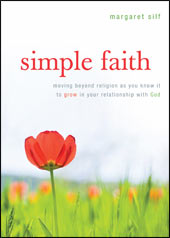

Moving Beyond Religion as You Know It to Grow in Your Relationship with God
Margaret Silf
5 x 7 Paperback
ISBN:978-0-8294-3623-5
Description:
For many people, faith is based on creeds, doctrine, and head knowledge. It’s about mastering the “facts” and making sure you give the “right” answer when any spiritual question is asked. But best-selling author Margaret Silf believes that faith is not about mastery but about mystery, and that living in that mystery allows us to focus much less on religion and much more on relationship–a relationship with the Divine.
In Simple Faith, Silf encourages us to rethink many of the teachings on faith that end up holding us back from experiencing the joy and freedom that a simple faith offers. In short but compelling chapters, Silf provides answers to many important questions of faith: Does life really have meaning? Is it true that God is love? Why do bad things happen to good people? Who is Jesus, and why did he have to die? Is faith really about saving our souls or about spending our lives doing good for others?
Silf’s overall message is very clear–faith is not knowing about God, but coming to know God, and that knowing this God requires us to accept the mystery that is God. For all who struggle with conventional religion, Simple Faith is a simple way to help draw closer to the Divine and find life-changing meaning in a new kind of faith.


by Chris Lowney
Heroic Leadership
I happen to believe that “if you are looking for God, God will find you.” Ignatius of Loyola or Mother Teresa would have likewise believed that even as we are looking, and even when we mostly feel lost, God is somehow finding us, whether or not it feels that way to us. Ignatius believed (as I do) that when we set ourselves toward some worthy purpose that transcends our meager strength, we tap into a source of meaning, strength, peace, and courage that is beyond us. We come to realize, in a graced moment, that we are called to some great purpose, that we cannot do it on our own, but that we don’t have to do it on our own. That’s why Ignatius urges, in one after another of his Spiritual Exercises, that we speak to Jesus “in the way one friend speaks to another.”

by Jim Manney
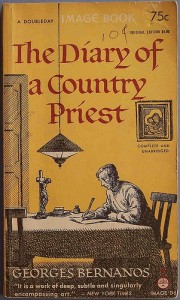
If you like to read novels about priests, Doris Donnelly of John Carroll University has six suggestions.
My book group has read four of the six in recent years. I’d say (and I think my fellow readers in the group would agree) that three of them get an A+: The Power and the Glory, The Diary of a Country Priest, and Death Comes for the Archbishop. The Sparrow, the only one about a Jesuit, is an interesting but uneven science fiction tale. The Innocence of Father Brown is a good suggestion for our group. As for The Thorn Birds — nah, I don’t think so.


by Becky Eldredge
I entered my silent retreat in a frazzled state of exhaustion. The journey of discernment and transition for the last 18 months had zapped me completely dry. I had my doubts that four short days of silence would provide any respite. Silence, however, allows us the space, the time, and the quiet to ask, “God, what are you trying to communicate to me?”
As I meandered for hours along the shore of the lake at Montserrat Jesuit Retreat House, my soul drank deeply of the beauty of God’s surroundings and the constant laboring God does for all of creation. The silence allowed me to notice the world alive with God’s creating power as the waves gently came on shore and as the lake provided homes and sustenance for a wide variety of animals.
I drank deeply of God’s creation, and as I did, I felt the slow return to stillness, to calm, to my inner core where God infinitely resides. As I re-entered that holy space within, I felt the love of our gentle Father reminding me that he has been laboring for me and with me these past 18 months. With that simple grace I was renewed within, and I felt the hum of inner peace that comes only from God.
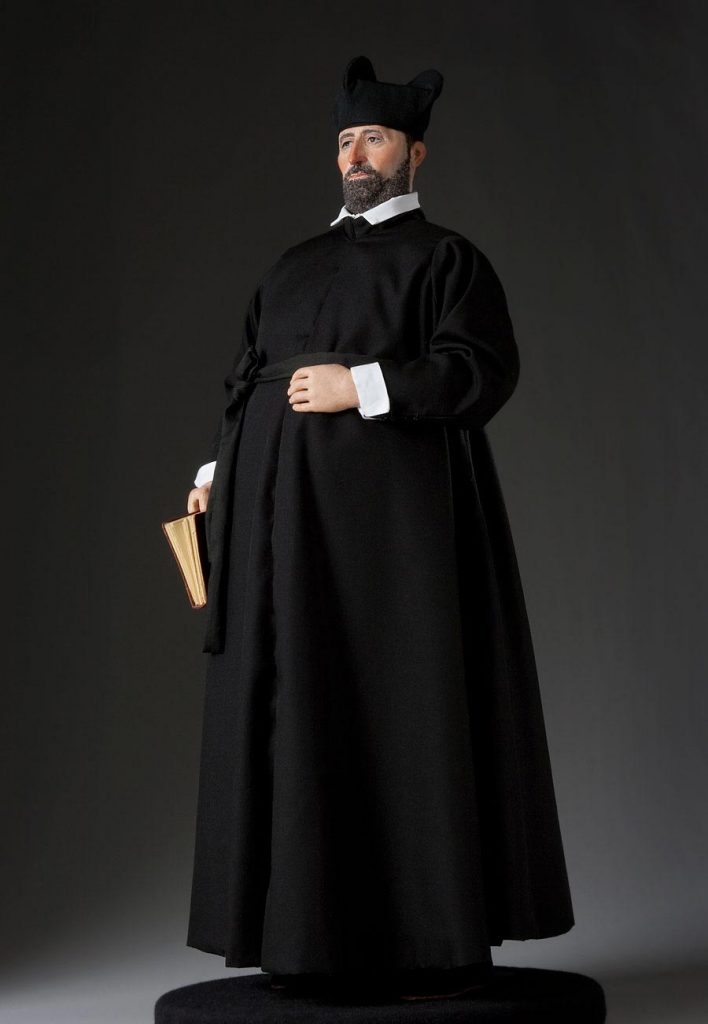

St Francis Borgia, Priest, SJ (Memorial)
Francis Borgia was born in Gandia, Spain, in 1510. He was the eldest son of the Duke of Gandia, great grandson of the notorious Pope Alexander VI (known as the ‘Borgia Pope’) and of King Ferdinand V of Aragon. He received a private education and was presented to the Emperor’s court at the age of 18. In the following year, 1529, he married Leonor de Castro and was made viceroy of Catalonia by the Emperor Charles V. He and Leonor had eight children.
In 1543 he succeeded his father as the fourth Duke of Gandia. Because of problems arising from his attempts to put an end to corruption by legal officials, he retired to his estate. He now devoted his time to the development of his property, including the setting up of a Dominican house and the restoration of a hospital.
His happy family life came to an end when his wife died in 1546. In the following year,1547, he quietly entered the Society of Jesus (Jesuits) and passed the dukedom on to his eldest son, while making provision for the rest of the family, including arranging their marriages. The news of this very distinguished candidate to the Society could not remain a secret for long and, although he tried to down play his social status, his genuine ability could not be hidden.
In 1551 he was ordained a priest. Because of his aristocratic birth, great abilities and wide reputation, he was immediately offered a cardinal’s hat. This he refused, preferring the life of a travelling preacher. However, in 1554 he was made Commissary General for the Jesuits of Spain and Portugal by St Ignatius Loyola, the founder and first superior general of the Jesuits. Here his previous experience of government and administration proved invaluable and he established many colleges and other Jesuit houses.
In 1561 he was called to Rome and in 1565 was elected Superior General of the Jesuits. For the remaining seven years of his life he was so active and effective in governing that he has been called the Society’s second founder. He worked for the reform of Christian life in Europe and set up a new Jesuit province in Poland as well as new colleges in France. He also promoted missionary work in other parts of the world, especially in the Americas. In Rome he was one of the founders of the Roman College (later known as the Gregorian University), he built the church of St. Andrew on the Quirinal as well as initiating the building of the Gesu church. Despite the high status of his office, Francis led a humble life and was widely regarded, even in his own lifetime, as a saint.
When the plague struck Rome in 1566, he organised relief for the poor as well as sending Jesuit priests to take care of the sick in hospital.
In 1571, he accompanied a papal ambassador on a visit to Spain, Portugal, and France, which was very successful. However, under the burden of both sickness and the cares of office, he died on 30 September 1572 soon after his return to Rome but not before giving his blessings to his children and grandchildren. He was 62 years old.
He was canonised by Pope Clement X in 1671.
Francis is remembered for his spirit of prayer and his humility that led him to renounce worldly honours in order to live for Christ alone.

by Paul Lickteig, SJ

I was just ordained a Jesuit Priest. Exactly how this vocation emerged is difficult to describe. Even in a Church that spends most of its time focusing on mystery, people have difficulty making sense of the choice to become a member of the Catholic clergy. I think of the various, surprised “What’s?” of my friends when I told them of my decision to join the Society of Jesus. Having been part of various artistic communities for years made my desire to be a Jesuit priest appear strange at best, polemical at worst. Yet, there it was: I had an undeniable pull to enter a religious order in the Roman Catholic Church.
Vocation is a strange thing. It is the idea that people can be drawn towards a particular way of life. Vocation is partially about the job, but more about the way a person’s choice of work allows something deeper to develop in his or her heart. For many, “the call” comes at the expense of other aspirations. It is a trade-off. We let go of certain impulses and choose to follow other desires, in an oftentimes circuitous route, that we hope will lead towards a deeper awareness of how me might better love and serve humanity.
This desire to love and serve led me to explore a single mystery in a deeper way: GOD. Awareness of the great I AM, the Source of Being (also the source of much debate and even war) was a sensitivity that I had desired to cultivate openly and without distraction for years. It was not that I thought I would find the answer. Rather, I hoped the choice to grapple with the mystery of existence and the human attempt to give voice to those things we call “eternal” would shape me in ways that I had come to admire in others. When I found the Society of Jesus, I found a group of people that were responding to this same mystery in a profound way.
I look to the group that I was ordained with, and I see my own struggle to accept the role of priest reflected in their stories. Their resumes and records of life experiences are extensive. They were, in different lives, medical doctors, the director of a New England think-tank, a political speechwriter, academics, MBA’s, artist’s, school teachers and even an Army Ranger. Of course, lists of accomplishments show little of the struggle that each of us went through to get to the place where we could choose to follow our desire to join the Jesuits. Somehow, in the midst of a culture that is far from supportive of such impulses, we had all found our way into a group that was dedicated to prayer and service lived within vows of poverty, chastity and obedience, Ad Majorem Dei Gloriam.
None of the eighty or so men I originally joined with could have known what was in store for us in the next eleven years of training. Weeks after we entered the Jesuits, the Twin Towers toppled and the U.S. entered a sort of hysteria. Months later, rumors of various sexual “improprieties” began to appear in the news, only to develop, in the coming years, into a horrible description of full-scale sexual abuse and cover-ups that spanned the course of decades. This was only the beginning. The coming years would bring war, natural disasters, political turmoil, religious factionalism, and a terrible economic recession. With each year, my classmates and I would be given new experiences in ministry as a way of preparing us for a deeper awareness of the world’s difficulties, as if we were not already painfully aware.
During those years of training I was asked to work with addicts in the Bronx, go to New Orleans to gut houses, live with tea-garden workers in Northeast India, and take classes in counseling. I taught religion at an all-boys prep school, spent summers in Ecuador learning Spanish and interacting with people of various mountain tribes, built affordable housing in Omaha, and prayed with people on silent retreats. I did restorative justice with the men incarcerated at San Quentin, ministered to the sick and the dying, and took stray classes in business management. I moved from community to community, never staying in one place for more than nine months at a time. In each new home I was asked to interact with the best and worst that humanity has to offer, and somehow find the grace of God thread through it all.
Ultimately, this is the purpose of Jesuit training: to find Christ in all things. Rather than fleeing from the world and finding Christ in the quiet of our own private meditations, we seek to name the Incarnation, the eternal God being revealed in all of our lives every day. We engage the existential difficulties of humanity not only in an academic way, but in the lives of the people that we meet, minister to, and minister with. Somehow in that place of conflict and uncertainty, we all learn to name the truth of the Spirit that gives us life and calls us all towards a greater embodiment of compassion and patience in a tumultuous world.
Looking back, I am not exactly sure how any of us made it to ordination. For each of us, though, there was something in the commitment that we made eleven years ago that would not allow us to forget our “yes” to God and Church. There is something in the faith that we profess that has allowed us to thrive. And while maybe none of us could name what it was that kept us here in a way that all would agree with (thus the old joke “three Jesuits, five opinions”), what I say is that eleven years ago I gave a commitment to continue exploring this great Mystery in a faith that stretches back thousands of years. It is a yes I will continue to follow as this life unfolds mercifully before me.
Index of Shalom October 2012
26th Week in Ordinary Time
27th Week in Ordinary Time
28th Week in Ordinary Time
29th Week in Ordinary Time
30th Week in Ordinary Time
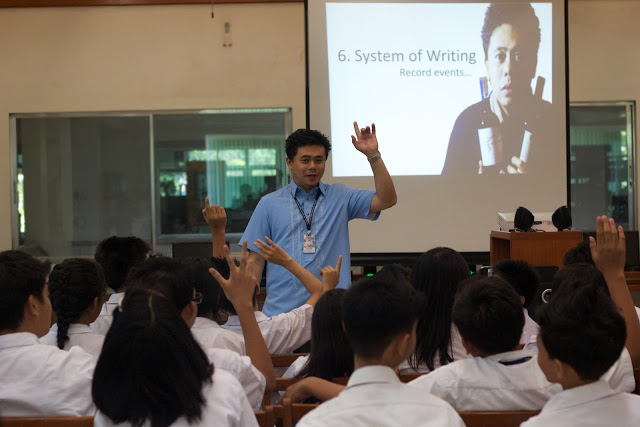

by Jeff Pioquinto,S.J.
Being a teacher and mentor to my students is my greatest consolation. There is no greater consolation that a teacher can get than seeing his students learn and grow as mature individuals. Growing closer to their God, becoming productive citizens of this country, responsible leaders in their community/class and being men and women for others.
Social Studies 2 and Information Technology 1 : Ateneo de Davao University.
“Do not go where the path may lead; go where there is no path and leave a trail.” – RW Emerson