
Author: cfliao
by LOYOLA PRESS on APRIL 2, 2009 James Martin, SJ, has been announced as the winner of the 2009 Writer’s Award in Spirituality. This award is given by the Loyola Institute for Spirituality at the Hearts on Fire Celebration. The Writer’s Award in Spirituality is awarded to a person who demonstrates excellence in furthering the spiritual teachings of St. Ignatius of Loyola through his or her writings. James Martin, SJ, is the author of several Loyola Press books including My Life with the Saints and A Jesuit Off-Broadway. James Martin, SJ, Advises Academy Award Nominated Film by LOYOLA PRESS on APRIL 2, 2009
Based on a play, Doubt is the story of a nun who suspects a priest of abusing a student in 1964. It shows all the characters struggling for truth and peace. The film was nominated for Academy Awards in best actor, best actress, two best supporting actresses, and best screenplay. Doubt was released December 12, 2008 and is currently available on DVD. The Hearts of Fire Celebration is an annual dinner and fundraiser that offers the Loyola Institute for Spirituality a chance to celebrate their ministry and honor contributors. The dinner is April 25, 2009 at the Double Tree Guest Suites at the Anaheim Resort/Convention Center. Along with Fr. Martin’s award, Bishop Gordon Bennet, SJ, will be honored with the Hearts on Fire Award and Mr. and Mrs. Eleuterio and Linda Rodriguez will be honored with the Rosita Diaz Award. For more information about the 2009 Hearts on Fire Celebration, please visit the Loyola Institute for Spirituality’s website.
 James Martin, SJ, author of My Life with Saints, served as an advisor to the Academy Award nominated film Doubt. The film stars Philip Seymour Hoffman, Meryl Streep, and Amy Adams. Fr. Martin has previously worked with Philip Seymour Hoffman in 2005, in the play “The Last Days of Judas Iscariot.” Fr. Martin wrote about that experience in his 2006 title A Jesuit Off-Broadway.
Taipei (Agenzia Fides) – “A leaf that has planted its roots of love here” is the literal translation of the the Chinese name “Ye You-Gen” given to Fr. Stephen Jaschko, Hungarian Jesuit missionary who died at the age of 99 on March 17, after having spent 54 years at the service of the missions in Taiwan. However, nearly his entire life was dedicated to the mission of evangelization in China, with heartfelt and active dedication. In the end, he even donated his body to the Medical Institute at the Catholic University of Fu Ren: a complete self-donation to the Lord. The news of his passing has caused a great sorrow from the Asian continent to Europe, site of his beloved homeland. For a greater love, a love for the missions, he had only returned to his homeland three times in nearly a century of life. The websites across the continent, Catholic and non alike, have reported on the news of his passing with great devotion, also publishing his biography. Both the daily publication Nepszadadsag and the Duna Television Station in Hungary, as well as the media in Taiwan, have given ample coverage on the missionary.
Almost a century ago, Father Jaschko – known to the Chinese as Fr. Ye (meaning “leaf”) – was born in Kosice in Hungary (today part of Slovakia) and became a Jesuit in 1929. He was sent to mainland China in 1936 along with other Hungarian brothers. Forced to leave the mainland in 1954, he began dedicating his life completely to the mission on the island, although never forgetting the mission on the mainland, and supporting it with his prayer. As soon as he could, he began assisting in the Diocese of Han Dan in the foundation of the Si Gao School for disabled, orphaned, or abandoned children. He never stopped thinking and caring for the evangelization of the mainland, the poorest among Chinese children both on the island and the mainland. In Taiwan, he founded the Saint Joseph Special Education Center and the Catholic Social Welfare Foundation in Hua Kuang, which are highly appreciated by the local people. They often considered him more Taiwanese than Hungarian. He was very disciplined in making every effort to save a cent here and there, because, he said, “every cent counts in a charitable work.” Upon his death, the local mass media spoke of his coherence of life as a missionary in comparison to the activity of so many corrupt politicians who send enormous sums of money to foreign nations.
The religious and children at the Si Gao School, in the Diocese of Han Dan, have felt great sorrow upon the loss of their father and founder. In fact, all the children at the school have adopted the same last name as Fr. Ye, because they are all his children. The religious look after the human, spiritual, physical, and medical well-being of the children. Funeral Masses were held by the 4 priests at the school. Many seminarians, religious, and faithful attended and there were also prayer vigils organized for the repose of his soul. (NZ) (Agenzia Fides 25/03/2009)
Father William Sullivan, in his 32 years at Seattle University as president and later chancellor, helped to transform the university. Current SU President Stephen V. Sundborg suggests Sullivan’s work has set it on a course to be the Northwest’s premier independent university.
Special to the Times
FATHER William J. Sullivan follows in the long line of Jesuit missionaries who worked far afield, often for decades, and then were called home when their work was done. This month, after 34 years nurturing and transforming Seattle University, he returns to the Wisconsin Province of Jesuits, in the state where he grew up.
Sullivan served for 20 years as president of Seattle University and another 12 years as chancellor, assisting me, his successor. He purchased a law school, built the internationally acclaimed Chapel of St. Ignatius, righted our university’s financially listing ship, and set it on its present course to be the premier independent university of the Northwest. In appreciation, Seattle University and the Seattle community have proclaimed him the school’s first president emeritus, hosted a reception for the entire campus community, and toasted him at a Rainier Club dinner attended by, among others, Bill Gates, whose wedding to Melinda French was performed by Fr. Sullivan in 1993. The honors were fitting tributes, for in mind, spirit and deed, Fr. Sullivan stands among the greatest generation of the nation’s Jesuit university presidents.
The great generation of American Jesuit higher education is characterized by gracious and articulate priests who led their universities by the strength of their wills and the power of their personalities. They are the symbols of their institutions and first citizens of their communities. Operating before e-mail, they had an individual presence and influence that cannot be replicated in a new era.
Moreover, they took the helm amid a battle to reshape contemporary Jesuit higher education in America. In several remarkable ways, they defined the territory of our colleges and universities and on which we as successor presidents now build. They often served long terms, established governance and boards that serve us well today, forced through balanced budgets and became prodigious fundraisers. Several transformed narrowly focused Catholic colleges into universities embraced and supported by the larger community. They built and modernized ramshackle campuses while developing academic quality, core curricula, scholarship and new programs.
Sullivan was among those who defined the place and purpose of Catholic higher education in American academia, culture and religion, while animating the university with the modern emphases of the Jesuit mission. And like the other great Jesuit presidents, he was a friend-maker, winning by warmth and graciousness a new and enduring cohort of supporters.
The result is a profound set of accomplishments. He expanded, renewed and transformed the campus. He founded the School of Theology and Ministry, a national model of ecumenical and interreligious dialogue. The Chapel of St. Ignatius, as our trustees noted in a proclamation, “today serves as the university’s heart and soul.” He enriched Seattle University’s intellectual climate through a variety of scholarships and, by establishing the Seattle University School of Law, extended SU’s values-based education to the legal community.
Since Sullivan’s presidency, the times and challenges of Jesuit-inspired higher education in America have changed. Enrollments have often doubled, staff and faculty tripled. We have four times as many programs, and the growth of our budgets has been topped by everyone’s expectations for higher education and the sheer complexity our operations.
A Jesuit president’s role has been complicated by a growing list of important issues, including technology, diversity, globalization, regulation, sustainability and greater competition for resources and enrollments. I welcome such changes, which make for a richer, more engaging campus with a breadth of resources and even more connections to our community.
But today’s generation of presidents can no longer put their personal stamp on universities the way Sullivan’s generation did. They had the freedom to act, yes, but that brings with it the challenge and loneliness of acting alone. Sullivan and his generation rose to the challenge with confidence and filled the space with courage. I am in awe of how large-heartedly they responded. In Sullivan’s case, I see an enduring legacy in Seattle University’s thriving campus, first-rate academics and rising prominence. Our city and our region are better for his service.
Stephen V. Sundborg is president of Seattle University.
 |
| Joseph M. McShane, S.J., President of Fordham Photo by Jon Roemer |
On March 30, Fordham University launched the public phase of a far-reaching fundraising campaign in support of new levels of academic excellence at Fordham and greater stature for the University as a nationally prominent center of learning.
Excelsior | Ever Upward | The Campaign for Fordham seeks $500 million to support new facilities, more student scholarships, more endowed faculty chairs and more funding for academic endeavors throughout Fordham’s colleges and schools.
Joseph M. McShane, S.J., president of Fordham, announced the campaign before an audience of more than 900 supporters gathered at the Waldorf-Astoria in Manhattan.
“For 168 years, Fordham has always told its sons and daughters to move beyond the limitations or constraints that they feel hold them back,” Father McShane said. “This night, we return the favor. This night, we pay back this institution that embraced us with faith, nurtured us with love and sent us out into the world with hope. This night, we announce the public kickoff of the most ambitious capital campaign in Fordham’s long and storied history.”
Excelsior | Ever Upward | The Campaign for Fordham seeks new stature for the University by 2016, the 175th anniversary of Fordham’s founding. It comes at a time when the University is climbing sharply in college rankings, gaining more recognition for its academic programs and attracting more of the nation’s top students.
“The campaign for Fordham University will be a transforming experience for this University,” said John Tognino (FCLS ’75), chairman of the Fordham Board of Trustees. “It will be the catalyst to propel us to 2016, when we will be the premier Catholic institution of higher learning in the United States, and it will afford us the opportunity to continue to fulfill our mission, and that is educating men and women of distinction.”
The campaign is more than halfway complete, with $266 million raised. It has been leaving its mark on the University since 2004-during the campaign’s “quiet” phase-in the form of endowed faculty chairs, endowed scholarships and new residence halls being built on the Rose Hill campus.
The campaign has already drawn three gifts of $5 million, four gifts of $7 million and three gifts of $10 million.
The campaign kickoff took place immediately following the Fordham Founder’s Award Dinner, which honored two Fordham benefactors and members of the Board of Trustees-James Buckman (FCRH ’66) and John Kehoe (FCRH ’60, FCLC ’85)-who are also co-chairs of the campaign.
At the event, Father McShane described campaign goals that will bring improvements throughout the University.
Academic support
Half of the money raised by the campaign will fund academic improvements. That includes $150 million for endowed scholarships and endowed professorships and $100 million in support for various academic endeavors: faculty recruitment and retention; research endowments for faculty; funding for Fordham centers and institutes; and support for academic programs such as on-campus living and learning communities and honors programs.
The University seeks more scholarship funding so it can continue to open its doors to the most academically promising students-now, and in future generations, Buckman said.
“I was very fortunate to be able to attend Fordham via scholarships provided to me by the University as well as by other sources. Had I not received that scholarship help, it would have been very difficult for my parents to send me to Fordham,” he said. “We still have a number of students who are in similar situations.”
Another campaign goal is to add 40 endowed chairs, thereby attracting more of the nation’s top scholars while improving the student-to-faculty ratio and allowing faculty more time for research and mentoring students. The increase is also expected to diversify the fields of academic expertise at Fordham and pave the way for innovative, interdisciplinary programs on topics of current interest, Buckman said.
Fordham wants endowed chairs in science education, immigration and refugee studies, interfaith dialogues and environmental science, among other topics with deep resonance in today’s world.
Annual Giving
The University has set a goal of $80 million in annual support that helps meet emergent needs throughout the University. These gifts, frequently matched by corporations and foundations, help keep tuition down and give the University financial flexibility for meeting new funding challenges.
Some annual gifts are unrestricted, allowing them to be used University-wide, while others may be directed to particular colleges and schools to support research, travel to academic conferences, or other academic needs.
Facilities
The University has outgrown its facilities since the last campaign, which was pegged to the 150th anniversary of the University in 1991, Kehoe said.
“In the interim, we have not had a campaign to go and fuel the resources of the University and to continue to build it,” he said.
One major project is a new building for Fordham Law School, widely acknowledged as one of the best law schools in the country. It has 1,500 students in a building designed for 650, and its space per student is less than half the amount offered by the nation’s top 20 law schools.
Other improvements sought for the Lincoln Center campus are a 400-bed residence hall, along with classroom renovations. One campaign goal for the Lincoln Center campus has already been realized-the Veronica Lally Kehoe Studio Theatre, a state-of-the-art facility, dedicated in February, which was made possible by a $2 million gift from Kehoe.
On the Rose Hill campus, the campaign is raising funds for the construction of Campbell, Salice and Conley residence halls, to be built on the southwestern part of campus by 2010. Groundbreaking for Campbell Hall was held last year. The projects are supported by benefactors including Thomas P. Salice (CBA ’82); his wife, Susan Conley Salice (FCRH ’82); Robert E. Campbell (CBA ’55); and his wife, Joan M. Campbell.
A new campus center and a recreation and intercollegiate athletics center will also come to the Rose Hill campus as part of the campaign. The 140,000-square-foot campus center will house campus ministry, student services, a ballroom, a food court and a career planning and placement center, among other features.
The recreation and athletics center-measuring 150,000 square feet-will reconfigure the outmoded Lombardi Memorial Athletic Center and the Rose Hill Gymnasium into a state-of-the-art center for sports and physical fitness.
The facilities projects will cost $170 million.
Kehoe noted that the University already has in place the essential infrastructure of learning-dedicated students and a Jesuit tradition of educational achievement.
“We don’t have the facilities other universities have. But we turn out excellence,” he said.
Apart from the specific improvements being sought, a central part of the campaign is Fordham’s Jesuit identity, with its attention to the full development of each student-intellectual, spiritual and moral-and its emphasis on being men and women for others.
“It’s not just about bricks and mortar, although that’s very important. It’s not just about meeting campaign goals, although that’s very important,” Father McShane said. “It’s really about investing in an institution that has, from its very founding, been all about the work of transforming people, transforming the city, transforming the world and serving God.”
Said Kehoe: “In Fordham, you find not just education, you find a way of being, a way of thinking. There’s love at Fordham. There’s redemption at Fordham. Fordham is a continuing way of life.”
Founded in 1841, Fordham is the Jesuit University of New York, offering exceptional education distinguished by the Jesuit tradition to approximately 14,700 students in its four undergraduate colleges and its six graduate and professional schools. It has residential campuses in the Bronx and Manhattan, a campus in Westchester, and the Louis Calder Center Biological Field Station in Armonk, N.Y.
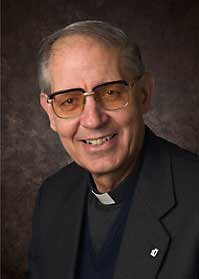
 Assembled for the February Jesuit Conference board meeting in Los Altos, Calif., Superior General Adolfo Nicolás gave the Provincials of the United States and English Canada an update on planning currently underway at the Roman Curia. Father General, in his first stateside visit since his election, shared an outline of five new strategic priorities. Developed during several days of prayer and discussion at a recent Curia retreat, the priorities will be refined and then distributed to the whole Society.
I. Spirituality
Continue to reinvigorate the process of ongoing Spiritual renewal desired by GC 35, nourished in the Spiritual Exercises, at the service of our universal mission and inspired by the best tradition of “Sentire cum Ecclesia,” the right Ignatian attitude towards the hierarchical church as expressed in our Formula Instituti and the Constitutions. This spiritual renewal has to strengthen the triptych: Identity, Community and Mission (GC 35 D2, n.19).
II. Apostolic Discernment
Encourage and focus our ongoing apostolic discernment in order to respond to the new demands of our vocation today, the directions of GC 35 and of the Holy Father. It is a call to the Society in different parts of the world and at every level to discern and chose “those physical and spiritual places” (GC 35 D2 and the Papal Discourse to GC 35) that represent important challenges to the spirit and the proclamation of the Gospel (frontiers). Father General said he is asking “every assistancy to reflect on what they can contribute to the world society.”
This apostolic discernment will require three strategies, among others: the determination of key apostolic frontiers in different regions and at every level of the Society; establishing regular and ongoing processes for initiating, implementing and evaluating the apostolic preferences of the Society, within the horizons of our commitment to faith, justice and dialogue with cultures and religions; and evaluating creatively and courageously all our apostolates in ongoing apostolic planning.
III. Collaboration with Others
The above goals will be impossible without the collaboration of others who share our vision and perspectives regarding the Gospel and Mission. Therefore, we will have to find strategies to develop new and “systematic” forms of collaboration with others in the spirit of Decree 6, n.29 of GC 34. “If we want to think dynamically about our mission and move forward, we must think of others and continue to search for forms of collaboration with laity,” Father General. He cautioned, though, that any systematic approach should “not create a hierarchy among laity.”
IV. Review and Reorganization of the Curia
Review, evaluate and reorganize the General Curia and all its administrative processes for a more agile, flexible and adequate service to the Society and in support of the General in his role as animator of the life and mission of the universal Society (GC 35, D5, n. 7.1). “The Curia is well organized with the experience of 460 years but has little time for reflection and consultation,” Father General said. He seeks to address this through enhanced delegation, simplifying correspondence and other structural changes announced in the coming months.
V. Formation
Give special attention to the challenges that formation presents today to Jesuit superiors and the central government of the Society. Implement directives already developed and officially published. Support programs of initial and ongoing formation in each Conference of Major Superiors that guarantee a solid human, spiritual, intellectual and ecclesial preparation and that equip our men for a better response to the new challenges of our mission as indicated by GC35. Monitor the different stages of formation to help bring to fulfillment the goals of each of the stages and transitions in formation.
“Formation is a time of testing and challenge” said Father General. One that requires “good accompaniment of men through each stage,” he added.
“In Rome, we are at a good moment.”
-Superior General Adolfo Nicolás
After briefing provincials on the strategic discernment, Father General offered a few comments on the current relationship between the Church and the Society. “In Rome, we are at a good moment,” he said. The General added, “Cardinal Levada (Prefect for the Congregation on the Doctrine of the Faith) wants to keep dialogue open … a great willingness for dialogue without judgment or punishment.”
Father General also took time to cite the important and unique role of Jesuit education in America. The “contribution of the United States to the world Society in higher education is exemplary; no other country has 28 colleges and universities,” said the Superior General. He recalled a quote from a friend in Japan commenting about the Jesuit identity of a local school, “it is not what happens in the chapel; when you enter the gate, everything is chapel.”
Father General concluded his remarks with a reminder to keep those less fortunate near our hearts. “Poverty is the wall of religious life; we must not be too far from the regular people.”
CHAD: A School For Semi-Nomadic Children
The Jesuit Refugee Service (JRS) opened a primary school for 94 semi-nomadic children in Chad, in Himede village, near the eastern city of Goz Beida. The school is the result of a close collaboration with the semi-nomadic communities of the area. The communities agree to build the schools with materials at hand and take responsibility for paying their teachers, who are local volunteers and who often have little formal training. For its part, JRS provides training to empower teachers and encourages the establishment of parent-teacher associations to manage the schools. In addition, JRS, in cooperation with UNICEF, distributes school supplies.
CHINA: A Rather Original Complaint
Chinese Catholics have expressed sadness that two bronze animal-head sculptures, designed by an 18th Century Jesuit missionary for Beijing’s Summer Palace, were auctioned off in Paris. The artist was the Italian Brother Giuseppe Castiglione, S.J. (1688-1766), known as Lang Shining to the Chinese. Some Chinese lawyers sent a request to the law courts in the French capital to ban the auction, but the appeal was rejected and the sculptures were sold on February 25 for 14 million € each. A Catholic businessmen from Hebei stated: “Those relics belong to us, and they refused to return them because they are worth a huge amount of money.”
PHILIPPINES: “Vietnam Service” Moves to Vietnam
At the end of 2008 the Vietnam Desk and the Vietnam Service moved from Manila to Ho Chi Minh City, Vietnam. The Service began in 1975 and was, for many years, lead by Jesuit Father Fernando Larrañaga; its mission was to send resources, especially financial ones, to Vietnamese Christians. The decision to transfer services to Vietnam was taken in 2003 by Fr. Adolfo Nicolás, when he was president of the JCEAO (Jesuit Conference of East Asia and Oceania). Father Felipe Gomez, former assistant to Father Larrañaga said: “It is impossible to quantify the services done by Vietnam Service. On education, it granted thousands of scholarship each year, mainly to rural children. Hundreds of sisters and seminarians have been helped yearly in their studies, and thousands of catechists have been regularly sustained. Hundreds of rural schools have been built or repaired. In the socio-economic domain, I do not think it is an exaggeration to say that the wells dug number in the thousands, small bridges built in the hundreds, thousands of farmers have been helped with seeds, fertilizer, and other materials. We financed the construction of many multipurpose buildings which was often the only way to obtain a chapel, rural dispensaries, family homes, and ‘facilities’ for religious Sisters, not to mention the aid to lepers, in form of food, medicines and housing, and other emergency supplies.”
JAPAN: A Film on the Martyrs
The martyrdom of Japanese Christians in the 17th century is the subject of a film being produced by the Italian-American director Martin Scorsese. The film is based on the novel Chinmoku (“Silence”) written by Japanese Catholic writer Endo Shusaku. He describes the persecution suffered by Japanese Christians during Edo period, especially in the Nagasaki region. The novel, written in 1966, tells the story of a Jesuit Portuguese missionary in Japan in early 17th century, during the time of the anti-Christian persecution. The title, “Silence”, harkens back to the silence of God in front of Christ’s cross, and recounts the forced recantation of the faith by the missionary after enduring horrendous torture. The books of Endo Shusaku reflect his special research of Christianity in the oriental culture, and present his particular vision of human fragility, sin and grace. The announcement of the film comes shortly after the beatification of 188 Christian martyrs of that period. That event took place on the 24th of November 2008. According to Japanese bishops, this event represented a milestone for the history Japan where the Christian religion had been prohibited for centuries. Shooting will begin around the end of the year in New Zealand.
SPAIN: Pilgrimage to Xavier Castle
On the 8th of March, thousands of pilgrims participated in the annual march to the Xavier Castle, in Navarra. Most pilgrims walked the final eight kilometers as a remembrance of the Via Crucis. Following his arrival at the Sanctuary, the Eucharist was presided over by Mons. Francisco Pérez González, Archbishop of Pamplona-Tudela. At the beginning of the ceremony, the Archbishop read a message sent by the Secretary of State Cardinal Tarcisio Bertone in the name of the Holy Father; in it the Pope exhorted everyone to live the faith in imitation of Saint Francis Xavier in order to bring the evangelical message to the whole world. Mons. Pérez González, after reading the message, added that every time he met him, the Pope expressed is fondness and devotion to e Xavier Castle, which he knows personally. In the homily, focused on the missionary vocation of every faithful, Mons. Pérez stated that a Christian is a citizen of this world who offers a message of hope to everybody. In spite of the bad weather, there were a total of 8,000 participants. An even greater number took part to the second march, on the 14th March.
—————————–
For further information: Fr. Giuseppe Bellucci
Jesuit Press and Information Office, Borgo S. Spirito 4, 00193 Roma, Italy
Tel. +39-06-68977289 – [email protected]
In the last edition of the Electronic Information Service we reported on the first portion of Father General’s trip to India; we now present the second half. Father Nicolás went to Goa where he experienced a most moving celebration of Mass at the altar of St. Francis Xavier. In his homily, Father General said how deeply touched he was to “celebrate the Eucharist at the altar of Saint Francis Xavier, with his body behind me and today’s Jesuits in front of me.” The homily focused on the heart, “in Asia, people want to see, and if our preaching does not touch the heart and does not show itself in actions and in behaviors, words have no efficacy.” After a short stop in Mumbai visiting the Jesuits, Father General returned to Rome. When he was back, I asked him two short questions. We present his responses and offer our wholehearted thanks for his availability.
What are your impressions about the Society after this first trip to India?
India continues to challenge any simplistic effort at easy classification. The variety of peoples, cultures, traditions, styles, etc. is so great that one cannot but admire the ease and naturalness with which people live side by side. It is the kind of naturalness that one would expect from very mature and experienced communities.
The Jesuits share in this multi-cultural life, with the advantage that the underlying social or caste distinctions are practically invisible, even if realism encourages us to think that they are not totally and definitely absent. Christian or human maturity is never the fruit of good will alone.
My visit has not covered the whole territory of India. But the little I have seen makes me think that the Society of Jesus in India has made its own the Church’s option for the poor. I have been in touch with more Dalit and Adivasi people and communities in my visits than with any other groups. The Jesuits are quite committed to these communities with a very simple and deeply inserted presence; and working on creative and life-giving projects that contribute to education, access to energy and water, community building or human dignity and rights.
Another encouraging factor is the ease with which our men refer to deeper spiritual realities in the midst of life, apostolic work or social concerns. The Indian spiritual traditions have left in its people such a sense of the divine that it does not take much effort to detect it in conversations as well as in many other social expressions of their life.
Which are at the moment the most important problems and the challenges the Society has to face in India?
The challenges are many and complex. To name a few, I note:
– Leadership at a time of deep and drastic social and cultural change within India itself and in relationship to the rest of the world.
– The demographic change within our ranks, and the implications this has for the spiritual as well as academic training of our men, who come to us with different cultural tools and even differently trained brains and/or sensibilities.
– The development of a deeply Indian and Christian Philosophy and Theology, without weakening the ongoing communion and conversation with the rest of the Church.
– As the communication and cooperation among the different Regions and Provinces develops and grows, greater coordination will be needed to ensure that truly qualified and creative men are assigned to the training of Jesuits and the most influential apostolates of the Assistancy.
– The preparation of Jesuits in different areas of Spirituality, Theology and Other Sciences, who could become resource persons for the whole Society of Jesus and could be invited to other parts of the world to assist.
– And many other such challenges.
CURIA
Starting on the 16th of March, fourteen new Provincials from six Conferences are attending a two-week Colloquium being held at the General Curia in Rome. This is the first of the three gatherings scheduled for this year, two in the English language and one in the Spanish and Italian languages. The agenda is quite full; its purpose is to give to new Provincials an overview of the issues the Society is facing today and at the same time let them learn about the commitments and duties of a Provincial regarding cura personalis, community and apostolic life, from the legal, legislative, financial and organizational viewpoints. The Colloquium offers Father General the opportunity to come to a more personal understanding of his closest collaborators and bring them up to date on the governance of the Society as well as the progress of the projects he received from the 35th General Congregation. New Provincials have the chance to better understand the General Curia, with all its offices and secretariats, and visit the International Roman Houses.
The General Curia website (www.sjweb.info) has expanded the resources available to Jesuits. In the as usum nostrorum section, the letters of Fathers General are available to the whole Society in the three official languages (English, French, Spanish) and when available, Italian. The letters are listed by date of issue from the most recent to the more ancient. These can be viewed and downloaded. At the moment, only the more recent letters are posted; plans are underway to add the older letters a few at a time. For Jesuits who wish to but are not registered to enter the ad usum nostrorum section, are asked to follow the instructions on the home page of www.sjweb.info; in a few days a password will be sent via email. This area is restricted to current members of the Society of Jesus.
QUEZON CITY, Philippines (UCAN) — Former students of the late Jesuit Father Thomas H. Green and people who have experienced spiritual direction under him say he has left a rich legacy in their lives.
The American priest, who is well-known for acclaimed books on spirituality such as “Weeds Among the Wheat,” “When the Well Runs Dry” and “Darkness in the Marketplace,” died on March 13 of cardiac failure. He passed away at the Jesuit-run San Jose Seminary for Philippine diocesan priests in Quezon City, which had been his home for the past 40 years.
Religious, laypeople and his spiritual directees of various nationalities attended his funeral Mass on March 19, his 77th birthday. The Mass was held in the church in the Ateneo de Manila University campus northeast of Manila.
Jesuit Father Victor de Jesus in his homily praised his former teacher’s “outstanding clarity and excellence” in teaching and writing. He noted that “possibly thousands” of seminarians and laypeople had benefited from his spiritual direction for over four decades.
His directees included non-Catholics as well. “His was an international apostolate” that “touched many lives” here and overseas, Father de Jesus shared.
Some people he directed spoke with UCA News. “He simplified complicated theological principles, pushing laypeople through windows previously closed to them,” recalled Ken Noecker.
The American member of Servants of the Word, a missionary brotherhood of single men from various Christian traditions, recalled Father Green’s zeal to train him and other laypeople as spiritual directors and retreat masters.
Toronto-based Jeanne Gaisano Chua said Father Green gave her spiritual direction via email when she was a Baptist. Chua said being a Baptist was “never an issue” with the priest, and that she eventually became a Catholic.
Another nun, 42 year-old Sri Lankan Sister Gones of the Little Sisters of Jesus said she went to Father Green for spiritual direction for 13 years. The priest “set things in perspective” then left her free to decide on her own course of action, she recalled.
Father Green had coined the term “co-discerner” to stress the spiritual director’s guiding role in the spiritual discernment process, saying that the directee alone can discern God’s will.
Father De Jesus in his homily, said Father Green was a “great spiritual director because he was a good listener” and a “learned man” who practiced the prayer life he preached. He added that while serving as San Jose Seminary rector he benefited from his late vice-rector’s “wisdom and prudence” and “balanced judgment” of candidates to the priesthood.
“His example of joy in the priesthood in his old age” is another legacy he leaves to aspiring priests, Father de Jesus said.
Father Green was born in Rochester, New York. He entered the Society of Jesus in 1949 and was sent to the Philippines in 1956. He was ordained a priest in 1963 in Quezon City and later taught philosophy and spirituality at Ateneo de Manila and Loyola School of Theology (LST).
He was buried in his society’s Sacred Heart Novitiate cemetery in Quezon City.
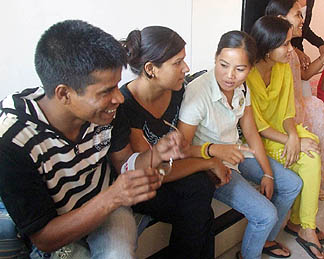
 KOLKATA, India (UCAN) — Nearly two decades after a forced exodus from the Himalayan kingdom of Bhutan, thousands of refugees living in Nepali camps still miss opportunities for a better life, professional training, and home.
Bhutanese refugees at the exchange program
Santiram Khadka, 24, was just a boy when his family was expelled in the early 1990s, along with other mainly ethnic Nepalese. This was a result of the kingdom’s policies that sought to control alleged illegal immigration by ethnic Nepalese, even though some claimed they were born in the country. Bhutan has a population of only about 800,000.
Its army suppressed protests, killing and wounding many who opposed the policies. The government confiscated land, closed schools, and forced many of Nepalese origin to sign a “Voluntary Migration Form” before they had to leave. Khadka’s father faced accusations of supporting terrorists, and was tortured.
Khadka’s family members are among what the United Nations High Commissioner for Refugees (UNHCR) estimates are nearly 110,000 Bhutanese living in seven camps in and around Tamak town, eastern Nepal.
Still traumatized by what his family experienced, Khadka recently shared his pain during an exchange program for these young refugees, in a Jesuit retreat house close to Kolkata, India.
Now seeking to learn leadership skills they could use in their communities, 10 young men and nine women from the camps joined the All India Catholic University Federation (AICUF) members in the March 10-14 event to share experiences.
Four of the refugee youths were Buddhists and the rest Hindus. Forty AICUF members participated in the program, organized by AICUF’s Jesuit-run St. Xavier’s College unit.
“We felt the need to form leaders in the refugee camps who will work for their people, and that is what we did during the workshop,” explained Purna Siwapoti, 22, a member of the AICUF national team.
The program trainers included Jesuits and AICUF students. Jesuit Father John Rojerse, national promoter of Leadership Training Service, spoke on the simple ways in which young adults can act as leaders in their communities.
AICUF students, who often conduct workshops for youths based on their training, also shared their knowledge and experiences of leadership.
Siwapoti’s federation has identified refugees, tribal people, dalit (former untouchables at the bottom of the Indian caste system), and women for special attention.
Siwapoti said a previous exchange program included a team of AICUF members visiting the refugees in Tamak last year.
Jesuit Father Peter Jong Lepcha, 39, coordinator of the Youth Friendly Centre (YFC) in Tamak, said the young refugees were among 14,000 youths aged 18-25 who were in contact with Caritas-Nepal, the Nepal Church’s social-service agency. The YFC provides the youths with facilities for education, art, culture, sports and games.
Father Lepcha said the young participants in Kolkata already had leadership qualities and only needed further training.
While many of the young people in the camps find their future uncertain, Khadka said the participants were returning from Kolkata with greater self-confidence. The workshop “fine-tuned leadership qualities” they had, he said.
An AICUF member, Noel Francis, said the exchange program helped both groups. “This was the first time we heard the stories of refugees directly.”
Principal Jesuit Father John Felix Raj said his college admits one to two students from Tamak camps every year. “We realized exchange of this sort is sure to enrich both the refugees and our students.”
Refugee students in the college study for three years. The college offers bachelor’s degrees in arts, science and commerce, and technical studies in bio-technology and computer skills.
A 2007 UNHCR report said there were people from more than 50 ethnic and caste groups in the seven Nepali camps. An estimated 60-70 percent of the refugees are Hindus, 20-25 percent are Buddhists, 5-8 percent are indigenous Kirat, and 2-3 percent are Christians.
The report added that training opportunities in the camps, especially for occupations, were limited. About 40 percent were students, while 25-30 percent had no education. Only a few of the refugees have had university education in India.
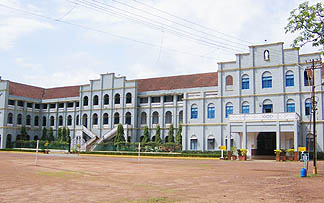
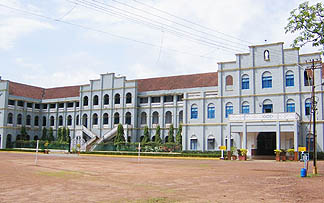
MANGALORE, India (UCAN) — Threats from Hindu radicals have forced a Jesuit college in southern India to conduct annual examinations under heavy police security. St. Aloysius College in Mangalore Radical groups have accused St. Aloysius College in Mangalore of discriminating against some Hindu students who were denied hall tickets — special admittance cards for examination participation. The groups have also threatened to attack the college’s principal and rector, forcing the civil administration to impose orders to prohibit outsiders entering the campus of 13,000 students during the March 13-26 examinations. “Now the examinations are being held with tight police security,” said Jesuit Father Richard Rego, who teaches in the college. The students affected by the heightened security are from the Pre-University Course (PUC) department of the century-old campus, that also has a primary school and a high school. The college conducts bachelor’s and master’s courses in various subjects. PUC principal John D’Silva, a Catholic layman, clarified the college had to refuse hall tickets to 12 students whose attendance fell short of the required minimum. Six of them are Hindus, four are Catholics, and two Muslims, he said. He pointed out that the college was only following a government rule on class attendance and the college action had “no communal angle” to it. The government requires 75 percent attendance in classes before a student is eligible to take examinations. However, it gives discretionary powers to colleges to reduce the percentage if absence was due to college-related activities. The affected students chalked up less than 50 percent attendance, the principal pointed out. Hindu groups, however, said the college had denied tickets to about 50 Hindu students. Srinidhi, a member of the national committee of the pro-Hindu Akhil Bharatiya Vidyarti Parishad (all India students’ council), told the press the college had initially penalized more students for low attendance, but later issued hall tickets to many of them after making them pay fines. He said the college had not informed students about their low attendance. However, Father Rego said the institution regularly informs parents about their children’s academic progress and attendance status. The propaganda against the college by Hindu radicals has been so strong that many people now believe the college has done some injustice to Hindu students, he added. The priest said the college acts every year on the issue of low attendance, but this year radical groups used it as another excuse to attack a Church institution. He added that these groups hope to divide people on the basis of religion. Karnataka state has witnessed several attacks on Christians and their institutions since the pro-Hindu Bharatiya Janata Party (BJP, Indian people’s party) came to power in May 2008. Rohit Someswar, a Catholic social activist, said the incident is part of harassment Christians have faced since then. According to him, the failure of 12 students, out of a total of 4,000, to meet attendance requirements, is “quite normal.”