

Author: cfliao
CAMBODIA: A “Drop of Hope”
An irrigation project has been initiated in the apostolic prefecture of Battambang. The project is aimed at offering villagers access to water all year round so as to improve agricultural productivity and provide drinking water. The project, called “A Drop of Hope,” is being coordinated by Pablo Figaredo, a Spaniard and the nephew of Jesuit Bishop Enrique Figaredo, the apostolic prefect of Battambang. It envisages the widening of the Sangke River and the installation of four water gates along four kilometers of the stream. The project will allow approximately 1,000 hectares to be tilled during the dry season and will encourage people to remain in the area for work and not leave for other places such as Thailand. Work began after discussions with local authorities. Pablo said they called the project “A Drop of Hope” because the area is so badly affected during the dry season when crops shrivel and die. He added that the lack of water when the river shrinks prevents any economic and social development. One of the villagers, Seum Soeu, told UCA News that the project would change people’s lives: “For so many years during the dry season we have faced difficulties in finding drinking water when the river was low.” He continued. “There are not many wells in the village. We thank the Church for this meaningful and fruitful project.” The project will be completed in 2011 and the cost is being covered through the help of benefactors in the Spanish city of Gijon. IRELAND: Marathon for faith and justice Slí Eile (“the faith that does justice”) is an organisation of the Irish Jesuits that provides a wide range of faith and justice activities for young adults ages 18 to 35. In a monumental effort to raise funds for Slí Eile, director Padraig Swan completed a grueling 56 kilometres in the Two Oceans Marathon in Cape Town, South Africa, in April. It took him a mere 5 hours, 40 minutes to cover the distance. And he doesn’t plan to stop there; rather, he will run a further three marathons this year, hoping to significantly add to the more than €10,000 he has raised to date. Slí Eile‘s Audrey Hogan was at the Cape Town event too, encouraging Padraig. After the marathon they stayed another two weeks to visit the projects in South Africa and Zambia where Slí Eile volunteers will work this summer. Padraig Swan wrote: “They will work at building a school and toilet block in a very rural area of South Africa and work with an orphanage, school, street kids projects, a hospice for the dying and agricultural projects in Lusaka, Zambia.” He added: “The work carried out by all Slí Eile volunteers in Africa and elsewhere (Colombia and Jamaica) has a lasting effect on the local communities that we visit as well as having the profound effect on the volunteers themselves.” LEBANON : Celebration at the Church of Jamhour College On the 31st of May, the solemn Mass for Pentecost Sunday was celebrated in the Church of Notre Dame de Jamhour Jesuit College in Lebanon, in the presence of educators, parents, alumni and friends. The occasion was the annual feast of the College and the 40th anniversary of the church. When the College was built in 1950 a competition was launched for the construction of a church for one thousand people, big enough to house all the students. The winner was a young French architect, Jacques Bosson, but the church was never built for lack of money, and the location remained empty. In 1964 Father Bonnet-Eymard took up the idea of building the church. Beginning with the original concept, the architect removed the interior columns and proposed a circular prayer space where everyone may see the altar. The altar is not in the middle of the room but at its side, so that all seem to be in front of it. The windows were fabricated by stain glass window master Gabriel Loire, from Chartres, France. the windows were created using unique modern techniques. The presentations are symbolic and inspired by the bible. Gabrial Loire calls the windows Hortus conclusus, ” the Closed Garden.” For more information: http://www.ndj.edu.lb THAILAND: Against landmines The Jesuit Refugee Service recently commemorated the 10th anniversary of the Ottawa Mine Ban Treaty (signed by Thailand on the 3rd of December 1997) and its own more than decade-long campaign to warn Thais of the dangers of mines. Many Thais have lost legs, arms or their lives because of the mines left behind by fighting in several border areas of the country. “The landmines are a silent war. This is an international problem,” said Emilie Ketudat, coordinator of the Thailand Campaign to Ban Landmines of JRS-Asia Pacific to the UCA News. “Even when the war is over, landmines continue to haunt people for years after.” A commemorative event was held in May at the Jesuit center in Bangkok. It included an exhibition on the landmine situation, past and present, stories from landmine survivors, a de-mining demonstration, a band performance by people with disabilities, artistic activities for children and video presentations. Thailand’s landmine problem is less well known than the problem in neighboring Cambodia where wars have left a deadly legacy of mines. According to Landmine Monitors Report 2008, Thailand is also affected by landmines and other unexploded ordnance that remain after the conflicts on its borders with countries such as Cambodia, Laos and Myanmar. VENEZUELA: Award for two students On the occasion of VIMUN (Venezuelan International Model United Nations), held at the Colegio Santiago de León in Caracas, two students of Fe y Alegría colleges were received prestigious recognitions, one as “Mejor Delegado” and another one with “Tercera Mención Honorífica”. VIMUN, is an intercollegiate program held on the campus of IESA (Institute of Higher Learning in Business Administration), a non profit institute. It brings together hundreds of students from more than 20 Caracas colleges to participate in a program modeled after the United Nations.
MANILA (UCAN) – Modern-day missioners are needed in the Philippines who can keep up with new trends and who are politically savvy, says the leader of the Jesuits in the country.
“We need new missionaries who can play with the images of modern media, who can sing the music of our young, who can speak the language of government and politics, who can tap comfortably on keyboards, who can remain unfazed by new technologies and new ideas and trends,” said Father Jose Cecilio Magadia, Philippines Provincial of the Society of Jesus.
He said the country needs more missioners now compared to the 19th century, when black-robed Jesuit priests first came here from Spain.
Father Magadia’s comments came during a homily at a June 14 Mass in Manila Cathedral. The Mass was to launch the final phase of celebrations marking the 150th anniversary of the return of the Jesuits to the Philippines, after the 18th-century papal suppression of the Jesuits, and the founding of what is now Ateneo de Manila University.
Father Magadia said poverty, inequality and injustice in the country frighten many Filipinos into leaving for other shores.
“To such a world, we should offer new missionaries … new bearers of the fire, new heralds of the Good News, willing to win the weary world for the Kingdom of God,” said the Jesuit provincial.
Mayor Alfredo Lim of Manila and other government officials, Jesuit priests, Ateneo teachers, alumni, students, their parents and other guests packed the cathedral for the event presided over by Cardinal Gaudencio Rosales of Manila.
Father Magadia recalled the first arrival of 10 Jesuits from Spain’s Aragon province to Manila and their subsequent establishment of missions in Mindanao, in the southern Philippines.
On Dec 10, 1859, the order took charge of the only primary school in Intramuros, in Manila, which they renamed Escuela Municipal. From an initial 23 boys, enrollment grew over the years and the school became one of the principal schools for the Filipino elite.
By 1909, when it renamed the Ateneo de Manila, it was providing primary, secondary and tertiary-level education. The original campus moved to central Manila, but was destroyed during the Second World War.
In 1952 the campus moved to its current site in Loyola Heights, Quezon City, where close to 12,000 students study from primary to university levels. It has also opened professional schools for business and law in Makati City and a college of medicine in Pasig City.
Ateneo University president Father Bienvenido Nebres was among 40 Jesuits who concelebrated the June 14 Mass. Earlier, he told UCA News that since he first became president in 1993, his focus has been to maintain the establishment’s high standards and keep producing young men and women to be “people for others.”
It is a “challenge,” he acknowledged “to achieve competitive excellence, while asking, to whom do you use your excellence for?”
Integrated social involvement is a key feature of the institution’s curricula at all levels. Its centerpiece social program is a university-wide social action program in partnership with Gawad Kalinga, a Philippine-based poverty reduction and nation-building movement that builds low-cost housing communities and schools in impoverished areas.
In 2004 the Federation of Accrediting Agencies of the Philippines and the Philippine Association of Accrediting Schools, Colleges and Universities granted the institution the highest possible rating.
During the June 14 celebration, past and present students came in droves to the cathedral, some dressed in their school colors, others 19th-century gowns and shirts. Jesuit artifacts were also offered at the Mass and donated for a planned museum.
Activities extending beyond the Dec. 10 anniversary include conferences and academic convocations, music concerts, art and science exhibits and a book launch.
NANCHANG, China (UCAN) – A church near Nanchang in eastern China is planning to erect a statue of groundbreaking missioner Father Matteo Ricci on the site where he is believed to have lived for a period of time.
The statue is the brainchild of Father Peter Wang Leizhen, the first resident priest here in 40 years. He told UCA News that he wants to unveil the statue in the courtyard of Xuposhan village church, about an hour by car from the city, to commemorate the famous Italian missioner’s 400th death anniversary.
The unveiling would coincide with the reopening in October of the church that has been closed for a year of renovations.
Father Ricci was a Jesuit priest, famous for his missionary work in China. He introduced Catholicism to Nanchang, capital of Jiangxi province, around 1595.
Villagers have told Father Wang of stories passed down from generation to generation that say Father Ricci stayed briefly in the village before going on to Nanchang city. In the 19th century, French members of the Congregation of the Mission built the Xuposhan village church on the site of the house where Father Ricci is said to have stayed.
The missioners also opened an elementary school to offer free education and accommodation to local children.
Father Wang said the decision to honor the famous priest was the easy part. Finding someone to create the statue is harder. The priest said he had approached many local sculptors and workshops but none were able to help. “We are still looking for someone in the country who knows how to make the Ricci statue,” said Father Wang.
He is also limited by his budget. Originally he had wanted the statue cast in bronze, which would be more durable, but that proved too costly. The parish budget is just 20,000 yuan (US$2,927), he said, and fiber-reinforced plastic would be cheaper.
The Xuposhan church was once a center of missionary activities before the founding of the People’s Republic of China in 1949. There were about 3,000 Catholics in nearby villages but most left after the church compound was confiscated during the Cultural Revolution (1966-1976).
The church was returned to the diocese in 1980 and priests from Nanchang city came to say Mass occasionally.
The parish now has about 100 Catholics, who have started coming to church after Father Wang made home visits since arriving here in November 2007. In October, two days ahead of the church reopening, the parish will conduct an evangelistic program to reach out to people who are not Catholics in the neighborhood, Father Wang said.
Father Wang believes the reopening of the church here would be a fitting moment to honor Father Ricci who is credited with bringing the Gospel to China and bridging European and Chinese civilizations.
The Italian Jesuit was born in 1552 and arrived in Macau in 1582. Macau was then a Portuguese colony and the gateway for foreigners entering China. The next year, he went to Guangdong province, southern China, and spent 12 years there before moving north to Nanjing but was turned back as foreigners were unwelcome at the time.
He retreated to Nanchang by boat in 1595 and spent three years there where he met with many intellectuals and bureaucrats who appreciated his wide knowledge of geography, mathematics and science. He also published a world map and books in classical Chinese.
His letters and other documents, however, do not identify the exact locations he had lived in, and no relics have been found so far.
Father Ricci arrived in Beijing in 1601 and the Chinese emperor allowed him to stay in the capital until his death in 1610.
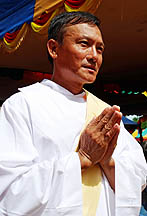
BATTAMBANG, Cambodia (UCAN) — The Church in Cambodia has ordained the first Jesuit priest since the Church revived in the country during the early 1990s. Father Phongphand Father Phongphand Phokthavi, a Thai national, was ordained by Bishop Emile Destombes, apostolic vicar of Phnom Penh, on May 24, in a special ceremony in Battambang attended by 2,000 people. The ordination of Father Phongphand, 53, brings the number of Thai priests serving in Cambodia to four. Ham Sok, one of the many people at the ordination, said the scale of the event was a sign that the Church in Cambodia is growing. During the ceremony, Jesuit Monsignor Enrique Figaredo, apostolic prefect of Battambang, said Father Phongphand “always gives himself to others, loves the poor and encourages people who have lost hope.” The monsignor, who has known the priest for 20 years, cited one occasion when Father Phongphand saw some people without shoes and offered them his own, saying, “I have another pair.” Cambodia has a special place in the Thai priest’s heart. During the 1980s he helped Cambodian refugees in Thailand while working with the Jesuit Refugee Service (JRS). Later in the 1990s he went to Cambodia with returning refugees and helped build a vocational center for the disabled near Phnom Penh. Talking to UCA News, the Thai priest said his inspiration for becoming a priest in Cambodia was when he saw the smiles of refugees despite the suffering they had endured during years of civil war. Monsignor Enrique Figaredo, apostolic He said the challenges he would encounter as a priest in Cambodia would not be cultural or linguistic, but would be in tackling poverty and suffering, and spreading the love of God. He added that his work from now on will be that of a parish priest in Kompong Thom in Battambang apostolic prefecture. He also said he wants to serve in Cambodia for the rest of his life. Besides the four Thai priests, there are also five Thai nuns serving in Cambodia. The last priestly ordination in the country took place in 2001, when four Khmer priests were ordained. Of the 50 priests or so presently in Cambodia, only about five are local Khmer.

Phokthavi at his ordination

prefect of Battambang, blesses Father Phongphand
Peter Schineller, S.J.
Two hundred years ago, June 8, 1809 was the cornerstone laying for St. Patrick’s (Old) Cathedral near Canal Street in what was then uptown New York City. That same day nearby in New York City was the death of Thomas Paine, author of Common Sense. And an interesting link between these two events.
Jesuit Fr. Anthony Kohlmann presided at the cornerstone ceremony. He was vicar General and administrator in charge of the 15,000 Catholics in the city. He had purchased the land for St. Patrick’s, so there would be a second church at Mott and Mulberry Street, in addition to the only other Catholic Church, St. Peter’s on Barclay Street.
That same Fr. Kohlmann, in company with Fr. Benedict Fenwick, S.J. had recently paid an unsuccessful visit to the dying Thomas Paine. A woman baptized by Fenwick had told Paine that only a Catholic priest could cure him. When the two priests arrived and started talking with Paine, they asked about his soul rather than his bodily pains. Paine, rationalist to the end, ordered them out of the room. According to the account of Fr. Fenwick, they were chased away by Paine and left, followed by blasphemies. Soon after that, Paine’s life ended on the same day that St. Patrick’s Old Cathedral was begun, June 8, 1809.
Peter Schineller, S.J.
© 2009 America
– From the 15th to 19th of June the new Treasurers from Spanish speaking provinces are attending a training course. They are fifteen in all: eleven Jesuits and four lay associates from nine Provinces. About 40% of Provincial or Regional Treasurers have changed in the past two years and there is important to offer courses to help them understand their new role. It is especially important given the publication of the new Instruction for the Administration of Properties (IAB) that presents revised accounting forms and procedures
– Between the 18th and 19th of June, a meeting of Jesuit Refugee Service will be held in the General Curia. Attending will be representatives of Development Agencies and Mission Secretariats responsible for the recruiting of volunteers. The aim is to share initiatives and collaborate on common projects, such as awareness, recruiting, formation and support of volunteers.
A Jesuit Runs the Roman Marathon. On 22 March, Father Leopold Slaninka, a member of the Roman community of St. Peter Canisius and responsible for the Slovak programme of Vatican Radio, took part in the Roman Marathon. He ran the more than 42 kms in a time of 3 hrs and 31 minutes resulting coming in 629th for his category (40-45 years). The Marathon registered over 11,690 entries, and together with all the other categories there were in total more than 100,000 participants. Father Leopold ran his personal best for the first half of the race (21 kms) with a time of 1:34. Congratulations!
Peter Schineller, S.J.
Two hundred years ago, June 8, 1809 was the cornerstone laying for St. Patrick’s (Old) Cathedral near Canal Street in what was then uptown New York City. That same day nearby in New York City was the death of Thomas Paine, author of Common Sense. And an interesting link between these two events.
Jesuit Fr. Anthony Kohlmann presided at the cornerstone ceremony. He was vicar General and administrator in charge of the 15,000 Catholics in the city. He had purchased the land for St. Patrick’s, so there would be a second church at Mott and Mulberry Street, in addition to the only other Catholic Church, St. Peter’s on Barclay Street.
That same Fr. Kohlmann, in company with Fr. Benedict Fenwick, S.J. had recently paid an unsuccessful visit to the dying Thomas Paine. A woman baptized by Fenwick had told Paine that only a Catholic priest could cure him. When the two priests arrived and started talking with Paine, they asked about his soul rather than his bodily pains. Paine, rationalist to the end, ordered them out of the room. According to the account of Fr. Fenwick, they were chased away by Paine and left, followed by blasphemies. Soon after that, Paine’s life ended on the same day that St. Patrick’s Old Cathedral was begun, June 8, 1809.
Peter Schineller, S.J.
© 2009 America
NEW DELHI (UCAN) – Afghanistan is the best thing that happened to the Jesuits in South Asia, says Father Hector D’souza, who on May 31 completed a five-year term as provincial of the Jesuits in South Asia.
Father D’souza says the opening of a Jesuit mission in the war-torn country not only energized South Asian Jesuits, it also helped correct some misconceptions Afghan people had about Christianity and NGOs.
Closer to home, the priest, acknowledged missed opportunities regarding a proposal to merge the three Catholic Church rites — the Latin, Syro-Malabar and Syro-Malankara rites — under one Indian rite. In addition, he also believes that the Church in India needs ‘real persecution’ in order to purify itself so that it can fulfill its mission in the country.
Two days before he left office, the 59-year-old priest gave the following interview to UCA News:
UCA News: What are your sentiments as you leave the post as leader of the world’s largest Jesuit unit? Have South Asians taken leadership among the Jesuits?
Father Hector D’souza: I am happy and satisfied. But I won’t say we are leading the Jesuits. It is true we are a major group. We have given a new thrust to our congregation and the Church. We are little more than 4,000, maybe 4,015 in 18 provinces and two regions.
We have gone beyond our boundaries. For example, our people are helping in Guyana. Most probably, we will take up the Amazonian belt, a huge area in Latin America. Our men are now working in several countries in Africa, taking care of mostly formation houses. Jesuits from Hazaribag and Ranchi provinces (in eastern India) now work in Cambodia.
What else did the South Asian Jesuits do?
Our greatest venture was in Afghanistan. We went to that war-ravaged country in 2005. There are nine Jesuits from South Asia now working there. Two more will join them soon.
Afghanistan is the best thing that happened to the Jesuits in South Asia. The Afghan mission has energized our provinces and given them a new zeal. It has convinced our men that they can go to areas that they could never dream of reaching.
We went there because we are asked to help out in refugee work. The first Jesuit team there was not from India, but from Europe and it could not do much. So our general asked us to help.
Initially three men went there to study the situation. They found it very fluid. We realized we could not go there as an NGO because NGOs have a very bad reputation. Afghan people believe NGOs are interested only in making money out of their misery.
NGOs work under great strain. Armed men guard their people and buildings. They go out with military escorts. Initially we stayed with CRS (Catholic Relief Services), which also work under heavy security. We realized we cannot work that way and left them and started staying among the people.
Universities wanted us to teach English to their officers and teachers. We also help in teacher training institutions. We work in Kabul, Herat, Bamiyan and Chak Sharan. We have had tremendous success. Whenever I was in Afghanistan, government officers asked me to send more Jesuits.
We give many ongoing courses lasting five weeks. The universities allow us to give special classes during the three-month winter holidays. We charge students for the course, but if they are regular, we give back the money at the end of the course. Our classes are packed.
People have realized that we do an honest job and that we are with them. We spend a lot of time listening to them. Our strength is also measured by how the women relate to us. Afghanistan society does not allow women to move around freely. They have to wear burqa (a head-to-toe garment worn by Muslim women that includes a mesh facial covering). However, mothers come to our houses, leave their children and go. They know only men stay in our house, but still they trust us. We have won over people’s good will.
We have also changed people’s attitude toward Christianity. Almost all foreigners in Afghanistan are Christians — army and U.N. officials. People there have different notions about our religion. But they tell us that they see another type of Christians in us. They are convinced that we are for them and we work for the poor. We have given a new vision of Christianity in Afghanistan.
We have also managed to change the Afghan people’s attitude toward NGOs. We brought several top-level government officials to India and helped them understand how real NGOs work. The CRS paid for their travel and we took care of their stay in India. The Afghan government has changed many laws about NGOs after those visits.
How did you manage to win over people?
Afghans love Indians. They tell us that Indians are their people. Last year I took six trips to the Missionaries of Charity house in Kabul. Every time the taxi drivers refused to take money after they found out that I was from India. I had to force them to accept the money. India has built roads and runs the public transport and a major hospital in Kabul. Except for the Taliban, everyone appreciates Indians. So we had an easy entry point as Indians.
All of us, even our senior men, have learned Dari, the local language. We have put our heart and soul into it. That also made a big difference.
Have you not faced any problems?
So far nobody has been touched. The places where we work are not under Taliban influence. The government officials do not want us to work in Kandahar and other Taliban areas.
What are the weaknesses of the South Asian Jesuits?
Our main weakness is that we do not publicize what we do. We are shy of publicity. We do many beautiful things but seldom tell people about them.
Some blame Jesuits for introducing casteism and inter-rite problems in the Church here.
If people say we created the caste problem, they are wrong. Caste is an Indian problem. The early missioners wanted the best way to convert people. So some went with the high-caste people while others worked among the low-caste. They did so after they realized they could not beat the system. So they went along with the system.
Sitting back now we cannot judge what people did more than centuries ago.
About the rite problem, when the Jesuits came to Kerala, Syrian Christians already existed there. The Latin-rite was imposed on them partly because of the Portuguese (colonial) hegemony. It was the white Catholic Church that dominated then. Jesuits were not the only people who came with the colonial rulers. Dominicans, Franciscans and others were also part of the system. What happened then was unfortunate.
Can’t the Jesuits take the lead to resolve the problem?
We did, but the Church missed a great opportunity. We asked if the three rites, Latin, Syro-Malabar and Syro-Malankara, could come together and have one rite, an Indian rite. At the Church in India Seminar in 1969, one of our men, (late Father M.M. Balaguer) and Bishop Patrick D’souza, who was then a priest, proposed an Indian rite. It was a grand assembly of people from India’s all three rites. Rite is after all about worship and Sacrament.
Father Balaguer proposed an Indian rite taking into account India’s unique cultural and social situations. We took the initiative, but nobody wanted it because everyone wanted power, money and glory. These are three temptations, and we succumbed to them. At the 1969 seminar, nobody wanted a common rite because it would have meant fewer dioceses and bishops. All of us have sinned and should beat our breasts and ask the Lord for mercy.
Let us not blame bishops or dioceses or anyone else. It was a collective failure. Vatican II was alive then and we had the freedom to innovate. Vatican II was the most progressive development in the Church. The Vatican was open to new ideas and movements at that time. If we had agreed on the Indian rite, the Vatican would have approved it after asking a few questions. Now, we have lost the chance.
Caste is a problem of the larger Indian society and we cannot resolve it.
What does the Church need now?
What we need now is real persecution. Persecution can purify us of our lethargy, inactiveness and failure to live the Gospel. If purification does not come within the Church, God will use other means to purify us.
Wherever the Church faced persecution, it has become very strong. For example, the Church in Gujarat (western India). It has become alive and vibrant after Hindu radicals targeted it a decade ago. The Church in India was very vibrant when the (pro-Hindu) Bharatiya Janata Party (Indian people’s party) ruled India (1999-2004). People were out on the streets for their rights. Similar things happened after the attacks on Christians in 2008.
However, the violence we have experienced are only pinpricks. Real persecution will come only when our structures are affected.
Growing Church in Chad Means New Vicariate
Pope Elevates Mongo, Appoints 1st Bishop
MONGO, Chad, JUNE 5, 2009 (Zenit.org).- Benedict XVI has elevated the apostolic prefecture of Mongo to an apostolic vicariate, since the number of Catholics in the region has increased by 15% in the last 20 years.
In the Central African nation, which has some 10 million inhabitants, 53% of the population is Muslim. Two decades ago, Catholics numbered only 5%; now they are 20% of the population.
Bishop Miguel Ángel Sebastián Martínez of Lai, Chad, spoke of the rapid growth of the Church in his country when he addressed the synod of bishops last October.
He explained the importance given to the Word of God and the Eucharist, noting that Catholics cannot always attend Mass each Sunday because of a lack of priests, but that they gather to read and pray the Bible, and to seek “what they should do to change that in their lives which is not in conformity with the Gospel.”
The Pope named Jesuit Bishop-designate Henri Coudray to be the first apostolic vicar of Mongo.
The French bishop-designate has been the apostolic prefect in Mongo since 2001. He is a specialist in the Arabic language, Islam and interreligious dialogue.
Henri Coudray was born in 1942 and studied at the Pontifical Gregorian University in Rome, the Sorbonne, and received a licentiate in Arabic and Islamic studies in Lyon.
He was ordained a priest in 1973 and made his profession in the Society of Jesus in 1980.
The Catholics of the vicariate, some 6,000 out of a population of 1.7 million, are distributed in six parishes, attended by nine priests, 13 women religious, five men religious, eight lay missionaries, and two seminarians.