

Author: cfliao
From 11 to 14 July Father General will visit the Philippine Province to celebrate the 150th anniversary of the return of the Jesuits to the country (see further on) and the founding of what is today the Ateneo de Manila University. In 1768, the Jesuits of the Philippine Province, 154 in all, were expelled by order of King Charles III of Spain. They returned almost a hundred years later, in 1859, with the intention of evangelizing the southern island of Mindanao. Besides undertaking this pioneering missionary work, in December of the same year they assumed responsibility for the Escuela Pia, later renamed Ateneo Municipal. The present day Ateneo de Manila University has a student population of over 18.000. The Sesquicentennial Anniversary Eucharistic celebration will be held on July 12; Father General will be the principal celebrant. About 4.000 people, including 200 Jesuits, are expected to participate. The next day Father Nicolás will deliver the keynote address on: “Issues and challenges in Jesuit education today” before a group of Jesuits and their lay collaborators from the five universities, one college and other schools of the Philippine Province. That evening Father General stay at Arrupe International Residence; the international scholasticate houses more than one hundred men in formation, coming from all the provinces of East Asia as well as the novices of the Philippine and Chinese Provinces. On July 14 he will meet Jesuits and lay partners working in spirituality and social centers, seminaries, parishes and chaplaincy programs. Time has been set aside for him to visit friends in Manila: the staff of the East Asian Pastoral Institute, where he was director for six years, and the staff of the Jesuit Conference of East Asia and Oceania, which he led as president for three years before his election as Superior General of the Society.
On July 15 Father General will leave Manila for Yogyakarta, Indonesia, where he will stay until July 21. From July 16 to 19 he will attend the meeting of the Major Superiors of the Jesuit Conference of East Asia and Oceania, and on July 17 he will meet the “Brothers’ Circle” of the Assistancy who will be having their biannual gathering at that time. The visit will be also celebrate the 150th anniversary of the “modern” Jesuit presence in Indonesia (“modern”, since Saint Francis Xavier had already served in what is today Indonesia in the 16th century). In 1859, two Dutch Jesuit missionaries landed in Batavia (today known as Java). Those humble origins have blossomed into the largest Province of the Assistancy with 348 Jesuits as well as 77 Jesuits in the two dependent regions of Malaysia-Singapore and Thailand. The official celebration of the event will be held on July 20th, and will be presided over by Jesuit Cardinal Julius Darmaatmadja, archbishop of Jakarta; The Eucharist will be celebrated in Bahasa Indonesia, the local language, while Father General will deliver the homily in English. The previous evening he will have dinner with nearly 500 Jesuits and friends, family members and collaborators, and will address them on the themes of mission and collaboration. On the evening of July 20th Father Nicolás will meet about 200 Indonesian Jesuits. On July 21st he will meet with the Provincial of Indonesia and his consultors before returning to Rome.
VATICAN CITY, JULY 3, 2009 (Zenit.org).- A former director of Vatican Radio, Jesuit Father Pasquale Borgomeo, died Thursday in Rome after a long illness. He was 76.
Father Borgomeo was with Vatican Radio for 35 years, and died “with a spirit of acceptance of God’s will, accompanied by the prayers of his brothers in the Society of Jesus, his family and friends, and especially, the Holy Father, who was informed of his worsening health,” said Jesuit Father Federico Lombardi, his successor. Father Lombardi is the director of the Vatican press office, including Vatican Radio and Television. Father Borgomeo’s funeral will be held Saturday. The priest left the directorship of Vatican Radio in 2005 due to his health condition. He had been named the director 20 years before, in 1985, and this after working as an editor with Vatic an Radio since 1970. Father Borgomeo had referred to his role as an “exciting adventure.” Pasquale Borgomeo was born in Naples in 1933. He joined the Jesuits in 1948 and was ordained in 1963. L’Osservatore Romano said that the priest “pursued no other objective than bringing the voice of the Pope […] to all the corners of the earth.”

 The Jesuit Vocation office sponsored a fun weekend in central Wisconsin for young men ages 16-20. Seven students participated this year from schools like Marquette University High School, Creighton Preparatory School (Omaha, NE), Marquette University (Milwaukee, WI), and others.
Several Jesuits helped to host the event, including Fr. Bob Tillman, S.J., Fr. Tom Doyle, S.J., Mr. PJ Shelton, S.J., Mr. Charlie Olsen, S.J., and Mr. Brad Held, S.J. The event was held at the Loyola Villa, a summer vacation house for the Society of Jesus on the beautiful lakes near Waupaca, Wisconsin. The participants enjoyed home-cooked meals by Br. Al Dorsey, S.J, daily Mass, canoe and boat rides, swimming, tie-dye t-shirt making, and mini-golf, and late- night games of Mafia.
JAKARTA (UCAN) – Witah was not at all business savvy when she first started selling vegetables on a south Jakarta street. The low prices she charged for her goods left her with little profit.
This changed after she joined a parish-run micro-financing program earlier this year.
The Credit Union Microfinance Innovation (CUMI)scheme, established last September, offers training on how to run a business effectively.
The scheme, started by Jesuit Father Antonius Sumarwan, assistant priest at Our Lady of the Queen Church in South Jakarta, also offers both savings and loans to poor people looking to improve their businesses, but are unable to get credit from mainstream banks.
“The program helps me to manage my business better and increase my profits,” said Witah, one of 110 members of CUMI. Eighty percent of members are Muslims, the rest are Catholics and Protestants.
She said CUMI gave her a 500,000 rupiah (US$49) loan on joining the program. She used the money to buy vegetables and then sold them using the business skills she had acquired.
“I sell vegetables in the mornings and afternoons. I can earn 300,000 rupiah a day and use the money to buy produce for the following day,” said the 62-year-old Muslim mother of eight. “I can now pay the rent, support my family and save the rest in CUMI,” she said.
Before joining CUMI, she sold vegetables intermittently and only in the mornings. As a result, she had little savings.
“I am happy and really thankful to the Catholic Church for helping me develop my small business,” she smiled.
Witah was sharing her experience with 150 priests, nuns and laypeople at a June 20 meeting of parish-level social ministries of Jakarta archdiocese. The archdiocese’s commission for socio-economic development organized the event, titled “How to improve the economic life of underprivileged families.”
Father Sumarwan told meeting participants he was inspired to start CUMI after reading Bangladeshi Muhammad Yunus’ book, “Banker to the Poor,” was published in 2003.
Yunus, a banker and economist, developed the concept of micro credit for entrepreneurs who are too poor to qualify for traditional bank loans. In 2006, Yunus and his Grameen Bank were jointly awarded the Nobel Peace Prize for helping the poor advance economically.
“Our target is underprivileged families so that they do not fall into poverty,” Father Sumarwan said, adding that each of the current members are obliged to save a minimum of 2,500 rupiah a week.
He said the first CUMI members were five women who used to sell food in front of the parish church every Sunday. “Our five lay activists trained them in running small businesses and improving their economic lives.”
CUMI has set a target of 150 members by the end of this year, Father Sumarwan said. He and his volunteers have been promoting the program by word-of-mouth.
Jesuit Father Yosephus Edi Mulyono, who heads the archdiocese’s commission for socio-economic development, told UCA News that at present, 96 percent of Church aid to the underprivileged is through charitable handouts. Economic empowerment programs form only four percent.
“The Church should do it the other way round, by providing 96 percent of resources for empowerment programs and four percent to charity,” he said.
“We will encourage other parishes to establish their own CUMI. We just want this program to grow so people will be more self-reliant instead of being dependent on others,” he said.
Ratri, another Muslim CUMI member, told meeting participants she was selling food on the streets before joining the program,. “After joining CUMI, my business improved. I now run a catering business,” said the 58-year-old proudly.
MANILA (UCAN) – American Jesuit Father James Reuter, who built the Catholic radio broadcasting system in the Philippines and laid the foundations for the bishops’ national media network, has retired.
Monsignor Pedro Quitorio III, from the bishops’ conference, announced Father Reuter’s resignation as executive secretary of the Episcopal Commission on Social Communication and Mass Media on June 16. Father Reuter, 93, sent in his resignation in May on the ground of “failing health.”
The American priest is well known for his actions during the rule of former president Ferdinand Marcos, who clamped down on all media during martial law, which lasted from 1972 to 1981.
Father Reuter developed and supported what was called “the mosquito press” — mimeographed newsletters containing uncensored articles produced in clandestine centers.
He also set up Church broadcasters at a private radio station after soldiers disabled the Church-run Radio Veritas during the 1986 people power uprising that eventually deposed Marcos.
The priest has meanwhile built the Catholic Media Network (CMN), which he began in 1964, into a network of 54 Catholic radio stations and four television stations operating in 11 regions and 35 provinces around the country.
Father Reuter also directed the Philippine bishops’ National Office of Mass Media, a post to which the Catholic Bishops’ Conference of the Philippines appointed him in 1969.
The American missioner had arrived in the country 31 years earlier as a seminarian. He was interested in broadcasting from the beginning and worked on a radio program while teaching at Jesuit-owned Ateneo de Manila University in 1941.
During the Japanese invasion in 1942, he entertained fellow priests and nuns detained in a prison camp by presenting plays he wrote and composing songs they sang together. He then left the country but returned in 1948. In 1960, the Philippine Jesuit Province appointed him the first head of its Office for Communication.
He set up studios and offices in the Jesuit residence in Santa Ana, Manila, in 1964, the same year he began CMN under its original name, the Federation of Catholic Broadcasters in the Philippines. This network became a primary media provider when cable lines could not reach all villages in the archipelago.
The bishops appointed him national director of mass media in 1967. He trained in broadcasting techniques in Hollywood, in the studio of the late Father Patrick Peyton, founder of the worldwide Family Rosary Crusade movement.
He later started the Philippine broadcast of the movement’s weekly radio-television series, “The Family Theater.”
Father Reuter founded the Asia branch of Unda (wave), the International Catholic Association of Radio and Television, which linked Catholic broadcasters in the region. He continued to be a leading regional figure in Unda and the International Catholic Organization for Cinema and Audiovisuals (OCIC), which merged in 2001 to form SIGNIS, a worldwide Catholic association for professionals involved in audiovisuals, broadcasting and new media.
Father Reuter has gathered numerous trophies and plaques of recognition over the years, including a 1981 citation from Pope John Paul II recognizing him for “courageously upholding truth, justice and integrity in Catholic communications.”
Monsignor Quitorio said Father Francis Lucas, who now heads CWM, has been appointed to succeed Father Reuter as acting executive secretary of the episcopal commission.
Father Lucas, 61, has spent much of his 36 years as a priest evangelizing and advocating for environmental, economic and agricultural development through media. He also chairs the Asian NGO Coalition for Agrarian Reform and Rural Development.
ANANTAPUR, India (UCAN) – About 80,000 people from a variety of religions paid tribute to Spanish missioner Vincent Ferrer at a state funeral on June 22.
The former Jesuit priest, who worked among the poor in southern India for more than 40 years, died of old age on June 19. More than 500,000 people in all paid homage to the former priest.
The 89-year-old missioner, popularly known as Father Ferrer, was buried in Bathlapalli, a village near Anantapur town in Andhra Pradesh state where he started his work among mostly dalit people.
Dalit are former “untouchables” in the Indian caste system.
He is survived by his Protestant wife Anne, son Moncho and daughters Tara and Yamuna.
Father Mummadi Joji Reddy, former vicar general of Kurnool diocese, led the funeral Mass along with 10 priests, including three Jesuits. Christian, Hindu and Muslim scriptures were read during the service.
A 100-member delegation from Spain also attended the funeral service.
The Andhra Pradesh state government declared a holiday on June 22 in Anantapur district where the missioner worked. It also gave him a state burial accompanied by gun salute.
Ferrer was born in Barcelona in 1920 and arrived in Mumbai (then Bombay) in 1952 as a Jesuit priest. He left the priesthood in 1970 and traveled to drought-prone Anantapur. He then founded the Rural Development Trust that provides schools, healthcare, housing, development for women, ecology and water programs.
Andhra Pradesh Chief Minister Y.S. Rajasekhara Reddy, in a condolence message, hailed the deceased missioner as “an icon of nobility, humility and veracity, who gave 56 years of relentless work to India.”
Bishop Moses D. Prakasam of Nellore said Father Ferrer was “a real Father.” The prelate told UCA News the missioner identified with the poorest of the poor and “his dedication and selfless works brought glory to his organization and to his donors in Spain.”
Jose Bonono, speaker of the Spanish parliament who led the delegation sent by his country, said Father Ferrer was an honor to Spain as he alleviated poverty in a distant land.
Father Benoit Vermander, Director of the Taipei Ricci Institute, was knighted and conferred the honor of “Academic Palms” ( Palmes Academiques) in recognition of his humanitarian and academic accomplishments in Taiwan and China, at a ceremony in Taipei on Thursday, April 2.
Several French and Taiwanese leaders in the fields of culture and science, such as former minister of the National Science Council Mr. Chen Jian-ren participated in the ceremony.
Mr. Vermander holds a Master’s in political science from Yale University and a PhD in the same discipline from the Institut d’Etudes Politiques in Paris. He arrived in Taiwan in 1992, and after a year and a half he went to Sichuan, China, where he took courses in painting with a Chinese painter, with whom he has since held six joint exhibitions.
In 1996, he succeeded Taipei Ricci Institute founder Father Yves Raguin as head of the institute, whose objective is to contribute to in-depth understanding of Chinese culture, through research, forums and publication. In particular, the Institute published in 2002 the Grand Dictionnaire Ricci de la langue chinoise, the largest Chinese-Western language dictionary ever published.
Under Vermander’s leadership, the Institute has expanded its scope to include a “culture of peace” in the Chinese world, research on identity, cultural diversity and sustainable development, and has organized several symposiums in Taiwan.
Benoit is the author of eight books, including “China in search of its borders” (2005), “Chinese Wisdom and Christian Meditation” (2007) and dozens of articles.
in scientific journals and numerous newspaper articles.
Further, Vermander et al launched the magazine RENLAI (“Te Human Flute”), a cultural monthly for opinion leaders in Taiwan and in the Chinese diaspora, as well as a companion website, www.erenlai.com.
QUEZON CITY, Philippines (UCAN) – Vocation promoters in the Philippines say their efforts have been more productive when they personally contacted young men instead of relying completely on communications technology.
Father Christopher Santos, vocation director of Novaliches diocese based in Quezon City, northeast of Manila, cited students’ feedback during his campaigns in schools. They had told him that they want to learn about the priesthood directly from priests.
“It is important for a vocation promoter to personally visit schools because at least the young men can ask questions on vocations,” said Father Santos.
He added that during his visits to private high schools, he gathers fourth-year students together or goes to classrooms to give a talk about the priesthood. He also answers their questions about the priesthood and about the faith in general.
The priest said he times his visits for later in the school year because “students may easily forget what I say to them” at the start. He also assigns Novaliches seminarians to speak to altar servers on the priesthood, on Saturdays during the October school vacation.
Novaliches diocese’s youth ministry’s website has started a forum on vocations but Father Santos said vocation promotion is still primarily focused on school campaigns.
Catechists in public schools are urged to spot students who may have an interest in religious vocation as well as ability to study philosophy and theology.
Father Santos said 14 men have been accepted this year as seminarians in Novaliches. In 2007 when he started as vocation director, just five applicants were accepted.
The diocese of Novaliches was among five Church jurisdictions created from the former Manila archdiocesan territory. Created in 2002, it covers the northern parts of Quezon and Kalookan cities. Thirty-seven diocesan priests minister to 1.5 million Catholic residents comprising 88 percent of the population in the diocesan area, the latest Catholic directory reports.
Since the diocese’s establishment, the vocation director has been the only personnel directly handling vocation promotion, Father Santos recalled. The office’s main concern today is the establishment of a formal vocations office and the creation of a network of schools to engage in promotional efforts.
Around the rest of the Manila area, vocations have been declining because many families want their sons to work after college, Father Jason Laguerta, executive secretary of the Episcopal Commission on Vocations told UCA News.
He, however, acknowledged increasing vocations in the central Philippines Cebu archdiocese and Bohol diocese, and in Tagum diocese in the south.
While ideally there should be one priest ministering to 5,000 Catholics, one priest currently ministers to 8,000 Catholics on average around the country, Father Laguerta said.
Based on his experience, using technology for vocation promotion is an “initial step,” but “one-on-one encounters are more effective since you get to see them, and they also get to see you as a priest.”
Jesuit Father Xavier Olin shared how Internet has helped his work. The order’s national vocation director cited four applicants who “never knew about the Society of Jesus (Jesuits) until they saw the vocation announcement on Facebook,” an online social networking site.
“One of them, an information technology specialist based in Malaysia, was searching and searching until he came here, and said he is ready to resign from his job. He will submit an application in October,” Father Olin said.
The Philippine Jesuits post lists of vocation activities, tips on discernment, and “frequently asked questions” on vocation on their website. They maintain a blog site, and post YouTube videos on Jesuit founder, Saint Ignatius of Loyola, information on the Jesuits, and an inspirational music video for vocation applicants.
However, Father Olin agreed that personal contact is invaluable. He cited a recent study of his order that found 95 percent of participants in Jesuit vocation seminars in the last 10 years reported getting information about the order from peers and Jesuit priests. Seventy-two Jesuit seminarians from various Asian countries are in the country preparing for priesthood.
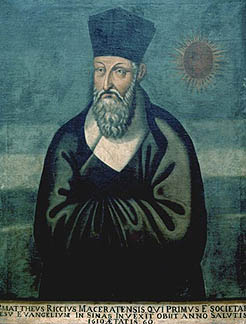
MACAU (UCAN) — The Macau Ricci Institute has marked the anniversary of the death of famous Jesuit priest Father Matteo Ricci, a Sinologist who promoted Christianity in China while introducing the country’s culture to the West.
 |
|
A portrait of Father Ricci
|
Next year will be the 400th anniversary of the death of the priest who lived the final 27 years of his life in China.
The Jesuit-run Macau Ricci Institute held a forum on May 11, the day Father Ricci died in Beijing in 1610.
The forum looked at the priest’s remarkable career in the country from the time he arrived in Macau, covering his travels through China to Beijing.
Father Gianni Criveller of the Pontifical Foreign Missions Institute (PIME) spoke on “Matteo Ricci’s Ascent to Beijing (1583-1610).”
Father Ricci, known as Li Madou to the Chinese, was a prolific writer, a Sinologist, linguist and an accomplished scientist.
Father Ricci, an Italian, began to learn the Chinese language on arrival in Macau, then a Portuguese colony and the gateway for foreigners entering China. After mastering the language, the priest set off for Beijing, arriving there in 1601.
Father Criveller, an Italian, told UCA News that he presented some lesser known aspects and misconceptions surrounding Father Ricci’s journey to Beijing. The priest made four lengthy stops between Macau and Beijing, at Zhaoqing and Shaoguan (then called Shaozhou) in Guangdong, Nanchang in Jiangxi and Nanjing in Jiangsu.
 |
|
Father Gianni Criveller (left) and Jesuit Father Artur
|
Father Criveller said the talk was a follow-up on his earlier forum speech last October, when he focused on Father Ricci’s life before coming to China. The two speeches will be published in a booklet in English and Chinese next year to commemorate the Jesuit’s 400th death anniversary.
Many people viewed Father Ricci’s life in China as a success.
“In fact, he had many setbacks and difficulties,” such as his discouragement upon seeing his companions die on the trip to Beijing, said Father Criveller.
Father Ricci was detained by officials when a crucifix was found among his gifts to the Chinese emperor. They believed it was a totem of black magic to have a figure nailed on a cross while the public depiction of a naked body was also unacceptable to the Chinese at the time.
Father Ricci is often remembered as a man of science, but he was much more than that, Father Criveller said.
 |
|
The tombstone of Jesuit Father
|
Some of the Jesuit’s techniques for introducing Christianity to China were controversial at the time. He preached the message that God was one and the same with the Chinese deity, the “Lord of Heaven”.
However, Father Criveller said Father Ricci had “talked and written about Christ … on certain occasions when people were ready to learn about Christ.”
The May 11 evening forum, chaired by Jesuit Father Artur Wardega, director of the Macau Ricci Institute, was followed by a concert and a cocktail party for the participants to exchange views.
Father Criveller, based in Hong Kong, has been living in Hong Kong, Macau, Taiwan and mainland China for 18 years. The PIME scholar researches, teaches and writes on the reception of Christianity in China.
By Hu Yi-fen
Translated by Wu Hsiao-ting
Photographs by Kuo I-teh
Reprinted with permission of By Rhythms Monthly Issued in summer 2001
 Fr. Stephen Jaschko is originally from Hungary, but he has put down roots in Taiwan and devoted his life to the Chinese people and to taking care of a group of mentally handicapped children. Never waiting until there was enough money to do things, he started a center for the mentally handicapped with only US$100. His greatest wish in life is to establish a permanent home for them.
A winter wind rose, and the night was wet with dew. In the small Hakka town of Kuanhsi, in northern Taiwan, stood a church which seemed to have long sunk into oblivion. The signboard, inscribed with “Kuanhsi Catholic Church” and “Catholic Hua Kuang Center,” looked even more desolate in the relentless chilly wind.
In a cramped but clean little room by the church, Fr. Stephen Jaschko, sj, who just entered the ninth decade of his life last year, diligently punched the keys of a forty-year-old typewriter. Even though he has retired, he still leads a busy life with his heart set on improving the welfare of the retarded children in the Catholic Hua Kuang Center.
A birthday wish
Fr. Jaschko was born on August 18, 1911, in Kosice, an industrial city then in Hungary but now in the Slovak Republic. He was greatly influenced by his mother. “My mother was a very nice person. She was always so happy. She often led me in prayer and told me how God loves us.” Like an innocent child, Fr. Jaschko said that the most precious things he learned from his mother were how to love and be grateful.
He has dedicated sixty-four years of his life to the Chinese people–twenty years in mainland China, and over forty years in Taiwan taking care of a group of “old children” who are unlikely to grow up (two thirds of the two hundred Hua Kuang residents are adults).
 At the insistence of the Hua Kuang residents, Fr. Jaschko celebrated his ninetieth birthday. But in order to save the birthday cake for the children, he did not take so much as a tiny bite of it. He made only one wish–to build as soon as possible a home with medical, educational, vocational and functional purposes for the Hua Kuang children so that they can lead a dignified life like other normal, healthy people.
“Building the Hua Kuang Welfare Establishment is my dream. I hope the kids here can lead a dignified life.” In order to spread the message, the Sagem Group financed a commercial for Fr. Jaschko to call for help from the public. The commercial was dubbed by the famous Taiwanese writer, Hsiao Yeh. “A ninety-year-old foreigner came to Taiwan to take care of other people’s children. If a foreigner can do that for our own children, how can we not do something for them?”
At a fund-raising press conference for the Hua Kuang Welfare Establishment, Fr. Jaschko said, “I am often touched by the abundant love of the Taiwanese people. The children at Hua Kuang do not have other abilities, but they do have the power to attract the love of the people on the island.”
Eight years ago, a series of tragedies occurred in which retarded parents, fearing that after they died there would be no one to take care of their retarded children, killed their children and then committed suicide. Shaken by these tragedies, Fr. Jaschko resolved to build a home where mentally disabled children could be nurtured and brought up in good health.
After several years of efforts, he finally managed to procure 14.6 acres of land in Hsinpu Township, Hsinchu County. He paid more than NT$20 million [about US$650,000] for it by means of a loan and with help from other people. It took another NT$330 million to level the land and build the Hua Kuang Welfare Establishment. Fr. Jaschko and the staff of the Catholic Hua Kuang Center have to raise at least NT$230 million before they can apply for a subsidy from the government. So far they have raised nearly half the amount, but there is still NT$150 million to go.
Reform through labor
 In 1936, Fr. Jaschko was sent by the Jesuit missionary society to mainland China to preach the Gospel. Before he left, his family held a farewell party for him. The close-knit family was unwilling to let him go to such a faraway place. Ever since he was a little boy, he had not spent much time at home. His family saw even less of him after he turned sixteen and decided to join the Jesuits. None of them knew when they would see him again after he went to China. Therefore, the farewell party was filled with profound sorrow.
Fr. Jaschko settled down in Anhui Province, eastern China, to learn Chinese. His teacher gave him the Chinese name “Yeh Yu-ken” based on the pronunciation of his Hungarian name, Jaschko. The Chinese name, meaning “putting down roots,” augured his future–he would remain on Chinese soil for the rest of his life.
During the nearly twenty years he spent in mainland China, the missionary witnessed an era in which the country was torn by war and strife. He himself was deeply involved and affected by it.
War broke out between China and Japan and sickness and poverty plagued the Chinese people, but there was not a single hospital for those who were ill or injured. Hoping to relieve the pain and suffering of these people, Fr. Jaschko, who had studied both theology and medicine, set out to establish a hospital in Hebei. With one hundred beds, his hospital was the first of such a large scale in Hebei Province.
During the twenty years the hospital was in operation, Fr. Jaschko saved countless people who would otherwise have been killed in the war. “Near Daming, Hebei Province, we managed to save lives among the Japanese army, the Chinese Communist army, the Chinese Nationalist army, and local bandits.” But to his complete astonishment, after mainland China fell into the hands of the Communists, the vice superintendent of the hospital rose up to “struggle” against him. He reported to the authorities that Fr. Jaschko had beaten a boy for climbing a church wall and entering the vegetable garden of the church. Fr. Jaschko was consequently imprisoned.
He said with a smile that the accusation was completely unconvincing. Everyone who knew him knew that this priest never beat children. He really couldn’t figure out why the vice superintendent did this to him. Later he discovered that he had done so in order to save his father’s life–the Communists had seized his father in order to force him to say things against Fr. Jaschko. As soon as he found out about this, he immediately felt relieved.
“At that time, what the Chinese people did really touched me,” Fr. Jaschko said. “As we all know, it is unavoidable that people die in hospitals. But when the Chinese Communist government asked families of patients who had died in the hospital to testify against me, nobody came forward. I was greatly touched.”
In 1953, the Communist party sent Fr. Jaschko to a reform-through-labor farm in the countryside of Changyuan County. During the three years that he was there, he did nothing but feed cows and weave ropes. But he said that he did not feel lonely or depressed at all at that time, because God was in his heart.
In October last year, Fr. Jaschko returned to mainland China to see the men who had once served as his acolytes. At their tearful reunion, they hugged each other and cried in each other’s arms. “When I saw them cry, tears filled my eyes too.”
Together, they reminisced about the past–Father’s vegetable garden, the Changyuan hospital during wartime, and how they couldn’t bring themselves to yell “Bring down Yeh Yu-ken” when Fr. Jaschko was arrested. The men who used to be so young had all grown old. The priest and his acolytes had missed each other terribly during the forty years they had been separated. Now they were finally comforted at the sight of each other.
A center for the mentally challenged
When Fr. Jaschko was released from the labor farm in 1955, he was deported to Hong Kong. From there he came to Taiwan and settled down in the coastal area of Chiayi, south-central Taiwan.
 Most people who lived in the coastal villages of Tungshih and Putai bred and sold oysters for a living, and life was not easy for them. Feeling that these poor fishermen were in urgent need of a small medical center to take care of their health, Fr. Jaschko raised money from overseas and built a two-story reinforced-concrete hospital in one of the villages. He then took up his lodgings in a small bamboo hut halfway up a mountain.
During rainy days, he had to fasten an umbrella to the back of a chair so that he could continue typing letters on his old typewriter to ask for financial aid. As time went by, Taiwan’s economy gradually took off and the local medical environment also improved. When fewer and fewer people came to the charity hospital for medical care, Fr. Jaschko closed it down and went to serve as pastor of a Catholic parish in Hsinchu.
There he decided to devote his life to the education and cultivation of mentally disabled children. “There was a street urchin whose parents refused to claim him and take him home. I have him to thank for my decision.” Fr. Jaschko brought the retarded child back to his place, and made up his mind to start an educational institution for children like him.
Although he had neither money nor people to help him, he did not balk at the task. He never waited until there was enough money to start doing things. An American patron donated US$100 to start his charity work, and with this money Fr. Jaschko set up the Jenai Center for Mentally Challenged Children.
During the initial phase of the center, more than ten retarded children were taken in. Because Fr. Jaschko could not find qualified teachers to educate them, he did everything himself, including feeding them. Once he started feeding these children, his hands would never stop.
The Jenai Center is now under the supervision of another Catholic priest. Fr. Jaschko has shifted all his attention to the development of the Catholic Hua Kuang Center. The number of teachers working at the center has grown from under ten to more than seventy. Every teacher is responsible for taking care of three or four children.
Fr. Jaschko worked very hard to obtain benefits for mentally deficient persons. At a time when Taiwan was still under martial law and the democratic movement was still considered taboo, he led five hundred retarded children and their parents to the Legislative Yuan to petition for their basic rights. They hoped that the government would provide more assistance for families with retarded children and pay more attention to these children’s rights to receive a better education and live a better life.
Fr. Jaschko’s petition received a warm response from the government. From that time on, educational centers for the mentally deficient sprang up one after the other all over the island. Parents no longer needed to keep their retarded children, who used to sit in despair at home waiting for a hopeless tomorrow, within the bounds of their households. Considering the grim political atmosphere on the island before martial law was lifted, what Fr. Jaschko did–going into the streets to protest for the rights due to the mentally deficient–made him a “radical” priest.
Over the past eighteen years, the Catholic Hua Kuang Center has brought up hundreds of retarded children and others with multiple handicaps. In addition to providing the children with daily care, the center also teaches them to take care of themselves and gives them job training. With their education, some of the students are able to go out and earn a living by themselves and even make plans for the future.
Standing on their own feet
 After more than ten years of strenuous effort, the Hua Kuang Center can finally offer a more adequate and refined education to its students and enable them more or less to stand on their own feet. The excellent performance of these children has made Fr. Jaschko really proud of them.
The teachers at Hua Kuang like to tell a story. “One day a hunter was walking on the road when he saw a sparrow lying on its back with its feet pointing towards the sky. Curious, the hunter approached the sparrow and asked why it kept its feet that way. The sparrow answered, ‘Someone told me that the sky was going to fall down. I’m learning to hold up the sky with my feet.'” The children at Hua Kuang are like the little sparrow–they want to contribute their little efforts to society. Even though their contributions might be insignificant, they should still be given the chance.
At present, about forty or fifty Hua Kuang residents work at jobs in Taipei and Hsinchu. A team of nine residents led by a teacher pack toys at a toy factory in Hsinchu. Teacher Li Jui-yun, who assists the team members with their work, remarked, “It’s not hard to cultivate their working abilities, but when it comes to interpersonal communications problems often arise.”
Li mentioned a Hua Kuang resident who worked at a rice-flour noodle factory. He envied people who were able to give their own business cards to others. One day he took his boss’s card to a printing company and asked to have his own cards printed, replacing the boss’s name with his own. After the cards were printed, he distributed them to everyone he met. The teachers at Hua Kuang had to put their heads together and think up a title for him to put on his cards. Finally they came up with one–President of the Hua Kuang Alumni Association.
For those residents who are less independent, the center often arranges for them to work as a team. When we visited the residents working at the toy factory, they seemed excited at our coming and began to work even harder. “Why are you suddenly so hard-working? You weren’t like this just a minute ago,” Li teased them.
 The factory foreman voiced his opinion of this group of workers. “When I first met them, I found them different from the mentally challenged children we usually see on TV. When I got to know them better, I realized that as long as they’re properly trained, they can become very good workers.” But since most of the factories that employ retarded persons are categorized as sunset industries, they are in danger of losing their jobs when these factories close down or are relocated abroad.
Because many Hua Kuang residents have to work during the day, Fr. Jaschko can only see them two nights a week when he teaches catechism classes at the church. One evening at seven o’clock, he found that some of the children were just having their dinner because they had had to work overtime at the factory. He felt so sorry for them that he even went to the factory to find out about their working conditions there.
The staff at the Hua Kuang Center revealed that Fr. Jaschko is very strict with them. No matter how busy they are, whenever he sees children who are not clean or tidy, he starts to sulk. “After coming so far on the road, we should realize that the most important thing is the quality of our education, not the number of teachers we have.” Thanks to his insistence, the education offered at Hua Kuang is of the best quality in Taiwan. This helps put the anxious minds of parents at ease.
Fr. Jaschko usually gets up at four in the morning. He makes a point of not having breakfast because he wants to experience what it is like to suffer so that he can sympathize better with other people’s pain. “As for my body, I have already signed a donation contract with a hospital.” He plans to donate his body to the National Taiwan University Hospital. In this way he may be able to save even more people.
The old veteran and his retarded wife
 Ever since it was established, the Catholic Hua Kuang Center has been growing with each passing day as more and more people are taken in. Currently there are two hundred and two residents. With a floor space of 64,800 square feet, the center was obviously far from big enough to accommodate all these residents. There was an urgent need to expand.
Because Fr. Jaschko cannot bear to see Hua Kuang students end up with no place to go after they grow up, he allows them to stay on at the center. As a result about two-thirds of the residents are over twenty years old. It is not uncommon to see whole families living there. Once the center even took in a family of six. The place is full of sad stories.
Mrs. Wang, more than fifty years old, is one of the older residents at Hua Kuang. If you ask her how old she is, she answers with a vacant smile, “I don’t know.” The answer saddens her husband, who is many years her senior, and makes him look even older.
Mr. Wang is a veteran of the Nationalist army that came to Taiwan in 1949. When he was younger, he worked for the government forestry department in the mountains of the island. Life was easy and carefree. But his life took a sudden turn when he was found to be afflicted with mountain sickness. According to the regulations at that time, married personnel were to be sent out of the mountains first. Anxious to leave, Wang looked hard for someone who would marry him.
A matchmaker introduced a young retarded girl to him. Of low social status and no longer young, Wang knew that he couldn’t afford to be too critical or picky. He quickly married the girl, and the two of them moved down to the plains and began to live a peaceful and uneventful life.
Not long afterwards, their son and daughter were brought into the world. Unfortunately, they were both retarded like their mother. Shouldering this heavy burden, Wang worked in a road crew for the highway bureau by day and as a janitor at a university by night. Yet even more misery was in store–a gravel truck killed his beloved son while he was riding his bicycle.
Hua Kuang director Wu Fu-mei said that every time Wang talked about his life, tears always streamed down his wrinkled face. “What awful things have I done that I should have to work like a beast for them all my life?” he would say. Old and feeble, he decided to settle his wife and daughter at Hua Kuang so that they won’t be left helpless when he leaves this world.
Unable to see his mother again
 When Fr. Jaschko was little, his father made a living by selling typewriters and books. They were originally quite well off, but when World War I broke out, his father’s business slumped badly and their life became very hard. For a period of time, his mother had to help support the family by begging from the army. “Although life was hard at that time, my mother was as tender and loving as ever. She really was a great woman.” When he talked of his mother, his eyes showed profound gratitude.
Fr. Jaschko believes that after one dies, God delivers a fair judgment on one’s life. “What did you do in your life?” God will ask him. “I don’t know, just look at my conscience,” he will answer. He does not in the least fear the coming of death. He believes that he will see his mother again in Heaven. He was once so laden with responsibilities that he missed the chance to see his mother one last time.
Fr. Jaschko’s only wish is to establish a permanent home–the Hua Kuang Welfare Establishment–for the children at the Catholic Hua Kuang Center. Only after he has fulfilled this wish can his mind rest at ease. The eyes of the ninety-year-old priest look so bright and magnanimous. He makes those who are near him feel warm and peaceful.