

Author: cfliao

Uta Sievers Some impressions from Father General’s talk to the Social Apostolate Coordinators The core of Father General’s talk to the coordinators this year was the question “Is the Society of Jesus moving away from the poor?” This had come up as an observation during our discussions and was a source of concern for our group. Father General pointed out how a circle of invisibility has led to fewer and fewer young Jesuits wanting to live and work with and among the poor. The starting point is that there are now fewer Jesuits in all apostolates, not just in the social apostolate. This overall scarcity is one reason why Insertion Communities, which represent the closest way of “being with” the poor and marginalised and are often small, are sometimes the first ones to be closed when a province decides to consolidate its communities; and the closure of an Insertion Community means a story that will go untold to the next generation of Jesuits1. At the same time, there are fewer Jesuits who volunteer to live in Insertion Communities and provincials are aware that they cannot force people into this ‘difficult’ way of living. Why do the provincials perceive it as difficult? A possible reason is that however great the initial motivation based on the Gospel message to be with the poor, there is also a wish not to disturb other processes such as formation and university studies. Secondly (and this is the main reason for the small number of new faces in Insertion Communities), as we ourselves grow older in the social apostolate, we have lost contact with the Scholastics while focussing on the poor. Not all is lost, however. In places where the social apostolate has made visible a way to live as religious among the poor, where we have kept in touch with the Scholasticates, young Jesuits have in fact opted for this way of life. Father General then shared some ideas with us as to what we, as persons active in the social apostolate, can do. One of his main concerns is the need to guard ourselves against the virus of success; working with the poor will never be ‘a success’ or make us successful in a secular sense. We need to discard the idea of success in our thinking, our mentality, our values – this is true for the whole Society of Jesus, but especially for the social apostolate. According to Father Nicolás’ vision of the Society, it is important to live in simplicity with the people whatever our field, pastoral or academic, or any other. This broad experience of commitment will inspire young people more than all-exclusive social justice work, which may send out the message that when you work with the poor, you cannot serve in any other way. In the same vein, he also warns against an “all or nothing” mentality in the social apostolate, since a purist’s vision of social justice will produce admirers but not followers. Instead, we need to plan this form of work with care; we need to plan our free time, our study, and our service in an interrelated and meaningful way. And last but not least, if we manage to make friends among the poor, we will never feel we are “moving away” even if we change assignments. Father Nicolás also raised the issue of the way in which we deal with our institutions, especially those that have a long Jesuit tradition. He was quite clear in his analysis that attachment was one of the weakest points of our traditional ministries. We become attached to our ‘creations’ and are very reluctant to let go of the good works we are running. In the process, we are literally killing Jesuits, overloading them with up to five different jobs, infecting them with the virus of success. Mobility is essential to our charism; thus we need to learn a new way of discernment, to let go and move on. For example, when starting a school, we should immediately prepare our lay successors so that we can hand the work over to them after no more than 15 to 30 years. He also stressed the fact that the shrinking number of Jesuits is being compensated for by the growing number of competent lay people who wish to work in our institutions. This gives us the freedom to dream again, to be creative, flexible and mobile. He encouraged us to see our institutions as our children: let them go off, get married and go their own ways. 1For the stories of active insertion communities, see Promotio Iustitiae 100: http://www.sjweb.info/sjs/pj/.
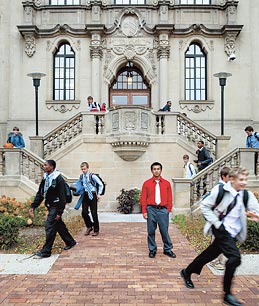
The University of Detroit Jesuit High School and Academy is the last Catholic college-prep school left in the city. Corine Vermeulen for TIME Today approximately one-quarter of the school’s 780 students are city residents, with the rest spread across the inner and outer suburbs. The school allocated $1.4 million in financial aid this year to students who could not afford the $9,990 tuition. “We will not turn away any student who is qualified to come here,” says U of D principal Gary Marando. Jesuits tend to roll their eyes at portrayals of their order’s missionary zeal. (Jeremy Irons’ action Jesuit in The Mission, says Father Patrick Peppard, one of the school’s theology teachers, was “a bit romanticized.”) Still, by any measure, U of D’s service to the city of Detroit since the Jesuits decided to remain has been remarkable. During a period in the late 1970s and early ’80s, the school’s president, Father Malcolm Carron, was even made a Detroit police commissioner. U of D’s continued presence in Detroit offers inner-city boys a way out. But it also gives affluent suburban students a way into a city that has long been neglected by its neighbors. For them, an education at U of D doesn’t involve just driving across city lines to attend classes. Seniors are required to spend every Wednesday morning on a service project in the city. And students in all grades (7 through 12) volunteer their time for no credit. Last year they spent more than 3,500 hours in activities from tutoring public-school kids to delivering food to disabled residents. “We made a commitment to stay in the city,” says Holly Bennetts, the school’s full-time service director. “We have a responsibility to make it better.” Students are told hundreds of times during their education at U of D that they are training to become community leaders, what the Jesuits call “men for others.” The phrase comes up in nearly every conversation with current and former students. “It’s kinda corny,” says Keith Ellison, class of 1981 and a Democratic Congressman from Minnesota, “but that motto really made me think about service. And it set a course for what I’m doing with my life now.” The Jesuit ideal can also be found in more recent graduates like Will Ahee and Tom Howe. Both grew up in tony communities – Grosse Pointe and Birmingham – that may be geographically close to Detroit but are worlds away culturally. Through U of D, they volunteered with Earthworks, an urban garden project that is reclaiming for sustainable agriculture some of the thousands of acres of abandoned lots in Detroit. When they graduated a few years ago, Ahee and Howe could have had their pick of universities. They chose to stay in Detroit and attend Wayne State University, where they study comprehensive food systems. How do these college kids spend their weekends? Working in a community garden they started near Elmwood Park, nine miles from U of D.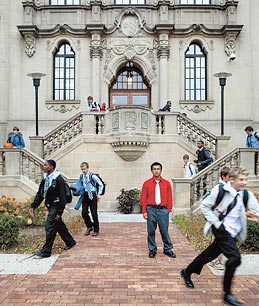
(See pictures of the remains of Detroit.)
(See pictures of a diverse group of American teens.)
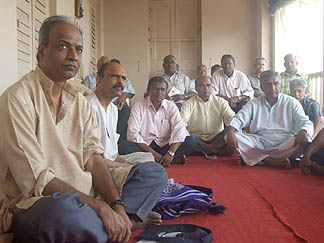
Jesuit provincials and regional
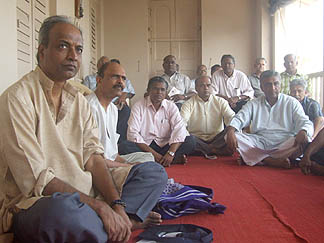
superiors at the Hindu shrine in Belur
KOLKATA, India (UCAN) — Senior Jesuit leaders from South Asia who prayed inside a shrine dedicated to a Hindu ascetic say the visit and prayers have “enriched” them.About 20 provincials and regional superiors of the Jesuit Conference of South Asia spent 15 minutes at the shrine in Belur on Oct. 29, during an event designed to foster interreligious relations.
The Religious conference comprises provincials and regional superiors from Bangladesh, India, Nepal and Sri Lanka.
The shrine, which sits on the banks of the Ganges, north of Kolkata, is dedicated to Sri Ramakrishna Paramahamsa, a 19th century Indian mystic, who claimed to have had visions of Jesus Christ. Swami Vivekananda, the mystic’s most famous disciple, founded the shrine in 1886.
Calcutta Jesuit provincial Father George Pattery, who organized the visit, said the monks at Ramkrishna Mission, who manage the shrine, promote interfaith dialogue. The Jesuit priest has close ties with the monks.
Father Anthony da Silva, provincial of Goa, told UCA News the visit was “an enriching experience” and added the shrine’s mystical atmosphere “greatly impressed” him.
Jesuit leaders meet Sister Mary Prema,
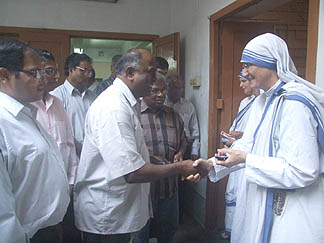
superior general of the Missionaries of Charity
Gujarat provincial superior Father Keith Abranches commented that the visit was “inspiring and enriching. It was another way of God-realization.”Dipankar Basu, a Hindu teacher at Kolkata’s Jesuit-managed St Xavier’s School, guided the group during their visit.
He said it was remarkable to see Catholic priests praying in their own way in a Hindu shrine. An event like this “is sure to have greater effects in creating goodwill, and help people of all faiths to have a change in attitude toward other religions,” Basu told UCA News.
Swami Shantanu Maharaj, from the Sri Ramkrishna Mission headquarters, said Swami Vivekananda founded his religious order on Christmas night in 1886, after he and his friends spent an evening meditating on Christ.
He said Sri Ramkrishna had a vision of Jesus, after which he could not think of anything else for three days. Two of his disciples, Swami Brahmananda and Swami Shivananda, too had a vision of Jesus on Christmas eve 1903 at the Belur shrine.
Earlier in the day, the Jesuit superiors celebrated Mass at the tomb of Blessed Teresa in Kolkata and met Missionaries of Charity superior general, Sister Mary Prema.
The Jesuit provincial and regional superiors are attending their twice-a-year meeting at Konchowki, south of Kolkata.
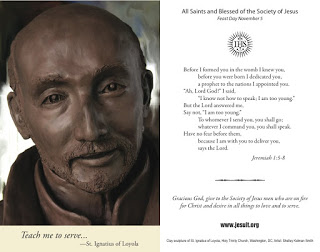
On November 5th, the Church remembers the the Saints and Blessed who have lived their Christian vocations as Companions of Jesus. Please join your prayers with mine as we remember all those Saints and Blessed of the Society of Jesus….those who have come before us and those who live among us now. A Prayer for Vocations Father, We especially as you May your will be done. Amen. Posted by Ryan Duns, SJ
in the name of Jesus,
through the power of your Spirit,
inspire men and women to labor for your kingdom.
through the intercession
of Mary, our Mother,
St. Ignatius, and all the saints,
to help the Society of Jesus
continue its service of your church.
On November 5th, the Church remembers the the Saints and Blessed who have lived their Christian vocations as Companions of Jesus. Please join your prayers with mine as we remember all those Saints and Blessed of the Society of Jesus….those who have come before us and those who live among us now.
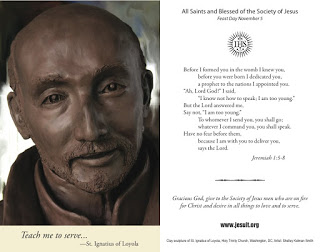
A Prayer for Vocations
Father,
in the name of Jesus,
through the power of your Spirit,
inspire men and women to labor for your kingdom.
We especially as you
through the intercession
of Mary, our Mother,
St. Ignatius, and all the saints,
to help the Society of Jesus
continue its service of your church.
May your will be done.
Amen.
Posted by Ryan Duns, SJ
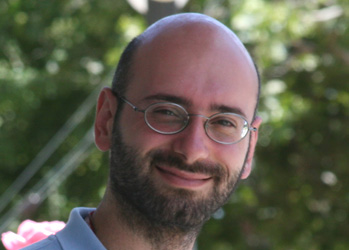
Giuseppe Riggio S.J.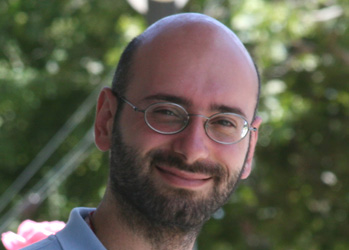
Giuseppe Riggio is an Italian Jesuit in formation. During his philosophy studies in Padua he worked with an association serving refugees and those seeking asylum; he organized courses for people interested in knowing more about immigration. Next, as part of his formation, he worked two years in the Social Justice Secretariat at the Jesuit General Curia in Rome. During that time he had the opportunity to attend the World Social Forum in Brazil and was able to spend some time in a community of indigenous people. Presently he is studying theology in Paris in preparation for priestly ordination.
The Conference of European Jesuit Provincials, holding its annual General Assembly from 18th to
20th October 2009 in Malta, brings to the attention of all European countries the continuing human
tragedy of the forced migrants who make their way from Africa across the Mediterranean Sea to
seek international protection and the chance to build a future with dignity. The question of
migration is a priority for the Society of Jesus worldwide. In Europe the Jesuit Refugee Service has
thirteen country offices, as well as a regional office in Brussels. Many Jesuits work in relation to the
integration of migrants within European societies.
The increasing inaccessibility of Europe to persons who urgently need protection obliges thousands
of men, women and children to risk their lives by crossing the sea on small, fragile boats, often with
tragic consequences. Every year, several hundred persons taking this route towards Europe in
search of asylum reach Malta, or need to be rescued and brought there. Except for the most
desperate and vulnerable cases, they are then held in prolonged detention, in conditions that deepen
previous suffering. If they succeed in gaining international protection, they still face untold
difficulties, stemming from overcrowding, from Malta’s very limited capacity to receive them, and
from the scarcity of employment opportunities.
We Jesuit provincials maintain that this humanitarian issue cannot be resolved in Malta alone, or even by the states on the EU’s southern borders. It is a matter that requires urgent action by the
entire European Union.
We therefore urge the states most directly concerned, and also the European Union, to make asylum
in Europe truly accessible, and to deal more justly and humanely with the forced migrants who
reach our shores. As this tragedy, with its roots in countries of origin in our neighbouring continent
of Africa, continues to unfold we make three calls to our governments and to the European Union:
to show effective solidarity with persons urgently seeking protection; to share with over-burdened
border states the responsibility of meeting our shared human rights obligations; and to strengthen
partnerships with African states so as to create new opportunities for their peoples to sustain a life
with dignity.
Equally, it is a challenge to the whole of European society to confront the fear and xenophobia that
sometimes underlies the utter resistance to the claims of migrants.
The Assembly represents about 5900 Jesuits, and their colleagues, working in twenty-three
member states of the European Union, as well as in Russia, Ukraine, Croatia, Switzerland, the
Western Balkans, the Middle East and the Maghreb.
Malta
20 October, 2009
 Malta is a country with no frontiers, only horizons
– Fr General Adolfo Nicolás sj
‘As Jesuits we are called to be at the frontiers – Malta is a country with no frontiers, only horizons.’
These are the words Fr Adolfo Nicolás, Superior General of the Society Of Jesus (Jesuits), used to describe Malta during the short speech he delivered to a Church packed with young people on Saturday evening.

‘When I stand on the roof and look in one direction,’ said Fr Nicolás to the young congregation, ‘I know there, in the distance, is Africa. When I turn and look in the other direction, I know there is Europe. In my lifetime I have met Maltese Jesuits who had been sent to India, Chile, different countries in Africa, the Middle East and Europe. Our Mission is a Universal one, and I know that you too have gone to give service in several countries. Just like the Jesuits of Malta, you too have a Universal Mission.”

‘The day begins, a wise man once said, when the light is strong enough for us to distinguish the face of a brother or a sister. When you go to visit the prison and the Detention Centres, you see the faces of brothers and sisters who are suffering, and you dream about the time when that suffering will end.’
A sight which Fr General will cherish, he said, ‘is the sight I have now, here. I see all of you, and I like what I see. What do I dream? I dream that a good number of you will want to join us and become Jesuits!… And I dream that the others will be our collaborators so that we can all work at the dreams that you have and that we have, so that the world can become a better place.’
Fr John Dardis sj, who hails from Ireland, delivered the Sermon. His message to the young people gathered
there was that faith is not simply a set of beliefs, but is found in the Person of Jesus Christ and what he has to say to us here and now.
The Youth Mass, organized weekly at Sarria Church, Floriana, by InYgo (Ignatian Youth Network), was also attended by over thirty European Jesuit Provincials who are in Malta this week, participating in their annual Conference.
SAM PHRAN, Thailand (UCAN) – Final-year seminarians have been told they must show greater respect for nuns and women co-workers after a report revealed simmering tensions between the two groups.
Priests are accused of being high-handed and disrespectful in some cases and of inappropriate behavior in others, according to Sister Kanlaya Trisopha, former chaplain of the Catholic Commission for Women.
Sister Kanlaya was speaking on the issue at a seminar and workshop for about 20 final-year seminarians and nuns about to take their final vows. The event, held in Ban Phu Wan pastoral training center in Sam Phran, west of Bangkok, aimed at helping participants avoid such tensions in the future.
Referring to a report on the matter during the Oct. 12-15 meeting, Sister Kanlaya highlighted a case “where a priest, who had a problem with a nun, brought up the issue in his homily and wrote about it in the weekly newsletter.”
“Even though the priest didn’t name the nun, the nun knew he was referring to her and she didn’t have the chance to respond.”
Sister Kanlaya told the seminar that the behavior of clergy sometimes raised eyebrows among the laity, citing a case involving a nun and a priest who worked together daily. “Instead of going home, the priest would take the nun to a recreational spot for dinner and only return to his church late at night. This was questioned by laypeople,” Sister Kanlaya said.
She said another source of tension came from the way instructions were sometimes given. Her report reveals that some priests do not discuss instructions with nuns and other women co-workers, simply handing them written orders.
“From a woman’s perspective, this shows disrespect, while men don’t see it as an issue,” Sister Kanlaya said.
Father Chaiyo Kitsakul, rector of Saeng Tham College, the national major seminary in Sam Phran, told participants, “There have been problems between priests and nuns because men and women see things from different perspectives.”
Priests often use their status, consciously or unconsciously, to dominate others, he said. He called on the seminarians to “listen to others, especially women and nuns.”
Father Miguel Garaizabal, a resource person for the workshop, told UCA News problems arise when priests feel that it is the duty of nuns to serve them.
“This training is aimed at both men and women to respect and fully support each other and build a model of friendship and collaboration,” said the Spanish Jesuit priest.
Nun participants also shared experiences of inappropriate behavior by seminarians. Immaculate Heart of Mary Sister Alicesara Suripa admitted she has “warned” seminarians who “touch us or try to hold our hands.”
Sornchai Dhipo, a seminarian from Chiang Mai diocese, said he would now be more sensitive toward women co-workers. He recalled an incident in which a new priest, upon arriving at a parish, asked a nun to vacate her office for him. This act soured the relationship between the two.
The recent workshop is the eighth in a series of annual dialogue sessions between final-year seminarians and nuns. In future, “we plan to invite lay women Church workers to attend as well,” said Father Chaiyo.
 Jesuits and co-workers in the social apostolate from the Asia-Pacific region met in Manila 17 – 21 August. The purpose of the meeting was to explore collaboration to achieve greater synergy for universal mission within the territory of the Jesuit Conference of East Asia and Oceania, and internationally. Participants from the Australia, Cambodia, China, Indonesia, Japan, Korea, Malaysia, Micronesia, Myanmar, Philippines, Singapore, Taiwan, Timor Leste, and Vietnam were joined by Fernando Franco SJ, Director of the Social Justice Secretariat in Rome.
From among the themes already identified by the Ignatian Advocacy Network at the international level, the meeting identified migration, interfaith collaboration, and environmental issues as being of the greatest concern in the Asia-Pacific region. The formation of young Jesuits and of co-workers for work in the social apostolate also emerged as a key concern, as did support for the regions of Cambodia, Laos, Myanmar, Thailand and Timor Leste. Formation and support for the regions of the Conference are established JCEAO priorities and the gathering wished to ensure that the social dimension is emphasized within them.

While this was the first social apostolate meeting of JCEAO in several years, Conference President Mark Raper has made a commitment to support annual meetings. A reference team has been appointed to support and assist Denis Kim, the Conference Social Apostolate Coordinator, and networks are being formed around key concerns. Already action plans are being developed. The next social apostolate gathering is planned for August 2010.
To assist JCEAO in its general planning, a mapping exercise has begun to identify key people and organizations active in the social apostolate in the Asia-Pacific region, to understand the socio-economic context of the Asia-Pacific region, and to identify possible creative responses to the challenges. It is expected that this exercise will provide more detailed information to support social apostolate networks on environmental issues, migration, and key issues in the regions.
