

Author: cfliao


KOLKATA, India (UCAN) — Jesuits in Kolkata have been urged not to rest on their laurels but work harder to serve Indian society, during programs marking 150 years of their Bengal mission. An entrance dance during the Mass celebrating
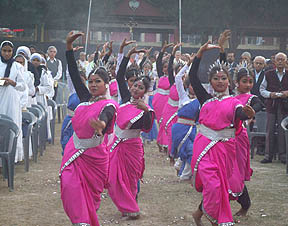
the 150th anniversary of the Bengal mission
The early missioners contributed a lot to the development of tribal communities in eastern India, noted Naresh Gupta, secretary of the national Jesuit Alumni Association of India, at a Nov. 28 function to mark the occasion.
However, he said he now wants the Jesuits to widen their scope and provide healthcare facilities in the country, which remain neglected.
Similarly, Jesuit Provincial of South Asia Father Edward Mudavassery, while paying tribute to the Jesuits’ contributions in Bengal, invited them not to bask in their past glory but get ready to face current challenges boldly.
More than 2,000 people, including 10 bishops, attended the jubilee celebrations at St. Xavier’s College in Kolkata (formerly called Calcutta), the capital of West Bengal state.
The program included a symposium on Jesuit contribution to the education and social life of people in eastern India, an exhibition on the Bengal mission’s growth and a multimedia presentation on the mission.
Cardinal Telesphore P. Toppo of Ranchi, in his homily during the jubilee Mass, compared the early Belgian Jesuit missioners to Abraham of the Old Testament, who left his homeland for a place that God had chosen for him. The cardinal expressed hope that the jubilee celebrations would renew the “missionary zeal in our time even though it may encounter many obstacles.”
Concelebrants during the Mass: From left: Retired Archbishop Henry D’Souza of Calcutta, Cardinal
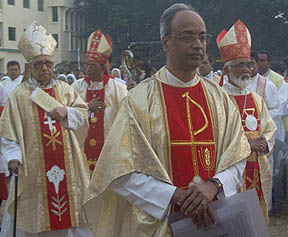
Telesphore Toppo, Calcutta Jesuit Provincial Father
George Pattery and Bishop Salvadore Lobo of Baruipur
Four Belgian and three English Jesuits landed in Kolkata port on Nov. 28, 1859. The mission they started now comprises two archdioceses, 21 dioceses, and seven Jesuit provinces, spread over Bihar, Chhattisgarh, Jharkhand, Orissa and West Bengal states.
Other guests at the event praised the pioneering spirit of the early missioners.
The Jesuits in Bengal have dedicated their life to enrich the lives of people with their quality education and cultural contributions, said Salomi Mamata, who works with Calcutta archdiocese’s social service center. “What I am today is thanks to the Kolkata Jesuits,” she said.
Snehashish Sur, a TV journalist, hailed the Jesuits’ values-based education and identification with local people. He said he was surprised when the late Belgian Father Gerard Beckers started living in a tribal Santal area after retiring from his work at St. Xavier’s College. “He moved around in a bicycle, and that was truly exemplary,” he added.


 Children enjoy hearing Christmas stories this time of year. Help them notice how the stories usually echo themes and values of the Bible’s account of how a great king of humble origins exalts the lowly, confounds the powerful, and brings salvation.
The Polar Express
A train full of children is taken on a magical ride to the North Pole to meet Santa Clause who selects one child to whom to present the first present of Christmas.
Rudolph the Red-Nosed Reindeer
When strong, powerful reindeer run into serious trouble, a lowly reindeer saves the day. This completely unexpected turn of events brings great joy to the world.
A Charlie Brown Christmas
Protesting the commercialization of Christmas, Charlie Brown buys a pathetic-looking, real Christmas tree. He is mocked for it, but Charlie and his friends learn the real meaning of Christmas when Linus tells the story of Jesus’ birth.
The Little Drummer Boy
A boy of humble origins grows to hate people after his family is killed and he is betrayed. His life begins to change when he meets the Magi and follows them to Bethlehem. Finally, when the boy encounters the Christ Child, he learns how to let go of hatred and embrace the true spirit of Christmas.


Of all times for the financial health of the world to end up in Intensive Care-just as the holidays entice us to splurge, to buy a little beyond ourselves because gift-buying and gift-giving are expressions of care, appreciation, even remembrance. We bake richer foods at Christmastime. And wrap things in shinier paper. And we like to spend a little more, just because this time is special. It is a time for feasting and lingering. It is a time for extravagance.

There is some justification for extravagance at this time of year. We are celebrating the love of an extravagant God. The Christ Child is the ultimate gift. God’s love is lavish, overflowing. God did not hold back from us, in sending Jesus, the son of God. In that birth we were given God’s very self.
And so, this year in which money is especially the focus of stress and strategy, perhaps we should think in terms of giving the self instead of stuff. God gave God’s self in fairly plain wrapping-the infant of two pilgrims with limited resources. No fine blankets or silky bassinet for Jesus. No huge basket of Ghirardelli’s chocolate treats for his parents. But the presence of that child was so rich and fine that poor shepherds, great intellects from far countries, a pious widow and an old prophet were all drawn to him with tears and joy.
What kind of presence am I to those I love? If I can’t give a hefty gift certificate or even a nice set of bathroom towels this year, how can I be more present to that person for whom I’ve been willing to pull out an overextended credit card in years past? If I can offer no great cash value, then what is left? My stories? My welcome? My precious time for a phone conversation? My visit that lasts longer than it takes to exchange wrapped boxes?
This has been a stressful autumn for my husband and me. Unemployment, then underemployment, then major house repairs, and family too far away to travel to easily. And what we are discovering is that, to come home in the evening and eat a simple meal together, to give a long hug and a word of encouragement, to spend a little more time with our dogs and cats doing nothing but petting and cooing-all of that is lavish enough for us. There will be no expensive dining out this year, no big party thrown for friends. There will be cooking together in the kitchen, looking for the best price on clementines. There will be one trip to a family wedding and brief stops at other relatives on the way back. On each stop we will enter the home and be there with smaller gifts but a bigger sense of us-us coming in the door, giving hugs, having a relaxed conversation, enjoying the presence of those we don’t get to see very often.
We tend to forget, don’t we, that God’s presence is enough. God’s grace is sufficient. We forget that and follow after the big pay-off, the nicer car, the gadget that will make life more convenient, the vacation that will be more romantic and exotic than all the others. We hanker after finer and pricier presents, when the only answer to our real desire is that awesome Presence.
This Christmas seems like a great time to spend more time in that Presence. And more time exploring the power and wonder of our own presence with others.
This article is written by Vinita Hampton Wright, author of Days of Deepening Friendship


“For the Son of Man did not come to be served but to serve and to give his life as a ransom for many” (Mark 10:45)
A s our political campaigns draw near to election day, we hear much talk about leadership. While we tend to know it when we see it, leadership is hard to define and does not seem to follow any one pattern or formula. Today’s Scripture readings describe leadership as the service of others and portray Jesus as the best example of it. A series of images from Mark 10 and Hebrews 4 in today’s readings can help us grasp Jesus’ noble and paradoxical notion of servant leadership.
In Scripture “cup” and “baptism” are sometimes images of suffering. To drink the cup is to accept the reality of suffering and to do God’s will in the midst of it, as Jesus did in Gethsemane. To undergo a baptism is to be immersed in water and to suffer a kind of drowning. The point that Jesus makes to James and John is that those who follow the way of Jesus and seek to imitate his example of servant leadership must be willing even to suffer for others.
The images of leaders “lording” over others and making their authority felt stand in contrast to the leadership style of Jesus. Too often in our world, leadership involves a battle of wills and means exercising force over others and making others conform to the leader’s will. This all-too-prevalent pattern is far from Jesus’ ideal of servant leadership.
To be “the slave of all” appears at first glance to be the opposite of being a leader. Slavery was an accepted institution in the Roman empire and an integral part of the economic and social fabric of Greco-Roman society. To speak of a slave was not unusual. But to describe anyone as “the slave of all” made no sense. A slave had only one master. How can anyone be the slave of all, and how can such a person be a leader? Nevertheless, Jesus, as a master of paradox in word and deed, brings these two concepts together in his concept of servant leadership.
The image of “ransom” evokes the practice of buying someone out of slavery or kidnapping. Paying a ransom can sometimes bring that person back to safety and freedom. The image suggests that Jesus’ death on the cross was a kind of redemption or ransom that enabled us to gain freedom from sin and death and to share the intimate relationship that Jesus enjoyed with his heavenly Father. The idea is rooted in the Servant of the Lord described in Isaiah 53: “through his suffering my servant shall justify many.” The goal of Jesus’ life and death was not power over others but rather the service of others. As the one who came not to be served but to serve, Jesus provides the pattern and the measure of his own ideal of servant leadership.
To express the effects of Jesus’ servant leadership, the author of Hebrews uses the images of “sacrifice” and “priest.” Like other early Christians, he understood Jesus’ death on the cross to be an atoning sacrifice for sins. Because Jesus freely and willingly went to his death for us, he reasoned that Jesus can therefore be regarded as a priest (since priests customarily offered sacrifices). He further argued that unlike the Jewish high priests who offered sacrifices yearly on the Day of Atonement, Jesus, who offered himself once for all as the perfect sacrifice for sins, can be called the great high priest.
Like other New Testament writers, the author of Hebrews interpreted the passion, death, resurrection and exaltation of Jesus as one great comprehensive event (the paschal mystery). In describing the last element he employs the image of Jesus passing through the heavens to return to his Father. Because of the paschal mystery, the author of Hebrews could exhort his confused and weary audience to hold fast to their confession of faith. His point was this: the one truly efficacious sacrifice for sins has been offered in Jesus’ death on the cross. Christ the great high priest has done his saving work, and the victory has been won once and for all. We do not have to do what the Jewish high priests did yearly on the Day of Atonement, because what Jesus did is more than sufficient. This is the author’s word of consolation and exhortation.
Today’s passage from Hebrews 4 allows us to understand better the results of Jesus’ practice of servant leadership. As one like us in all things but sin, Jesus can be sympathetic toward us and can serve still as our advocate and defender. And because of his servant leadership, we can approach God confidently and even boldly and expect to find mercy at what is now the “throne of grace.” All this flows from and through the servant leadership of Jesus.
Praying with Scripture
• How do you define leadership? Who best exemplifies leadership for you? Why?
• In what respect is Jesus the best example of his own ideal of servant leadership?
• Why does the author of Hebrews express the effects of Jesus’ servant leadership in terms of sacrifice and priesthood? Do you find these images helpful? What images might you use?
Daniel J. Harrington, S.J., is professor of New Testament at Weston Jesuit School of Theology in Cambridge, Mass.
 At the end of his 1981 encyclical on the family, Pope John Paul II had this to say about the Holy Family: “Through God’s mysterious design, it was in that family that the Son of God spent long years of a hidden life. It is therefore the prototype and example for all Christian families. It was unique in the world. Its life was passed in anonymity and silence in a little town in Palestine. It underwent trials of poverty, persecution and exile. It glorified God in an incomparably exalted and pure way.” This statement focuses our attention on two central elements of family life: the ordinariness of home life, and the sufferings that family members will inevitably have to face. The Holy Family, by its wonderful example, can help all families, the Holy Father said, “to be faithful to their day-to-day duties, to bear the cares and tribulations of life, [and] to be open and generous to the needs of others.”

Our Lady, Throne of Wisdom, Completes Aussie Tour 
By Carmen Elena Villa
VATICAN CITY, DEC. 18, 2009 (Zenit.org).- The Sedes Sapientiae icon of Our Lady — commissioned by Pope John Paul II for university students in 2000 — has finished its tour of Australia and is headed now to Africa.
A climate of prayer, intercultural friendship, and naturally, the search for wisdom, marked the Thursday vespers service during which the icon was given to African students by their Australian contemporaries.
Breaking with tradition, Benedict XVI himself presided over a pre-Christmas vespers service with
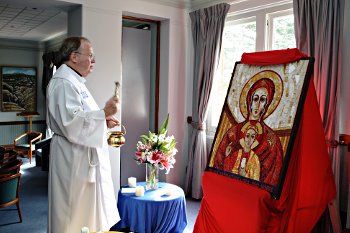
university students of Rome (usually the vicar for Rome celebrates the Mass and presides over vespers, and the Pope arrives at the end to give an address).
The icon of Our Lady, Throne of Wisdom — created by Jesuit Father Ivan Rupnik — spent the year visiting Australian universities. The Pope chose this venue following the July 2008 World Youth Day in Sydney.
Daniel Hill, of the University of Sydney, was with 10 other young Australians in a delegation that traveled to Rome to entrust the icon to Africa.
He said the icon’s time Down Under was “a beautiful experience,” explaining that the image visited 13 universities.
Hill recounted to ZENIT how during the tour, small groups of students gathered to reflect on the presence of Mary in university life. “It helped us to understand that the university should be a light that radiates the light of Christ through the example of his holy Mother,” he said.
Seminarian Nicholas Rynne spoke of the change experienced by many young Australians over the last two years. “As Catholics, it is easy to feel isolated, but with this icon and with World Youth Day, we have had a powerful experience of communion with the Church.”
As 2009 was an important year for the Church in Africa — with the Pope’s first apostolic visit there last March and October’s synod on Africa — 2010 will see the icon traveling to various universities across that continent.
The vespers service in Rome on Thursday already had an African feel, with the entrance and closing Marian hymns being sung to African melodies.
For young Father Paul Ubebe of Nigeria, the presence of the icon “enables us to be closer to the Church as university students. In this way, we value more the role of Mary in our salvation.”
Reine Marie Miranda of Senegal told ZENIT that the most moving experience at vespers was the Pope’s homily. Benedict XVI said, “Without the wisdom of God, not anything has been made of all that exists: A Christian professor or student reads everything in his light.”
For Miranda, “to be humble is to see study with the eyes of little ones. Reasoning as a child, one can make miracles, because for a child, there are no limits.”
Two Jesuits from OCIPE in Brussels, José Ignacio Garcia (CAS) and Jacques Haers (BSE), are present at the COP15 Climate Conference in Copenhagen as NGO observers, part of a team of Franciscans International. They keep up a blog, with posts in English and in Spanish, reflecting their personal reflections and experiences. This blog can be visited at: http://ignatianeconet.wordpress.com.
Jesuit Refugee Service/USA (Washington, D.C.) – In letters to the U.S. State Department and to the United Nations High Commissioner for Refugees, Jesuit Refugee Service/USA has joined our partners to share the views of InterAction’s Humanitarian Partnerships Working Group and Refugee Council USA’s Protection Committee on key issues ahead of next week’s High Commissioner’s Dialogue on Protection. The Dialogue on Protection Challenges will take place on December 9 and 10, in Geneva. The conference will focus on the hurdles faced by refugees and forcibly displaced people in cities and other urban settings. In 2007, United Nations High Commissioner for Refugees António Guterres established the Dialogue to facilitate informal discussion of global protection issues by UNHCR, nations, academics, non-governmental organizations and other stakeholders. Jesuit Refugee Service/USA and our partners welcome the release of the “UNHCR Policy on Refugee Protection and Solutions in Urban Areas” and are pleased with the principles and general direction reflected in the document. It represents a considerable improvement over previous iterations of UNHCR’s policy and approach to these populations. The need for this new policy could not be more urgent as the majority of refugees now live outside camps and urban refugees are likely to be the face of displacement in the 21st century. The challenge now is to ensure its timely and effective implementation. We remain concerned that while the policy document provides a strong framework for action, it does not provide the operational guidance that is urgently needed by the humanitarian community. The issues are complex and require new approaches, new partnerships, and new skills. We hope that the Dialogue will provide an important venue for identification of the key operational issues and initial planning on implementation. At the Dialogue, and in the ensuing months, we urge the U.S. government to: Complement a U.S. call for action on implementation with a pledge to integrate the concerns of urban refugees into U.S. diplomacy, and with an assurance that U.S. financial support for protection and assistance of refugees also includes those in urban settings. The international donor community will need to work in a more coordinated fashion, cutting across development and humanitarian assistance ‘silos,’ to meet the needs of urban refugees. The U.S. can show its support for such an integrated response by ensuring that funding streams, including those overseen by PRM and USAID, are flexible to assist vulnerable urban refugee populations as well as camp-based populations. As a leading nation in providing resettlement as a durable solution, the U.S. can also do much to promote the strategic use of resettlement as one way to unlock protracted urban refugee situations, in addition to promoting local integration and voluntary repatriation. Convey the U.S.’s support for UNHCR,’s strategy to develop deeper partnerships across UN agencies and with governments and non-governmental organizations (NGOs) to better address the needs of urban refugees, as articulated in the new policy. Given the obstacles inherent in reaching out to refugees in urban contexts, the response on the ground will need to employ a variety of approaches and will need to mobilize the capacities of diverse actors, including the UN, humanitarian and development organizations, local and national governmental bodies, and local and international NGOs. The international community will need to work much more closely with local and national entities than has been the case in the past in order to create a cooperative environment in which urban refugees can be identified, protected and served. NGOs, in particular, have a critical role to play in turning a good policy into strong programming in the field. Our organizations – both humanitarian and development – are already operating in urban areas. We have excellent connections with local NGOs and access to communities that allow us to serve as effective partners with governments and with UNHCR in identifying and serving refugees and vulnerable populations in urban areas. Precedents already exist for cooperation between UNHCR, governments, and NGOs in a number of urban settings. Good practices, already identified in the course of such cooperation, can serve as a basis for the development of innovative pilot projects. In some contexts, UNHCR and governments are already partnering with NGOs to help with identification, outreach and assistance to urban refugee populations. We welcome the emphasis on partnership that currently exists in the policy and look forward to working with UNHCR and governments to establish mechanisms for partnerships at all stages of the response in urban settings – from identification to assistance. Donor support will be key. Housing, education, cash assistance, and medical care will be more expensive. Outreach and identification will be labor intensive and hence more costly. In light of the significant resources implications of the new policy, we look forward to a discussion of how implementation activities will be reflected and prioritized in the global needs assessment process. We look forward to partnering with governments and UNHCR to educate donors and all relevant actors on the increase of resources that will be required to bring adequate protection and assistance into the urban environment. Perhaps more than ever, UNHCR will have to strengthen its advocacy role and legal protection capacities. Maintaining protection space in urban settings, particularly in light of forced encampment policies, arbitrary arrest and detention, and state failure to adhere to or recognize international refugee law, will be challenging. NGOs stand ready to join UNHCR in public advocacy on behalf of refugees in urban settings. We are fortunate that several U.S. based NGOs will be able to attend the Dialogue. They will come prepared to speak on a variety of themes and issues related to the agenda (click here). These themes represent only preliminary thinking on the policy and suggested ways forward. We also hope we can count on the U.S. government’s support for our recommendations in these important areas as well.

A JRS education program
for Iraqi refugees in Amman, Jordan.
(Peter Balleis, S.J./Jesuit Refugee Service)

Iraqi refugees in Syria
take part in a JRS education program.
(Peter Balleis, S.J./Jesuit Refugee Service)

Besides having Christ as the focal point, Nativities capture a snapshot of the life of the people in these scenes. Yet each artist interprets the scene according to his or her particular culture. For example, an American artist might depict the Nativity in a garage, with dogs and cats roaming around instead of camels and sheep. By creating Nativity scenes that reflect their cultures, these artists show us that God is truly present in our lives here and now.
This wood carving was created by Agustín Cruz Tinoco, who was born in San Juan Oxolotepec, Oaxaca, Mexico. He is an excellent folk artist and woodcarver. Many of his creations are done in the Oaxacan style of alebrijes, which are representations of imaginary human- or animal-like creatures using vivid colors and images.
In the woodcarving “Nativity”, Tinoco has created a boat-like vessel with a masthead shaped like a woman. Sitting on the prow is Mary with Jesus on her lap. She is dressed in ordinary Mexican clothing. Her husband Joseph is rowing the boat. A figure representing a shepherd stands at the end of the boat, watching over the family. On the left side are two kings and on the right is another king and an angel. The kings bring gifts of a pig, a turkey, and a rooster.
This ceramic nativity was created by Feriberto Aylas, who is from Ayacucho, Peru. Aylas specializes in ceramics and strives to keep the traditional techniques of the Andean people. In each of his creations, Aylas seeks to express the heart of Peru through depictions of the daily joys, rituals, and activities found in Andean villages.

In many Nativity scenes, each person, animal, and object is created separately. This Nativity, however, is different. The whole scene is composed out of a single piece of clay. The clay is hand-shaped and prepared for firing. After it is fired, it is painted by hand with natural pigments. When the paint is dry, a clear sealant is applied.
If you were to design a Nativity scene that showed how God is present in your life, what would it look like?
My life has been one continuous apprenticeship. And my best teachers have been the poor and the young people of Andalusia and Latin America, especially those of Paraguay.
Right now my apprenticeship is in Bañado Sur de Asunción, a neighbourhood with 16,000 inhabitants. Every ten years or so this zone is flooded to a depth of four metres, so that for more than nine months we have to live in wooden shacks strung along the city’s avenues. When the waters of the Paraguay River finally recede and people return to their homes, they have to start all over again from scratch.
The Bañado Sur district is the frontier between humanity and inhumanity. Some 90% of its people live in poverty, and more than half live in absolute misery. What is most lacking is work, and I don’t mean dignified work, just work. There is a garbage dump where men, women, and children spend their lives for the sake of earning two dollars a day. The heat and the humidity of the place are suffocating, and the people have to work completely covered with clothes. Other people push little carts around the city centre collecting plastic items; they spend more than two hours going and another two returning.
In Bañado Sur there are no sewers, and waste waters flow through the streets. Drugs are rampant and hold the young people of the neighbourhood in their grip. Many robberies are committed every day for the sake of getting a ration of marijuana or crack. To top things off, there is frequently no water or electricity in the area. And the malnutrition is alarming.
Nevertheless, despite all this, I consider Bañado Sur to be Paraguay’s moral reservoir. If in the midst of these conditions the people still show a great desire to live and are so outstanding in their hospitality and solidarity, then there is no person and no force that will ever take those values away from them. And all of this in the midst of great joy and peace.
What have I learned? Well, that my Faith is lived out in struggling with them and beside them – on the board of advisors for all the social organizations of Bañado Sur and as the priest for three of the area’s chapels. I join with the “Thousand in Solidarity” in providing assistance so that 500 youths aged 14 to 18 can earn a living by studying and then go on to the university.
But the most important thing I have learned is that at the age of 81, I can still have a youthful heart. This is the greatest treasure the young people and the poor have given me. Perhaps at last I am beginning to be a little like them.