
by Shea Zirlott
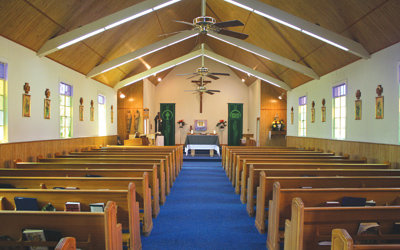
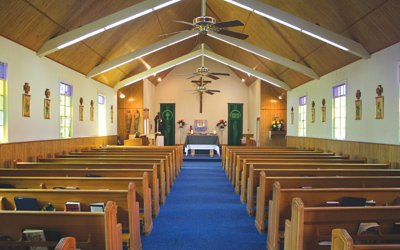
In a small church in west Anniston the Sunday before last, about three dozen faithful were spread out amongst the 25 pews. The pews may not have filled, but parishioners were not all that was missing from All Saints Catholic Church.
There was no priest present, due to a “miscommunication with the cathedral” about plans for a visiting priest to celebrate Mass.
Instead, deacon Mike Cova said his first Mass of many that day to the worshippers gathered in the cozy, 75-year-old church.
Mass without a priest is something the parishioners at All Saints have grown accustomed to over the past two decades, and they have learned to adapt and make the most of their situation.
Going without a resident priest dedicated to their parish is an option that many in the congregation prefer to the option they were forced to accept in the past. In the late 1980s, because there were not enough priests to go around, the archdiocese of Birmingham closed the doors of All Saints and merged the congregation with the much larger Sacred Heart of Jesus Catholic Church in Anniston. “We felt like outcasts there,” said parishioner Rose Munford. “We wanted our church back.”
The doors reopened after about a year, and since then Mass has been led by whomever was available, including deacons and local priests who could fit Mass at All Saints in with Mass at their own parishes.
All Saints has not always been without a priest. When the historically African-American church was established in the 1940s, in the midst of Jim Crow and segregation, the church was home to a Catholic school as well.
“I have always felt that we were given a wonderful education because we were exposed to the orders, and we were held to a higher standard than other kids, and learned art and music,” said Munford. “This is what formed me. Their dedication is why I do so much in the community.”
This past year, All Saints had the same priest come every weekend to lead Mass, but he was not solely responsible for All Saints parish. Then the archdiocese assigned him to a bigger church in Birmingham.
“They pulled our priest and left us with no one,” Munford said. “We are smaller and don’t bring in a lot of money. Our money barely keeps us open.”
Munford considers her church to be “a very blessed church that has been very fortunate.”
Many of her fellow parishioners like the experiences and insights that the visiting priests have brought with them throughout the years, saying they have helped them grow as a parish.
Priests declining nationally
In recent years, the Catholic Church has faced a decline in the number of men and women called to vocations – priests, deacons or members of any holy order – especially young men and women in the United States.
Also, a substantial number of older priests have retired from the active priesthood.
The church has been forced to close or reshuffle parishes. Many priests have come from countries such as India, which has a booming Catholic population and has ended up with more priests than it needed.
What some are calling a priest shortage is actually a “relative phenomenon,” according to M. Rev. Mark Lewis, S.J., provincial supervisor of the Jesuits of the New Orleans Province. “Compared to the 1950s, the numbers are lower, but the biggest drop in clergy numbers seems to have occurred in the 1970s, and it has leveled off now,” he said. “We notice it more because the population of priests is now divided between the much older majority and a growing number of young priests, a group too small to replace every older priest.”
Locally, there are two Catholic churches in Anniston, one in Jacksonville, one in Piedmont and a Catholic school in Anniston.
In the archdiocese of Birmingham, which covers 54 parishes in the state, the number of priests has declined while the number of Catholics has grown, according to Rev. John Martignoni, director of the office of new evangelization and stewardship.
There are 103 priests in the diocese for those 54 parishes. But some parishes do not have a priest, and some share priests amongst parishes. There are 89,000 Catholics in the diocese, which averages out to one priest for every 864 Catholics.
Parishes have been affected because each priest is responsible for more people than in decades past. The ratio, Martignoni said, makes it “harder on the individual priests because they are busier with sacraments, and it is making the priest’s schedules more hectic and their lives busier.”
The archdiocese is taking steps to reverse the trend, Martignoni said, working with a vocations consultant to boost the number of seminary students over the next five to 15 years.
There are many factors influencing the decline in seminarians, including the rising cost of seminary and the recent sexual abuse scandals that have rocked the Catholic Church. Lewis said the real concern should be about quality, not quantity. He thinks changes arising from the abuse crisis, including psychological screenings, have helped the church ordain better priests. “Increasingly, the need for good, holy and well-adjusted priests comes to the forefront,” he said. “If there are fewer, they should be better, stay healthier and be good leaders of the community.”
Not just a Catholic crisis
Rev. Bryan Lowe of Sacred Heart Catholic Church in Anniston says the decline in ministries and vocations is not unique to Catholicism.
“It is just not seen as something valuable to do by as many young people as used to see it as something valuable,” he said.
Society has pushed some, he said, to be overly concerned with how much money they can make, or how prestigious they can become. He thinks the church needs to introduce the idea of vocation to its young people, so that when they are thinking about what they will become, religious life can at least cross their minds.
Rev. James Macey of St. Charles Borromeo Catholic Church in Jacksonville became a deacon 10 years ago. After his wife died, he began the process to become a priest.
Macey is part of a growing trend of “second career priests.” Macey is a retired military officer and former university professor. Lowe of Sacred Heart Catholic Church is also a second career priest, answering the call after also retiring from the military.
Macey thinks the decline in religious vocations is due, at least in part, to the culture in America.
“I think it has to do with a general deterioration of moral values, that there is this move away from faith and morals. We live in a very secular society,” he said. “A religion that says, ‘thou shalt’ and ‘shalt not’… these aren’t conditions that are conducive to generating a lot of vocations.”
The rise of deacons
As the number of priests has declined, there has been a rise in the number of deacons, like Mike Cova. Deacons are not priests, but can perform many of the tasks of priests. They can lead Mass, bury the dead, marry, baptize and visit the sick. Deacons cannot give absolution by hearing confessions, or consecrate the Eucharist (also called transubstantiation, when the bread and wine become the body and blood of Christ). Instead, deacons can lead Mass and use previously consecrated bread and wine.
Prior to 1961, there were no deacons in the Catholic Church, according to Cova. Today, there are close to 16,000. There are 54 deacons in the archdiocese of Birmingham.
One of the major differences between deacons and priests is marital status. Priests are “married to the church,” whereas deacons are allowed to be married. According to Cova, 95 percent of the deacons in the United States are married. (Interestingly, there are no deacons in India because there is such a large number of priests in the country.)
Cova acknowledges there may be a shortage of priests if you just look at the numbers, but thinks the real shortage of priests is because “we want priests to be accommodating for us.”
“We are in a society of convenience. We want it when we want it, and we want it now,” he said. Parishioners want to be able to go to Mass at a time that is convenient for them, he explained, and not necessarily when the clergy is available.
He pointed out that there have been congregations in remote areas that have survived for centuries without the constant guidance of a priest. Instead, the local people carried on and held the church together as a community.
The future of All Saints
Munford said she looks forward to a time when All Saints will once again have its own priest. She feels the church needs a priest who will be able to bring more people into the congregation, especially children. The congregation now consists of mostly adults with very few children.
“If you don’t bring younger people in to carry on, the church will stop existing,” she said.
Munford has high hopes for the future of her church, and the potential of her fellow parishioners. “Church is a community. If we really learn the Word, any of us should be able to go up and read the Scripture and give a sermon, if we have learned God’s word and speak it in his name.”
There is potential good news for All Saints. According to Cova, parishioners can expect to see the same priest presiding over Mass every Sunday in the near future. The archdiocese has realigned some priests, although the changes have not gone into effect yet.
He said the parishioners at All Saints have dealt well with not having a full-time priest, but he knows they “would be tickled pink to be able to have a daily Mass.”
Read more: Anniston Star – A shortage of priests Catholic church struggles to serve its growing membership