
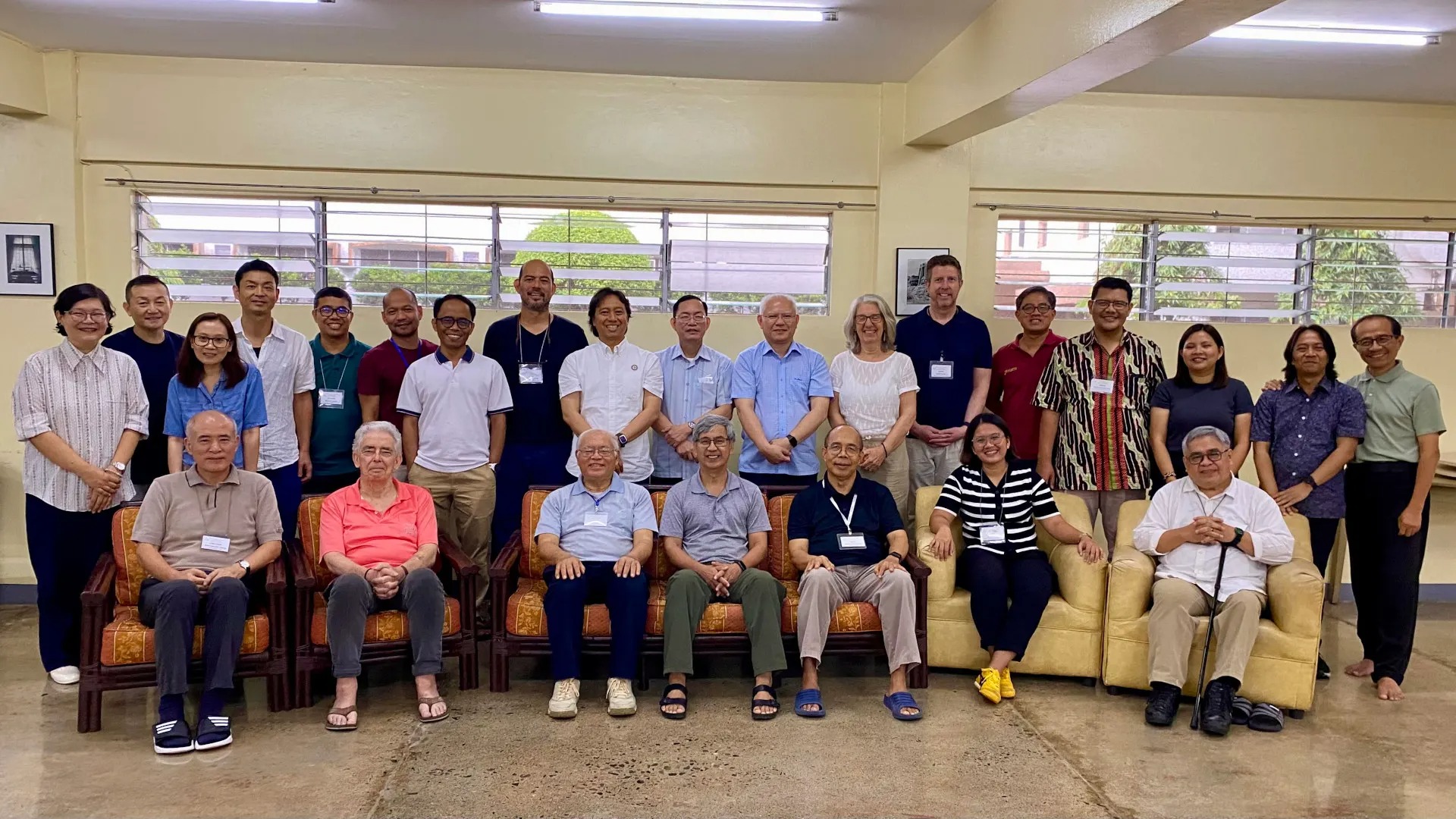
Each year, the Extended Consult gathers to discern the movements of the Holy Spirit in the works and ministries across our conference. Bringing together the president’s consultors, secretaries, and coordinators of apostolic works, the Extended Consult serves as an important instrument of communal discernment in the Society of Jesus.
Prayer and spiritual conversation are at the heart of every consultation. At this year’s gathering, held from 6 to 8 October at the East Asian Pastoral Institute in Manila, listening surfaced as a central theme. The prayer points given by Fr Chris Dumadag SJ set the tone for the two and a half days and highlighted how collaboration begins with deep, prayerful listening. As conference president Fr Jun Viray said, “Listening is a prerequisite for discernment.”
This focus on listening flowed naturally into a key input on the process of crafting the next apostolic plan. The major superiors initiated this process with the guidance of planning consultant JP Villanueva during their assemblies in Palau in February and Tokyo in July. Part of the process involved imagining what a collaborative conference might look like in 2035. From these reflections, Villanueva outlined a vision of a “conference deeply anchored in discernment in common, co-responsible in mission, and collaborative in loving, especially the poor”.
Apostolic planning will be a three-year journey. In 2026, the priority will be discerning where the Spirit is already at work—taking a long, loving look at our reality, listening deeply to where our hearts are, and sensing together where the Lord is leading us as a conference. This listening phase will entail taking stock of what is happening on the ground; deciding which programmes to stop, start, or continue; identifying common themes and emerging tensions; and recognising promising seeds for the future.
To put this in context, Villanueva posed the question: In what world does our mission happen today? He introduced the concept of BANI to describe the nature of our modern era. BANI stands for Brittle ecosystems, Anxious people, Non-linear changes, and Incomprehensible logic. “We live in a world where once one problem is addressed, another one surfaces,” he explained, noting that transformation has become the new business as usual.
This raised the question: How does Ignatian leadership respond in a BANI world? The group affirmed the enduring grace of Ignatian spirituality in the exercise of leadership and care for mission. Dr Achoot Cuyegkeng, professor at the Ateneo de Manila University and co-author of Leading with Depth: A Practitioner’s Guide to 21st-Century Ignatian Leadership, discussed four dimensions of leadership—reflection, listening, discernment, and missioning. An Ignatian leader is self-aware, listens deeply to understand rather than simply to respond, discerns decisions not merely for efficacy but from spiritual, moral, and communal guidance, and inspires others to respond to the call of mission.
Dr Achoot Cuyegkeng discusses “Leading with Depth”
A tangible example of leadership and governance for the sake of mission is Pakistan. A Zoom update from Fr Noel Jayanathan SJ, acting local superior, and Fr Riyo Mursanto SJ, formation delegate, revealed the modest gains of the Jesuits’ presence in the country. Christians are a small, marginalised minority in Pakistan. The Jesuits focus on education, running two secondary schools and a kindergarten serving about 1,120 students, as well as a formation house for candidates and vocation promotion. Their presence, though small, is greatly valued by the local church for its contributions to formation and education. The Loyola Hall Research and Spirituality Centre has become the premiere centre in the country for research, training, and seminars, and the Jesuits are trusted even by non-Christians. A major challenge, however, is the lack of personnel and the need for more formators, spiritual directors, teachers, and administrators, making it crucial to manage expectations amid limited resources and current realities. A significant development was Fr Viray’s announcement that the Ateneo de Manila’s School of Education is interested in offering teacher training sessions for the Jesuit schools in Pakistan.
Safeguarding was also addressed, with Fr Hans Zollner SJ joining online. He emphasised that safeguarding must go beyond safety concepts or guidelines. “The proof of our commitment is in every single apostolate and community.” Safeguarding may have common principles, but approaches must be tailored to local contexts. The Ignatian way forward involves discernment, decision, and humility.
The consultation closed with a response to the call from the JCAP president on issues emerging from the members of the Extended Consult. Julie Edwards, secretary for the social apostolate, asked how the body could work together to make the social apostolate a priority across the conference. She referenced Fr General Arturo Sosa’s message at the Social Justice and Ecology Secretariat meeting last June in Rome, where he spoke of “the urgent need to strengthen the social apostolate and make the difficult commitment to defending and deepening democracy at all levels, on all continents, and in the world system”. Father General described the political dimension of the social apostolate as “the highest form of charity”. This requires including the voice of the poor and collaborating in and beyond the church to create social and political conditions that enhance dignity for all. The emphasis is not to lead but to form partnerships with others.
COP31, which is likely to be held in Australia, was suggested as an opportunity for JCAP to build alliances across church and civil society, continuing the collaborative spirit the Society is showing in COP30. While our role might be modest, participation would mark an important step in weaving integral ecology into every aspect of our apostolic life. The group appeared open to this possibility, which the president’s consultors can take up in their meeting following the Extended Consult.
By Jesuit Conference of Asia Pacific