
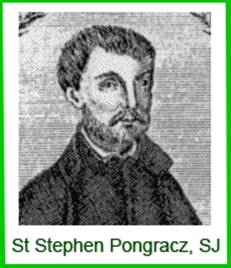
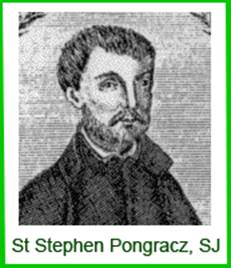
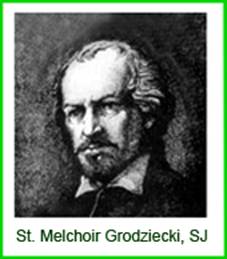
Today we remember three priests who died heroically for their faith, two of whom – Stephen Pongracz and Melchior Grodziecki – were Jesuits and one – Mark Krizevcanin – a diocesan priest.
Stephen was born in Transylvania, in central Romania, about the year 1582 and entered the Jesuits in 1602.
Melchior was born into the Polish aristocracy in Grodiec, near Cieszyn in Silesia, Poland, about 1584 and entered the Jesuits in 1603. He met his companion, Stephen Pongrácz, in the Jesuit novitiate at Brno in 1603.
Stephen could have lived an honourable pleasant life in his native Transylvania, but chose to
preach the Gospel in Prague, eastern Slovakia.
Mark was born in Krizevci in Croatia and did his studies in Graz and in Rome at the Germanicum and Hungaricum. After his ordination he returned to his homeland and served in the Zagreb diocese until he was put in charge of the seminary Trnava, Slovakia. Later, his former professor, Cardinal Pazmany, invited him to the Esztergom Archdiocese in Hungary and entrusted him with the very responsible task of the administration of the seminary and the training of future priests.
In 1619 both Jesuits were sent to the Kosice region (then in Hungary) to care for the religious needs of Catholics living in that Calvinist-dominated region. The king of Hungary had requested the services of Jesuits to care for Roman Catholics neglected during the 30 Years War of the early 17th century. At that time Kosice was a stronghold of Hungarian Calvinists, and the few Catholics who lived in the city and its outlying districts had been without a priest for some time.
Pongracz worked with Hungarians, while Grodziecki evangelised Slavic- and German-speaking peoples. Their ministries were so successful that they became targets of Calvinist antagonism.
Wanting to take advantage of Hungary’s involvement in the Thirty Years War, Gabriel Bethlen, a Calvinist prince in Transylvania tried to expand his own territory.
When the Calvinist Minister heard the Jesuits had arrived in Kosice, he sent his soldiers to arrest them. On news that the Protestant army was marching on the city, the two Jesuits who had been working in small towns returned to Kosice, where they were joined by the diocesan priest Mark Krizevcanin, who was then administrator of the nearby Szeplak Abbey and a canon in Kosice Cathedral.
In July 1619 the Catholics were accused of intentionally causing a fire. The commander of the Calvinist Armed Guard, Juraj Rakoczy, entered the city with the army on 5 September 1619 and on 7 September had all three Catholic priests thrown into a dungeon. They were urged to repudiate their faith in the Successor of St. Peter, stop being “papists” and become Calvinists.
When the priests refused to do so, the soldiers began beating Mark, stabbing him, crushing his fingers and rubbing flaming torches into his side. Finally they beheaded him.
Stephen Pongrácz was tortured next, with the soldiers twisting a rope around his head and almost crushing it. They hung him from the ceiling and cut him deeply before finally turning to Melchior Grodziecki who was beaten and beheaded. The soldiers threw the three bodies into a sewer ditch outside the house but Stephen Pongrácz did not die for another 20 hours.
The news of their martyrdom spread with the speed of lightning but Prince Bethlen did not want to allow the martyrs to be buried with dignity. Only after six months was the Countess Katarina Palffy allowed to bury them with his permission. Today, their graves are in the Ursuline church in Trnava.