


The industry term for the appeal of a Web site is “sticky.” Visitors (or “eyeballs”) stick to a site if it is interesting, lively, useful, provocative and generally appealing. Conversely, the “bounce rate” refers to how frequently initial visitors navigate away from a page to a different site. Sticky is good; bouncy is bad.
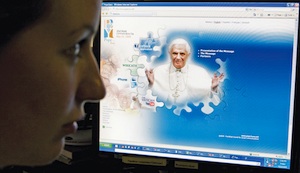
How bouncy or sticky are Catholic Web sites? More broadly, how well is the church using social and digital media in its mission to spread the Gospel? Since “the church” can mean many things, let’s narrow the topic down: How well are those who work in church organizations in this country using social and digital media?
First, the good news. These days almost every Catholic organization and diocese and most parishes have a firm Web presence. Available to both the devout and the doubtful, these sites are repositories of useful information. One can check out editorials in the diocesan newspaper, follow the pastor’s blog (and read his latest homily), make donations to a favorite Catholic charity, and check on Mass times. An up-to-date Web site is as much a necessity today as a weekly parish bulletin is (or used to be).
More good news: The U.S. Conference of Catholic Bishops has found great success in the world of social media. It has over 29,000 “fans” on Facebook, where the conference sometimes sponsors trivia contests and where fans use the page for lively discussions. The conference also maintains its own YouTube channel and frequently updates its Twitter feed. Sample tweet: “Are you ready to spend some behind-the-scenes time w/Pope Benedict XVI at the Apostolic Palace? The grand tour.” (Note 4 tweeters: 2 save space drop XVI).

Most good Web sites are updated daily. If they want young eyeballs, then this is done several times a day. And good Web administrators post not just text but video, podcasts, slideshows and interactive conversations. If not, he or she should not be surprised by a lack of visitors. Those who wonder whether it is really possible to update sites daily would do well to remember that there is plenty going on in our church, so it is not hard to be creative: point viewers to international church news they might not otherwise see; upload videos of Catholic speakers; link to articles from your favorite Catholic magazines (hint); point to new (or old) Catholic art; and post the latest Vatican press release.
Too Busy?
Back to the good news: The official church has hit its stride in the blogosphere. Archbishop Timothy Dolan of New York blogs religiously (pun intended). So does Cardinal Sean O’Malley, O.F.M.Cap., of Boston, who supplements his blog with photos. The blogosphere is a natural place for articulate communicators, and there are many in the church. But blogs present significant challenges, like encouraging dialogue among readers and building a sort of virtual community. Take a look at a few diocesan blogs and note how many comments there are: often the number is zero.
Why zero? Too often it is because the blogger posts and then walks away. To paraphrase Truman Capote’s comment about Jack Kerouac, that’s not blogging, that’s publishing. Responding to commenters encourages more people to read, post and discuss. This practice is not without its own dangers; it is easy to get bogged down in arcane theological e-battles.
Accepting and publishing comments, even those not in line with church teaching, is another challenge that demands, besides patient catechesis, constant charity. Still more charity is required when the comments become ad hominem. “In omnibus caritas,” as Blessed John XXIII liked to say. Easy to say, but harder to do when someone says you are an idiot, a heretic (or both) or that one should be, as someone recently said of yours truly, summarily laicized.
Doubting the Haters
One area where the institutional church’s relationship with digital media is doing poorly is in its own reading of blogs; one can pay too much attention to those who are called “haters.” Not a few Catholic bishops, administrators, theologians, thinkers, writers, priests, brothers and sisters have been vilified for no good reason on Catholic blogs whose raison d’être is to police, condemn and attack.
Sometimes these attacks ping around the Web and find their way to the Catholic school where the targets of the attacks work, the university where they teach or the diocese in which they minister. So a caveat: Don’t believe everything you read in the blogosphere. Remember that the authors of some so-called Catholic blogs are not always reliable. It is better to check with the subject of the attack.
Languages and Modalities
Back to how the church can better use digital media to spread the Gospel. As for the (somewhat) newer media, the church is still playing catch-up. That is understandable: church workers are busy folks. But the lack of attention may give the unwitting impression that the church considers Facebook, YouTube and Twitter as beneath them or inherently risible. “You tweet?” said a priest to me recently. “Whatever for?” When I told him that I post 140-character homilies every morning, he rolled his eyes.
My response was this: Does the church seriously want to reach young people? I mean people who are really young-not just under 50, but under 25-young men and women in college or high school. The church longs to reach the young, but is it willing to speak not only in the language of young people, but in the modes they use? Or does the church expect them to come to it and speak, as it were, in its own language?
Jesus, after all, asked his followers to go to the ends of the earth, not just to places where they felt comfortable. And Jesus did not sit around in Capernaum waiting for people to come to him. Sometimes people came to the house where he was staying; more often, he went to them. And more important, Jesus spoke in a language that people understood and used media that people found accessible.
Using a mode of communication specifically designed to reach his audience, Jesus’ parables were vivid stories that drew from everyday life-simple tales about farmers planting seeds, women sweeping their houses, a man being beaten by robbers-and easily understood stories from nature-a mustard seed, lilies, birds, clouds. Jesus spoke the language of the people of his time, used examples from their daily lives and offered it all in a mode they appreciated. He was not afraid of being seen as undignified by talking about commonplaces like mustard seeds or sheep. The Son of God did not see that as beneath him. And if he did not consider speaking in familiar styles as undignified, then why should we?
The truly creative church administrator, pastor or bishop might even think beyond current modes and into the fastest emerging field of digital opportunity: mobile communications, mobile app development and apps specifically designed for tablet computers (like the iPad).
The Birds of the Air
In every age the church has used whatever media were available to spread the good news. Jesus used parables drawn from nature and everyday life; St. Paul used letters to reach out to the early Christians; St. Augustine practically invented the form of the autobiography; the builders of the great medieval cathedrals used stone and stained glass; the Renaissance popes used not only papal bulls but colorful frescoes; Hildegard of Bingen, some say, wrote one of the first operas; St. Ignatius Loyola encouraged the early Jesuits to write and publish pamphlets, and the early Jesuits used theater and stagecraft to put on morality plays for entire towns; Dorothy Day founded a newspaper; Daniel Lord, S.J., jumped into radio; Bishop Fulton Sheen used television to stunning effect; and now we have bishops and priests, sisters and brothers and Catholic lay leaders who blog and tweet.
No medium is beneath us when it comes to proclaiming the Gospel, especially to the young. This includes Web sites, but also all social and digital media. How sad it would be if we did not use the latest tools available to us to communicate the word of God. If Jesus could talk about the birds of the air, then we can surely tweet.
Read Fr. Martin’s “10 Dos and Dont’s” for Web-savvy organizations.
James Martin, S.J., is culture editor of America. This essay is adapted from an address given at the 2010 World Communications Day, sponsored by the Diocese of Brooklyn. ad hominem.tweet