


eRenlai Newsletter June 2011
Dear friends,
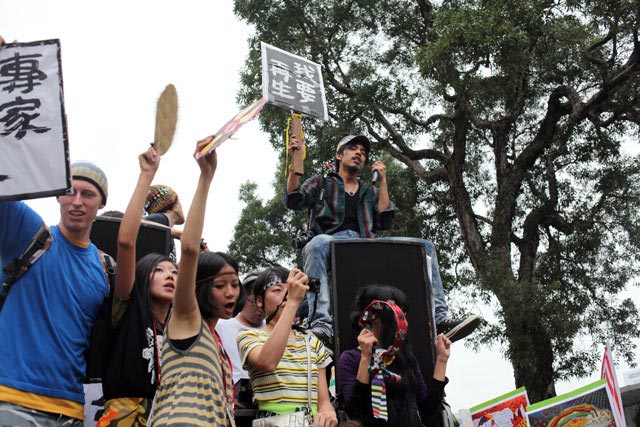
In this month’s Focus, eRenlai reveals the innovation and creativity of Taiwan’s most dynamic social movements, with activist Zijie Yang as our trusted guide. A scholar on local social movements, Professor Ho Ming-sho, first introduces the history of social movements in Taiwan. With this historical foundation in place, we then move on to look at more recent events with an exploration of the two contrasting opinions on the failure of the Wild Strawberry Student Movement, which was sparked off in November 2008 by alleged police brutality during a visit by Chen Yunlin, the chairman of the Association for Relations Across the Taiwan Straits of the People’s Republic, to Taiwan. The focus also includes a translation by Robert Voight of the first in-depth analysis of the student movement, an extract from Professor Ho Tung-Hungâ€TMs notes on the protests.
In the light of the perceived failure of the Wild Strawberry Movement, the focus goes on to explore the new energy and innovation that define or will go on to define social movements in Taiwan. One of these movements is what Sean Hsieh called “the opening of new spaces”. We introduce two of these spaces – Café Philo and Go Straight Café which cultivate, train and empower youth to take part in social and political activism, and which illustrate the key role that gathering places like coffee shops play in fortifying civil society. Go Straight Café has reflected on the lessons learned during the Wild Strawberries Protests to pursue more innovative and creative forms of protest. It is now home to a group of cultural activists called “NoNuke”, who employ music, art exhibitions and social events to foment dialogue within the wider public, and have fought for a nuclear-free Taiwan over the last two years. In the wake of the Fukushima Nuclear disaster in March, NoNuke also collaborated with Gon-li She, a group of young people attempting to promote punk music in Taiwan, to channel the anger and frustration of young punks and rave-goers into social activism. This cooperative effort bore fruit with the 4/30 manifestation against nuclear energy in Taiwan and in the subsequent art exhibition, ‘Don’t brush off what you see’, which brought together ten artistic works concerned with nuclear power and energy resources.
In a tribute to the American activist duo “The Yes Men”, the Academy of Interference, printed 10,000 hoax mock-ups of the front pages of Taiwan’s major newspapers, declaring falsely that the proposal for the controversial KuoKuang Petrochemicals factory had been rejected by the government. The stunt achieved its desired effect, garnering media attention. Eventually the government removed its support for the project which could have endangered the survival of the last remaining Chinese White Dolphins. Another group, concerned above all with nature and the land rights of indigenous peoples, is the Langyan Action Group, who every year since 2007 have lit pyres, setting off smoke signals that call for justice as well as a nuclear-free homeland.
Conor interviews a different type of activist – Vincent Huang took time to explain his experience in the Gay Movement and what bearing his disability has on his role within it and on his outlook on life in general.
Benoit Vermander imparts advice on the life-long process of moral development and warns us not give way to the overdetermined truths that logic might seem to provide. Benoit also summarizes the conclusions of the conference on “Interreligious Encounters, Peace-building and Theological Inventiveness in todayâ€TMs Asia†sponsored by the Xu-Ricci Dialogue Institute at Fudan University in Shanghai; Around 60 scholars debated the contribution that Christian studies bring to reconciliation and dialogue in an Asian context, from the perspective of cross-spiritual encounters, cooperation in the field of social and environmental justice, systematic theology and public philosophy.
In response to the Focus ‘Beyond the Pale: Architecture in Taiwan’ Pierre Maranda would like to introduce readers to what world-famous anthropologist Claude Lévi-Strauss wrote on the subject of religious and cosmic interpretation of traditional Chinese architecture.
Finally remember to look out for our world music CD which will come with Renlai Monthly magazine next month. The CD a sample represents the blend of various musical cultures that can be found in modern Taiwan. Congratulations to all the winning submissions and remember to check out the interviews with the bands that took part that will be online over the course of this month.
Happy Dragon Boat Festival and we wish you peace over the Feast of the Ascension!
Nick and all the eRenlai Team
www.eRenlai.com
Taipei Ricci Institute|eRenlai Magazine|Renlai Monthly
Hsin-hai Road, Section 1, No.22, 3fl.Taipei 100, TAIWAN
Tel: (886 2) 2368 9968 Fax: (886 2) 2365 4508
email: [email protected]