


Periodic reviews of Church media centers are necessary for their efficiency and success, says Jesuit Father George Ponodath. The Indian priest now heads a committee looking to suggest ways to enhance the efficacy of the government-run 24-hour educational channel Vyas.
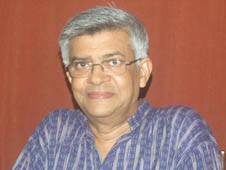
Father George Ponodath
The channel is run by the University Grants Commission (UGC), the top body for higher education in India that functions under the Ministry of Human Resources Development.
The 59-year-old Jesuit also runs the Educational Multi-media Research Center (EMMRC) of St Xavier’s College in Kolkata. EMMRCs in colleges across India contribute programs to Vyas.
The EMMRC in St. Xavier’s has twice been named Best Media Center and won over 50 awards since it started in July 1986. It is also India’s only government-funded media center run by a Christian institution.
Father Ponodath in the following interview speaks about the unique contribution of the Jesuits in media and some of the problems faced by Church-run media centers.
Q. What does the committee’s job involve?
A. We examine the scalability of the programs. It’s not enough to say a media center has 15,000 programs and 500 employees. We have to ask how many people watch the programs. How do we improve our visibility and the scalability of the project? We’re studying the reach, scalability and sustainability of the entire countrywide classroom project. We are also studying ways and means of improving the quality of programs.
Q. How are you going about the review process?
A. We conducted a nationwide survey and used the results to understand the extent of our reach. To our pleasant surprise, we found our programs were watched more in villages than in cities, which is how it should be. Figures suggest we reach about 10 percent of the population in rural areas of Jharkhand, Bihar and West Bengal states. We are still studying the data and it is still too soon to talk about where we go from here.
Q. St. Xavier’s EMMRC has won several awards. Why is that?
A. Consistency in producing programs – both in number and quality. When you look at the size of St Xavier’s College and our media center, ours is a big fish in a small pond.
Other media centers are in large universities, so are small fish in a big pond. Their function, mobility and independence are restricted, whereas I was given ample freedom by the principal.
We are not considered a separate department, but a separate entity. This is a great advantage over other centers. All of them require this kind of independence.
Q. What makes your center special?
A. Content wise we do better than other centers. Most have directors with backgrounds in chemistry or mathematics etc. My field is educational television. Other centers have technicians from other departments, while most of our staff have media technology training. Kolkata has a lot of resources, which makes us better. We also have a young production team, which makes more creative programs.
Q. Are you looking to provide e-content for education?
A. For the past 25 years, we were concerned only with television. Now with the Internet, we should think about e-content. Creating e-content cannot be easily done without television technology. With our experience we have already conducted five e-course sessions very successfully. This was done by combining television and Internet.
Q. As a media expert, how do you view Church media centers?
A. I’m not directly linked with any of the other Church-run media centers, except for a short period when I was involved with the Jesuit Chitrabani media center. However, I did have a lot of Church people asking me for advice or training. I feel that something is basically lacking in Church-run media centers.
If you ask a producer at our center what he is doing, he would say he is making a program for the UGC to be telecast on Vyas. So there is a product, and there is an end-user. In Church-run media centers, there are lots of products, but end-users are not usually defined. If they are, it is not specified how the product reaches users. It is not enough to produce; you have to develop a strategy for marketing the product. That is not happening in a Church-run media center.
Most Church centers lack a professional approach. By that I mean they should have a syllabus, trained staff and hands-on experience.
Q. Do you think periodic reviews will help Church media centers?
A. They’re essential for all institutions. If the Church invests in certain people, or buildings, they should monitor what’s going on. You can’t just say that many things can’t be measured because it is necessary in this case. How many people do we reach? How many people are watching our programs? These are questions which should be asked and answered honestly.