


LONAVALA, India (UCAN) — Man’s mastery of nanoscience and nanotechnology will not diminish the attraction of religion, a Jesuit scholar says.
Jesuit Father Job Kozhamthadam
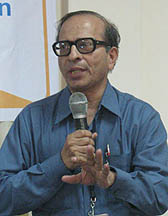
Father Job Kozhamthadam says people will still continue to be drawn to the mystery of religion even if scientists manage to answer all of nature’s mysteries.
Religion’s principal role is to help man find meaning and direction in life, the Jesuit priest told about 140 university professors, researchers and activists at a seminar.
The Jan. 1-5 event was titled: “Science-Religion Dialogue in the World of Nanoscience: The Encounter between the Mastery of Science and the Mystery of Religion.” It was held at the Indian Institute of Science and Religion (IISR), established by Father Kozhamthadam 11 years ago, in Lonavala, near Mumbai.
Father Kozhamthadam, who has a doctorate in the history and philosophy of science, delivered the keynote address.
Science and religion are inseparable companions, he asserted. While science helps man make sense of the world, religion assists him find meaning in life, he explained.
Understanding nature’s mysteries through research and study, particularly in nanoscience and nanotechnology enables man to have a better understanding of life and nature, he said.
Nanoscience is the study of the control of matter on an atomic and molecular level, while nanotechnology is the science of building machines at a subatomic level.
“Mastery and mystery should go hand in hand in our endeavor to build a better world and a better humanity,” he said.
He pointed out that although science has made “incredible strides” in understanding the universe, man still cannot say the age of mystery is over.
For instance, despite many neurological breakthroughs, several fundamental aspects of the human mind and brain remain unknown. Human understanding of the mind is “still laughably primitive,” he quoted US psychiatrist Peter D. Kramer as saying.
The priest said scientists still face “a formidable challenge” in cracking the neural code, the set of rules that transforms electrical pulses emitted by brain cells into perceptions, memories and decisions.
Thus, there is no sign that mysteries will disappear, “not even natural mysteries, much less religious mysteries,” he said.
Jnana Deepa Vidyapeeth (light of knowledge university), the pontifical seminary in Pune, together with three other colleges and a university helped organize the seminar.