
 KOLKATA, India (UCAN) — Nearly two decades after a forced exodus from the Himalayan kingdom of Bhutan, thousands of refugees living in Nepali camps still miss opportunities for a better life, professional training, and home.
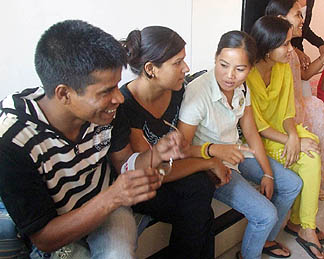
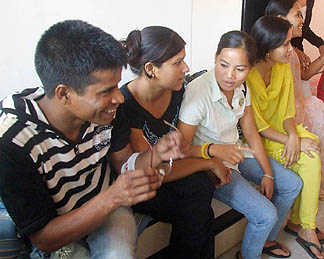
Bhutanese refugees at the exchange program
Santiram Khadka, 24, was just a boy when his family was expelled in the early 1990s, along with other mainly ethnic Nepalese. This was a result of the kingdom’s policies that sought to control alleged illegal immigration by ethnic Nepalese, even though some claimed they were born in the country. Bhutan has a population of only about 800,000.
Its army suppressed protests, killing and wounding many who opposed the policies. The government confiscated land, closed schools, and forced many of Nepalese origin to sign a “Voluntary Migration Form” before they had to leave. Khadka’s father faced accusations of supporting terrorists, and was tortured.
Khadka’s family members are among what the United Nations High Commissioner for Refugees (UNHCR) estimates are nearly 110,000 Bhutanese living in seven camps in and around Tamak town, eastern Nepal.
Still traumatized by what his family experienced, Khadka recently shared his pain during an exchange program for these young refugees, in a Jesuit retreat house close to Kolkata, India.
Now seeking to learn leadership skills they could use in their communities, 10 young men and nine women from the camps joined the All India Catholic University Federation (AICUF) members in the March 10-14 event to share experiences.
Four of the refugee youths were Buddhists and the rest Hindus. Forty AICUF members participated in the program, organized by AICUF’s Jesuit-run St. Xavier’s College unit.
“We felt the need to form leaders in the refugee camps who will work for their people, and that is what we did during the workshop,” explained Purna Siwapoti, 22, a member of the AICUF national team.
The program trainers included Jesuits and AICUF students. Jesuit Father John Rojerse, national promoter of Leadership Training Service, spoke on the simple ways in which young adults can act as leaders in their communities.
AICUF students, who often conduct workshops for youths based on their training, also shared their knowledge and experiences of leadership.
Siwapoti’s federation has identified refugees, tribal people, dalit (former untouchables at the bottom of the Indian caste system), and women for special attention.
Siwapoti said a previous exchange program included a team of AICUF members visiting the refugees in Tamak last year.
Jesuit Father Peter Jong Lepcha, 39, coordinator of the Youth Friendly Centre (YFC) in Tamak, said the young refugees were among 14,000 youths aged 18-25 who were in contact with Caritas-Nepal, the Nepal Church’s social-service agency. The YFC provides the youths with facilities for education, art, culture, sports and games.
Father Lepcha said the young participants in Kolkata already had leadership qualities and only needed further training.
While many of the young people in the camps find their future uncertain, Khadka said the participants were returning from Kolkata with greater self-confidence. The workshop “fine-tuned leadership qualities” they had, he said.
An AICUF member, Noel Francis, said the exchange program helped both groups. “This was the first time we heard the stories of refugees directly.”
Principal Jesuit Father John Felix Raj said his college admits one to two students from Tamak camps every year. “We realized exchange of this sort is sure to enrich both the refugees and our students.”
Refugee students in the college study for three years. The college offers bachelor’s degrees in arts, science and commerce, and technical studies in bio-technology and computer skills.
A 2007 UNHCR report said there were people from more than 50 ethnic and caste groups in the seven Nepali camps. An estimated 60-70 percent of the refugees are Hindus, 20-25 percent are Buddhists, 5-8 percent are indigenous Kirat, and 2-3 percent are Christians.
The report added that training opportunities in the camps, especially for occupations, were limited. About 40 percent were students, while 25-30 percent had no education. Only a few of the refugees have had university education in India.